

Recipe: Add a handful of earthworms to a forest soil, mix well.
Result: Everything changes, from the chemistry of the soil, to the plants that gain their sustenance from the soil, to the wildlife aboveground. When soil changes, effects wash outward to all parts of an ecosystem, like blast waves from ground zero.
Let’s start with the worms. Researchers have identified about 15 species of non-native earthworms in Vermont. These species have been arriving since Europeans set foot on this soil; before that, there were no native worms in Vermont, having been crushed or frozen by the Laurentide ice sheet over 13,000 years ago. Most of these species are European in origin, though last year worm experts at the University of Vermont found an aggressive Asian species called the crazy snakeworm.
Worms eat mostly dead stuff. They may wiggle around just under the leaf litter, munching away at the dead leaves. Some species may scrunch around just under the soil surface, pulling apart leaf bits with their toothless mouths. Other species may move up and down through the soil, hoovering rich, dark organic matter in one end and out the other. They leave burrows and fecal casts throughout the soil profile, allowing air and water — and other tiny fauna — to travel through the soil more easily.
When worms digest soil, they release nutrients from the soil particles, making it more available to plants. That’s why gardeners love worms. That can be a good thing for forest plants, except that sometimes it’s not. Invaders, like Japanese barberry, can get a leg up from the flush of nitrogen, shouldering native plants out of the way. Other times, those nutrients can get flushed down through the soil and out of reach of plants, like water down the drain.
Gardeners remedy this by adding compost for worms to chow. Forests can’t. Add worms to a forest and suddenly you’ve changed which plants can make a living in that soil.
All the burrowing and munching worms do changes something else invisible yet essential in forests: mycorrhizae (pronounced “my-co-rye-zee”). “Myco” means “fungus” and “rhiza” means “root” in Greek. Hair-thin threads of fungi weave together the roots of plants under the forest floor, helping their host plants squeeze more nutrients from the soil and getting sugary food in exchange. Most plants, in fact, can’t survive without their particular mycorrhizal partner.
Worms break apart that thin web of sustenance, making it harder for mycorrhizae-dependent plants to live. Some plants, however, don’t need mycorrhizae. These plants tend to do better with worms around: grasses and sedges, plus invasive species like garlic mustard.
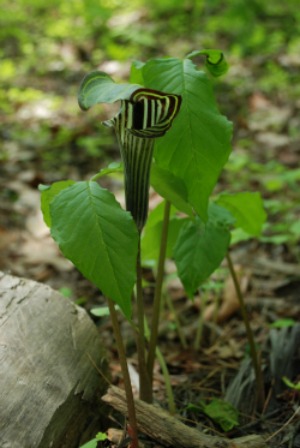
Worms do something else to plants underground: they eat roots. But some plants create what are called secondary compounds, meaning they are not essential to immediate survival. Plants often use secondary compounds for defense against being eaten. Jack-in-the-pulpit, for example, uses calcium oxalate to make herbivores sick. Researchers think jack-in-the-pulpit does well in wormy areas because worms won’t eat its nasty roots.
It’s not just hungry worms that plants need to worry about. When there are no understory shrubs to munch on, deer eat more tree saplings. Thus, adding worms to forests can spell doom for the future of the forest itself.

Worm effects ripple out farther than just to plants. Because worms destroy the leaf litter on the forest floor, they make life harder for animals that depend on those dead leaves. Salamanders, for example, hunt insects and other arthropods hiding within the litter. They eat worms, too, but apparently the trade-off is not enough to compensate for the loss of a food source. Ground-nesting birds like ovenbirds depend on the leaf litter to camouflage their nests. Take away the litter and their babies get found and eaten by predators.
The easiest way to tell if worms are in a forest is to look at the ground. Are there lots of plants on the forest floor? If so, are they all grasses and sedges and jack-in-the-pulpit and invasive plants, or are they a mix of shrubs and herbs? If the former, worms are probably present. And is there leaf litter on the ground? If not, blame worms.
The best test for worms, however, is to add a spoonful of liquid mustard to a gallon of water and pour it on the ground. Worms, if present, will come to the surface within a minute.
Earthworms can be found in the city, too. You can tell if worms inhabit your patch of lawn by looking for fecal casts. These are piles of tiny, cylindrical pellets, a millimeter or two in diameter.
Urban earthworms can be a nuisance by emerging en masse during a rainstorm and getting squashed. Somewhere in the cultural ether, there’s this idea that worms come out of the soil when it rains to avoid drowning. That’s not true. In fact, they prefer things wet. Worms make an appearance in the rain because it’s the best time to migrate to find mates. Since worms breathe through their skin, if their skin isn’t wet to allow oxygen through, they can’t breathe. That’s why you sometimes find dried-up crusty worms on the sidewalk — these are the worms who left home late for the party.

