



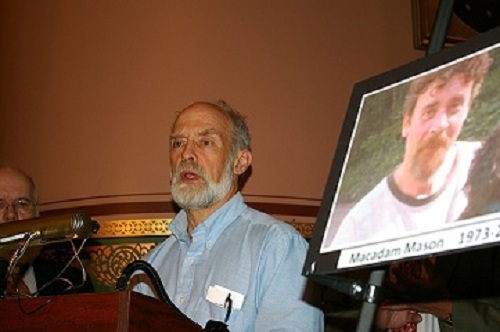
The 39-year-old artist, who was recovering from a seizure, had called Dartmouth-Hitchcock Medical Center to warn that he might hurt himself or others. Vermont State Police responded to the scene and shocked Mason with a stun gun. Medical officials later classified the death as a homicide.
“A year later, police continue to use these lethal weapons without any requirement that their use be restricted to life-threatening situations,” said John McCullough, director of Vermont Legal Aid’s Mental Health Law Project. “In fact, there continues to be no serious control over their use. Because we know that Tasers can cause death, it is essential that the deployment and use of Tasers be strictly regulated to circumstances in which their use is necessary to protect human life or prevent severe bodily harm.”
Advocates, attorneys and legislators joined McCullough at the Statehouse on Thursday to call on the Legislature and the Shumlin administration to create stronger policies for law enforcement’s use of Tasers.
Last legislative session, Reps. Jim Masland, D-Thetford, and Anne Donahue, R-Northfield, spearheaded H.225, aimed at creating a unified Taser training and deployment policy. The bill has the support of 32 representatives, spanning party lines, but it didn’t budge from committee. In the second half of the legislative biennium, they say, the General Assembly must act.
“There has been incremental progress on more officers receiving training (from the Department of Mental Health) around the state since Macadam Mason was killed, but it’s not at all universal,” said Masland, who was Mason’s neighbor. “It is clear that what we really need is for all officers to have the same training, having to deal with individuals having a mental health crisis.”
Laura Ziegler, an advocate and former psychiatric patient, said training is not enough. There must be standards for use, and law enforcement officials should be held accountable for meeting those standards.
“I keep hearing about how police have to buy into anything being suggested,” she said. “I think the people that need to buy in is the Vermont community and the Vermont Legislature to create a standard that actually protects us, that gives us equal protection under the law — not only by law enforcement but from law enforcement, so that no one dies because they didn’t hear or understand a command.”
After Vermont Attorney General Bill Sorrell ruled that State Trooper David Shaffer was justified in his decision to fire a Taser at Mason’s chest, Sorrell created a Taser review panel.
Allen Gilbert, director of American Civil Liberties Union of Vermont, was on that five-person panel with Sorrell, two legislators and Ed Paquin, director of Disability Rights Vermont. Gilbert said the panel’s findings were fourfold:
• The state must evaluate Taser training policies, particularly with respect to people with disabilities.
• The state should adopt a uniform training standard.
• Taser use should be subject to greater accountability and oversight.
• The state must adopt a statewide Taser policy.
“The attorney general has asked the Vermont Criminal Justice Training Council to review statewide Taser training that’s in place generally, and the training in place specifically for dealing with people in crisis or with cognitive disabilities or impairments,” Gilbert said. “The attorney general has also asked the Law Enforcement Advisory Board to consider a uniform statewide policy on electronic control devices.”
Sorrell has also reconvened the “Act 80” advisory group, which has worked for the Attorney General’s Office since 2004 on police interactions with people who have “mental health conditions,” as Act 80 is written.
Neither Gov. Peter Shumlin nor Department of Public Safety Commissioner Keith Flynn immediately returned a request for comment on this issue.

