



The federal government released data last month that confirm Vermont’s reputation as a green state, at least as compared to other states.
The Energy Information Administration’s report, “State-Level Energy-Related Carbon Dioxide Emissions, 2000-2010,” ranks all 50 states plus Washington, D.C., by various metrics of carbon dioxide emissions. Vermont took home the gold for the lowest total emissions and the least reliance on carbon-based energy and got a figurative silver medal for its low per capita emissions. While Vermont can still cling to its unofficial title of greenest state, the data reveal that in terms of reducing their per capita emissions, Vermonters are no superstars — just average.
A few caveats and particulars: The Energy Information Administration’s report looks at carbon emissions from energy-related sources only, so the petroleum used in plastics, for example, is not included. Emissions from the production of fossil fuels are attributed to the state where they originate, not where they are consumed. The report includes data on carbon dioxide only, not the emissions of other greenhouse gases. Also, greenhouse gas emissions swung downward during the 2008 recession and have since nearly reached previous levels. The data used in this report are from 2010, when emissions were lower than they are today.
Total emissions 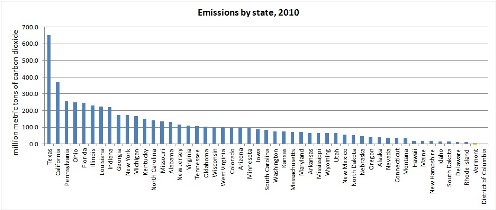
Vermont came in last among all states for carbon dioxide emissions in 2010. Vermont released 6 million metric tons of carbon dioxide in 2010, only a tad more than Washington, D.C. The Energy Information Administration report attributes this to Vermont’s overwhelming reliance on nuclear energy. Vermont also has numerous hydroelectric facilities that account for over 20 percent of its energy. New Hampshire, in contrast, emitted 17 million metric tons of carbon dioxide in 2010.
Change in emissions
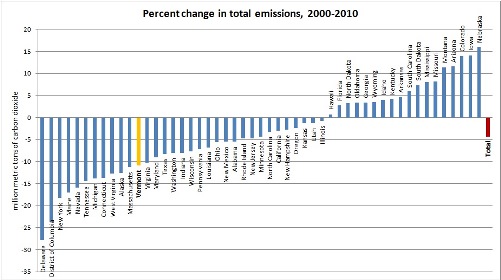
Not only did Vermont take the cake in total emissions, it also beat out most other states in cutting emissions in the last decade. The state sliced carbon dioxide pollution by nearly 11 percent between 2000 and 2010, as compared with a national decline of about 4 percent and a drop of almost 3 percent in New Hampshire. How much of this is due to the 2008 recession, the Energy Information Administration report did not say. Delaware was by far the champion by this metric: it cut emissions nearly 28 percent in just 10 years. Nebraska, on the other hand, increased its total emissions by 16 percent.
Per capita emissions 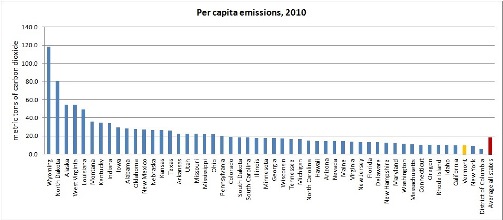
Vermont had the second lowest per capita emissions of all the states, outranked only by New York. The Energy Information Administration report suggests that New York’s low per capita emissions are due to the large proportion of urban dwellers in that state — city folks tend to use less energy because they walk and take public transportation more often and tend to live in apartments — and an economy based on financial markets, not something more energy intensive. Considering that Vermont is largely rural, our low per capita emissions are a sign that we’re doing something right.
Wyoming’s exceedingly high per capita emissions are attributed to the cold winters, high energy production, and low population. In fact, the top five states are all fossil fuel producers.
Change in per capita emissions
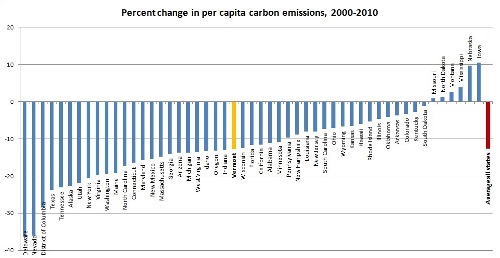
Despite Vermont’s remarkable achievements in total and per capita emissions, when it comes to actually reducing per capita emissions we’re in the middle of the herd. Smack in the middle, in fact; Vermonters cut their personal emissions by less than 13 percent between 2000 and 2010, exactly the same as the national average. One important question emerges from the figures on total and per capita emissions: what is going on in Delaware?
Carbon intensity 
Vermont also took home the prize for least carbon-intense state. Carbon intensity, kilograms of carbon dioxide per million British thermal units (Btu) of the energy supply, is a measure of how much a state relies on carbon-based fuels for power. Much of Vermont’s electricity comes from nuclear energy. West Virginia, by contrast, gets over 80 percent of its energy from coal, making it the most carbon-intense state in the nation.
Change in carbon intensity 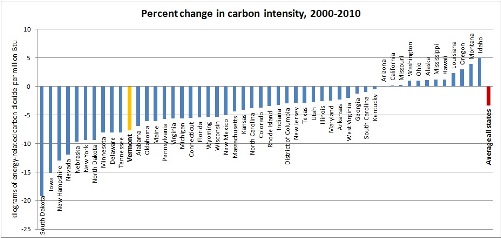
Changes in carbon intensity indicate whether a state is becoming more or less dependent on carbon-based fuels. Vermont placed 11th in this category, showing that it is becoming less reliant on fossil fuels for energy. Vermont was already one of the least carbon-intense states in 2000, second only to Washington state.
Emissions by sector 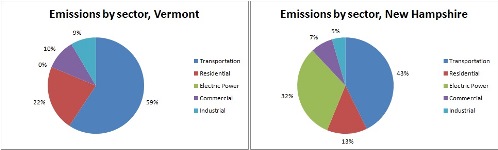
In 2010, nearly 60 percent of Vermont’s carbon emissions came from transportation. Because of Vermont’s reliance on nuclear energy, the electricity sector comprised just 0.1 percent of carbon emissions. Electrical power production in New Hampshire, on the other hand, accounted for a third of all carbon emissions.
Emissions by fuel 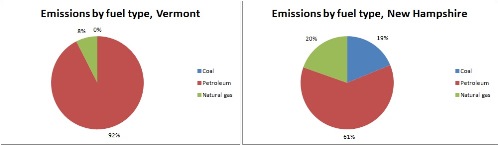
Carbon emissions from petroleum in Vermont, at 92 percent, were greater than that in any other state. No other state but Hawaii produced more than 80 percent of its emissions from petroleum. By contrast, New Hampshire’s carbon emissions came from 61 percent petroleum, 20 percent natural gas, and 19 percent coal. Vermont produced no emissions from coal and just 8 percent from natural gas.
The 10 states, including Vermont, with the least carbon emissions per capita get most of their power from nuclear, hydroelectric, and natural gas energy. In stark contrast are the 10 states with the greatest per capita emissions. Seven of those states are primarily powered by coal, the rest by natural gas.
Editor’s note: The source for all data used in these graphs is the Energy Information Administration’s report titled “State-Level Energy-Related Carbon Dioxide Emissions, 2000-2010” and its associated data available online at http://www.eia.gov/environment/emissions/state/analysis/.
