

Editor’s note: This op-ed is by award-winning journalist Telly Halkias. It first appeared in the Portland Daily Sun.
With all the hubbub over Benghazi missteps, Guantanamo inmate hunger strikes, and Syrian use of chemical weapons, I’m often asked to recommend a primer that puts today’s Middle East crisis in context. Sadly, it’s not a new question, and one I’ve answered so much over the years that it’s worth a broader discussion.
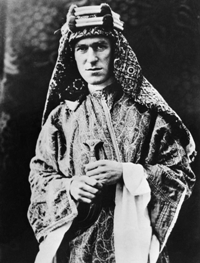
Photo by Lowell Thomas
During the First World War, an obscure archaeologist-turned-British Army officer, T.E. Lawrence, integrated into Arab culture and embarked on a guerilla campaign against the occupying Ottoman Turks. He chronicled his exploits in the classic, “Seven Pillars of Wisdom.”
This is the first book anyone should read to begin an appreciation for the Middle East.
In doing so, the first obstacle to overcome is the imagery forged into popular consciousness by the 1960s blockbuster “Lawrence of Arabia.” Covers of the book are still adorned with immaculate, clean-shaven Peter O’Toole look-alikes striking Errol Flynn poses. The grime and misery of desert existence in peacetime is challenge enough; in wartime, it’s close to unbearable.
Once past that, and as someone who spent a year in Lawrence’s area of operations, “Seven Pillars” offers insightful cultural and military parallels to today’s evolving situation.
The text is organized into 10 books covering the years 1916-18, beginning with an examination of the origins of Arab revolt, and ending with the liberation of Damascus. An understanding of regional history leading up to Lawrence’s account is helpful, particularly of the developing Ottoman demise in the 19th century.
Lawrence’s military mission was to create havoc in the Ottoman ranks so as to aid a British advance through Syria, Palestine and Lebanon. This would secure the foothold of vital Mediterranean ports on Turkey’s southern flank to aid future operations against Germany’s ally.
To do so he collaborated with Arab tribes, most notably the Saudis under Emir Faisal, and groups of regional Bedouins. In describing the plans of major armies and the concurrent harassment of local irregulars, Lawrence explains two enduring facets of the area: the effects of guerilla warfare on a larger empire, and the Arab mindset therein – both unchanged from what U.S. troops, and others, are facing today.
As with many combat veterans, what survives these passages is the image of a fragmented, tortured soul not quite able to find inner peace afterwards.
Lawrence also finds moments to reflect on the intimate. He describes facets of Bedouin life down to the logistics of eating and sanitation, and shows a desert bereft of fable and whimsy. At the point of his pen, silver screen images fade; the harshness and filth of desolation take over.
As with many combat veterans, what survives these passages is the image of a fragmented, tortured soul not quite able to find inner peace afterwards.
There are several things to consider when reading “Seven Pillars.” First, it starts slowly. Fans of Dickens and Stevenson will enjoy the detail in which Lawrence covers the seeds of Arab rebellion. Such narrative can be invaluable in grasping historical perspective; however, it doesn’t begin at the pace of a Ludlum thriller.
Next, Lawrence himself ends up somewhat incomplete. The book only covers a brief span of years and remains much more a memoir than an historical account. But Lawrence does foreshadow many of his own shortcomings, particularly his sadomasochistic tendencies following torture in Turkish hands. That he evolves into a ruthless killer is part legacy from his persecution in captivity, and part osmosis from the no-quarter warrior ethos of the Arabian Desert.
Finally, as with many autobiographies, Lawrence becomes enamored with his actions and overstates their importance. He is qualified to comment on the desert fight and Arab allies. But when he reverts to himself and the British Army, he tends to make too much of his role in certain operations, and inflates his knowledge of post-war imperial intent.
More than two decades ago, despite my familiarity with Middle Eastern culture, I found this book to be most useful before and during my year in the desert. Lawrence’s cultural analysis and appreciation for Arabs still rang true 80 years after its publication. The Bedouin tribes he describes were many of the same I dealt with during the first Gulf War. In this way, Lawrence’s rendering is priceless.
But “Seven Pillars” is only a start. It falls short in lending insight into the region’s current fundamentalist trend, but does touch on its origins. It succeeds as a self-portrait and cultural introduction.
In testament to Lawrence, who remains a folk hero to many Arabs, the book is a required text in Middle Eastern studies programs worldwide. Readers still flock to it almost a century later, a herald louder than any of Gideon’s trumpets.
You may email Telly Halkias at tchalkias@aol.com.

