


Vermont residents voiced their opposition to bringing next-generation Air Force fighter jets to South Burlington amid the rain and echo of passing F-16s Wednesday.
“We are here today in the rain to show solidarity with the neighbors, neighborhoods and communities of South Burlington, Winooski and Williston that are being so gravely impacted by the basing of F-35 warplanes in Burlington,” said Chris Hurd, spokesperson for Stop The F-35 Coalition.
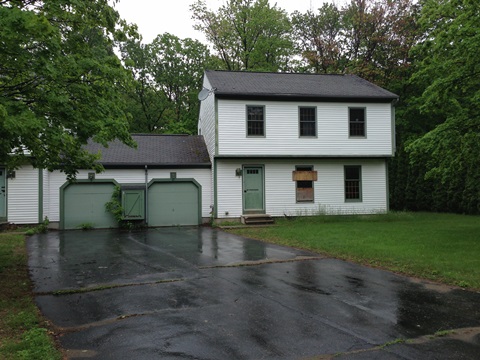
Hurd was soon muted by the sound of an F-16 jet passing over the abandoned residential neighborhood off Airport Parkway, where the group held a news conference Wednesday.
After the sound faded, he continued to announce the group’s opposition to basing the F-35 fighters at nearby Burlington International Airport due to health and environmental concerns for residents of surrounding residential area.
The airport is one of three locations under consideration for the new F-35s. The Vermont Air Guard currently flies F-16 fighter jets from the airport. The F-16s, which have been in operation since the 1980s, are being phased out by the Air Force.
Horace Shaw, an independent GIS consultant and resident of Winooski, said the current residential situation violates the U.S. Department of Defense’s basing zone guidelines, suggesting that many residents might have to relocate.
The Department of Defense defines three zones at each end of the runway. Clear zones are the areas closest to the ends of airstrips. Accident potential zones one and two are the areas farther from the airstrip, with zone two being the farthest.
The guidelines suggest that there should be no residential or commercial properties in any of these areas. There can be, however, two single-family properties per acre in accident potential zone two.
There are 32 commercial and industrial properties in the clear zones and 657 and 1,443 residential properties in the accident potential zones one and two, respectively.
These zones include areas of Burlington, Colchester, South Burlington, Williston and Winooski.
A link to the map created by Horace Shaw is here.
He said that in other parts of the country the Air Force had relocated its basing projects when communities did not pass zoning regulations to keep residential properties out of the zones.
In addition to the risk of potential accidents, the F-35 jets will make more noise than the F-16s, the group said.
James Marc Leas, a patent lawyer in South Burlington, said potential noise could impact the hearing health of residents in the area.
According to a June 1998 report coauthored by the U.S. Department of Health and Human Services, workers should not be exposed to 115 decibels of day-night average sound levels for more than 28 seconds, a noise level comparable to the F-35 fighter jet, Leas said.
The current noise level of the F-16 jet is 94 decibels, according to the U.S. Air Force F-35A Operational Basing Environmental Impact Statement draft. Leas said that one can be exposed to this level of noise for more than an hour without harmful health effects.
A link to the Air Force’s Environmental Impact Statement draft can be found here.
Leas responded to criticism that noise from the F-35 jets will affect residents of the area for only six minutes per day.
“That is at least five minutes and 32 seconds too long,” he said. “It’s outside the limits for human health to have this plane be here.”
Hurd said the abandoned residential neighborhood on Picard Circle in South Burlington is a consequence of the noise emitted by the F-16s. He added that many other neighborhoods would have to be abandoned should the F-35s come to Burlington.
One resident voiced her opposition to the project based on her inability to relocate.
Carmine Sargent, a 41-year resident of Elizabeth Street, said she chose the area next to the airport because its flat topography and because the South Burlington school system suited her daughter’s needs. Sargent’s daughter has spina bifida and uses a wheelchair.
Sargent said she plans to stay put because her home has been made accessible for her daughter and that she is a single parent without the money to equip another home.
“For me to be able to replicate that at my age would be prohibitive.” Sargent said. “I couldn’t do that again.”
She said many of her neighbors share a similar opposition to the project but do not want to speak out.
“I think it is because they are afraid of being labeled, as I have been labeled, as anti-military and anti-development. I feel that we are none of these,” Sargent said. “We are pro-community. We are trying to save a neighborhood.”
Hurd said a revised draft of the Air Force’s environmental impact statement, an approximately 2,000-page document, will be released Friday.
Residents will have about 45 days to read and analyze the draft before the scheduled release of the final version by the end of September.
“We are under the gun here,” Hurd said.
An F-35 public information meeting will be held at 7 p.m. Thursday at the Unitarian Universalist Church in Burlington.
