

The final budget deal was set on Monday after 10 days of negotiations between House and Senate leaders.
The chairs of the two Appropriations committees pieced together $10 million in savings as part of an agreement with the Shumlin administration. Legislative leaders agreed to rescrub the budget in lieu of raising new General Fund taxes.
A new revenue report in April that projects a $16 million surplus for fiscal year 2013 helped to ease that budget reduction process. House leaders were insistent that lawmakers leave the session with $9 million in cash reserves in order to prepare for anticipated federal cuts next year; the surplus enabled them to set aside $8 million without having to raise revenues.
The $1.3 billion General Fund budget is balanced by about $60 million in one-time savings or revenues that will not be available next year. That means unless the economy improves and tax receipts exceed expectations, the state will continue to face the difficult post-recession problem of filling an ongoing gap between revenues and spending.
Gov. Peter Shumlin proposed to increase spending by about $34 million to fund child-care and energy efficiency programs, but lawmakers dialed back those proposals, and in the end also cut down the administration’s request for new positions in state government from 79 to about 60.
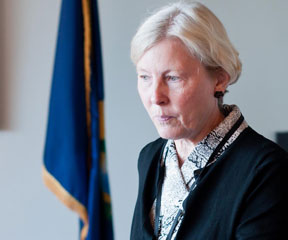
Sen. Jane Kitchel and Rep. Martha Heath, the budget chairs, set out to make $10 million in reductions in the remaining days of the session without touching human services programs. In the end, with the exception of a $2 million cut to services for developmentally disabled Vermonters that had already been agreed to, they succeeded.
“It was a lot of work, but when resources are tight, we need to make sure government is efficient,” Kitchel said.
Heath cited higher provider reimbursements and an agreement on Reach Up as the two most significant changes to the budget this year.
“I think a budget document is a values statement and in that sense it is a political document,” Heath said.

The House and Senate agreed to two Shumlin administration proposals that are projected to save $4 million. Jim Reardon, commissioner of the Department of Finance and Management, told lawmakers he could find $2.5 million in labor savings across state government through attrition, overtime management and travel cuts. Reardon said an additional $1.5 million could be generated in tax receipts by enhancing the Tax Department’s revenue collections.
By turning back the clock on a 3 percent increase in Medicaid provider reimbursements by one month, the state will save about $1.18 million. Instead of going into effect on Oct. 1, the increase will kick in on Nov. 1.
The budget pares back funding for the Low Income Heating Assistance Program by $1.9 million. The Senate had set aside a total of $7.9 million (including $1 million from the weatherization program); the agreement follows the $6 million House plan. This is the first time the state has included LIHEAP money in the base General Fund appropriation. In the past, the program has received enough money from the federal government to cover the cost.
The governor’s education initiatives didn’t fare well. Budget-writers agreed to increase subsidies for child-care providers by $1.6 million — less than half what the House had originally called for and just a fraction of the $17 million recommendation from the Shumlin administration.
A $2 million request for public school pre-K programs didn’t make it to the Senate Appropriations Committee in time for review. The money would have come from the Education Fund.
The budget includes the governor’s recommended 3 percent increase to funding for higher education. The $2.5 million is to be used to reduce tuition costs for Vermont students at the University of Vermont and the Vermont State Colleges.
They also appropriated $1.5 million for General Assistance, a new state program for temporary housing.
An agreement on Reach Up, the state’s welfare-to-work program, puts a five-year cap on benefits with deferments for individuals who are caring for an ill parent or severely disabled children. The budget also calls for an analysis of whether Reach Up is helping recipients find work.
The Joint Fiscal Office identified a total of $2.23 million in savings from reserves ($851,000), a projected reduction in a Medicare Part D “clawback” payment to the federal government ($966,498), an adjustment in the state’s Unemployment Insurance payment ($226,000) and abandoned property receipts ($187,721).
Another $1 million was derived from tobacco settlement revenues ($232,000), a reduction in state fleet management costs ($237,000), higher than anticipated banking and insurance receipts ($425,000) and money from the Information Centers General Fund ($125,000).
A request for additional funding for the Working Landscape program was scaled back to $250,000; additional funding for the Vermont Housing and Conservation Board was set at $125,000 and the Clean Energy Development Fund got a $100,000 bump. The Vermont Historical Society lost out on $30,000.
They also agreed to a $75,000 wind energy siting study.
Editor’s note: This story was updated at 5:56 a.m. on May 14.
