

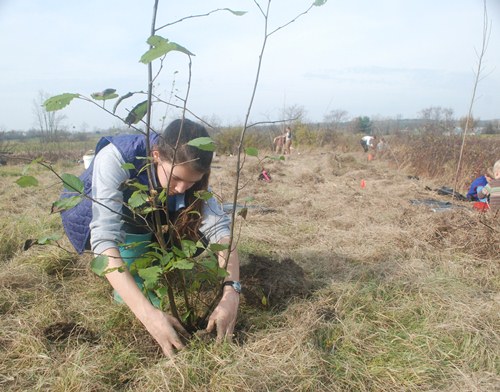
Leah Berger, 14, patted soil into place around the finger-thick sapling. Around her, other volunteers did the same, planting maple, cottonwood, alder, oak, dogwood and willow. In all, they planted 300 trees in a hayfield along a thousand-foot stretch of Alder Brook just north of Essex Center on a recent Saturday morning, an event organized by the Intervale Conservation Nursery and the Wildlife Management Institute.
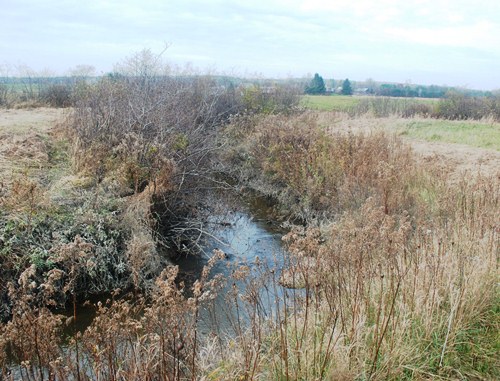
The strip of trees, called a riparian (meaning riverside) buffer, will grow into a small woods, where shrubs, grasses and wildlife also thrive. Riparian buffers, wetlands, and floodplains slow and absorb floodwaters, making downstream communities safer.
Even as climate scientists predict more frequent and severe storms and floods, much of the future funding for such projects is uncertain, as it had been provided by the now-expired 2008 Farm Bill.
“You just don’t know what’s going to happen,” said Mike Ingalls, the manager of the Intervale Conservation Nursery in Burlington. The non-profit nursery grows saplings to plant in riparian buffers and relies on federal funding authorized by the Farm Bill.
This year, the Intervale Conservation Nursery planted more than 8,950 trees as part of Farm Bill-funded projects, equivalent to 30 acres or 10,500 linear feet of buffer. Next year, Ingalls is trying to work with a budget that’s been cut by $60,000, nearly half of the nursery’s normal budget. Because the trees take several years to grow big enough to transplant, the nursery will have an excess of trees if funding doesn’t come through. Ingalls is working on finding the money elsewhere, but, he said, if Congress doesn’t pass a new bill until January, the “worst-case scenario is we’re throwing out the trees.”
Two programs, the Wetlands Reserve Program and the Conservation Reserve Program, are responsible for a significant portion of the wetland conservation and riparian buffers in Vermont. Through the Wetlands Reserve Program, farmers can choose to take flood-vulnerable land out of production — land that they would have difficulty farming anyway. The Natural Resources Conservation Service, which administers the program, purchases a conservation easement from these farmers and pays for restoration of the wetland habitat, often planting riparian buffers. Vicky Drew, the state conservationist for the NRCS, said that the Wetlands Reserve Program is relatively small, with an enrollment budget in Vermont of between $500,000 and $600,000, and it has a backlog of applicants.
The Conservation Reserve Program, administered by the Farm Service Agency, pays farmers to plant vegetation that conserves soil and slows floodwaters. According to Bob Paquin of the Farm Service Agency, last year they added roughly 100 acres of riparian buffer in the state. As of Sept. 30, these programs can no longer accept new applicants.
The Wetlands Reserve Program may have played a key role in protecting downstream communities from major flood damages during Hurricane Irene. A new 11-minute documentary by the Conservation Law Foundation, called “On the Anniversary of Tropical Storm Irene: The Untold Stories of What Went Right,” explains the role wetlands played during those floods. Although rivers generally carry more water at points downstream than upstream, an opposite pattern occurred on the Otter Creek: it held half the volume of water in Middlebury as it did in Rutland. The documentary attributes this to the extensive wetland complex preserved between Rutland and Middlebury.
The Otter Creek wetlands consist of 8,700 acres. According to Drew of the NRCS, 2,000 acres of that was conserved through the Wetlands Reserve Program. The Intervale Conservation Nursery planted 1,500 trees last year as part of the Wetlands Reserve Program, most of which were along or near the Otter Creek.
“We know that those programs, like the NRCS programs, which have done a tremendous amount to keep a lot of those acres along Otter Creek available for floodwater mitigation … we know those are vitally important to preventing flood damage in the future and will become even more important as we get more frequent and more violent storms,” said Louis Porter of the Conservation Law Foundation.
The state appropriates money to match federal funds from the Wetlands Reserve Program, but that money, too, is on hold. The state partners with organizations like Ducks Unlimited to target areas for conservation and restoration and find willing landowners. Then the NRCS, with Farm Bill funding, buys the conservation easement and pays for restoration.
Kari Dolan, of the Agency of Natural Resources ecosystem restoration program, said, “The Farm Bill programs have been absolutely critical to get projects on the ground, to deal with water quality impacts from our land uses, as well as the opportunity to restore wetland functions and floodplain function in Vermont.”
Next year, state and private partners are looking to focus on conserving wetlands in the Connecticut River Basin, parts of which were hit hard by Irene, as well as the Lake Memphremagog and Hudson River basins. But all of that work is on hold until the next Farm Bill is passed.
“These wetlands and floodplains serve as sponges during our flood events and not only that, they help to maintain a base flow in our rivers. They provide services year-round, not just during flood events,” said Dolan. These services are important, given that climate scientists predict both more severe floods and more severe droughts for Vermont. “It’s a travesty that we had to put these programs on hold.”

