

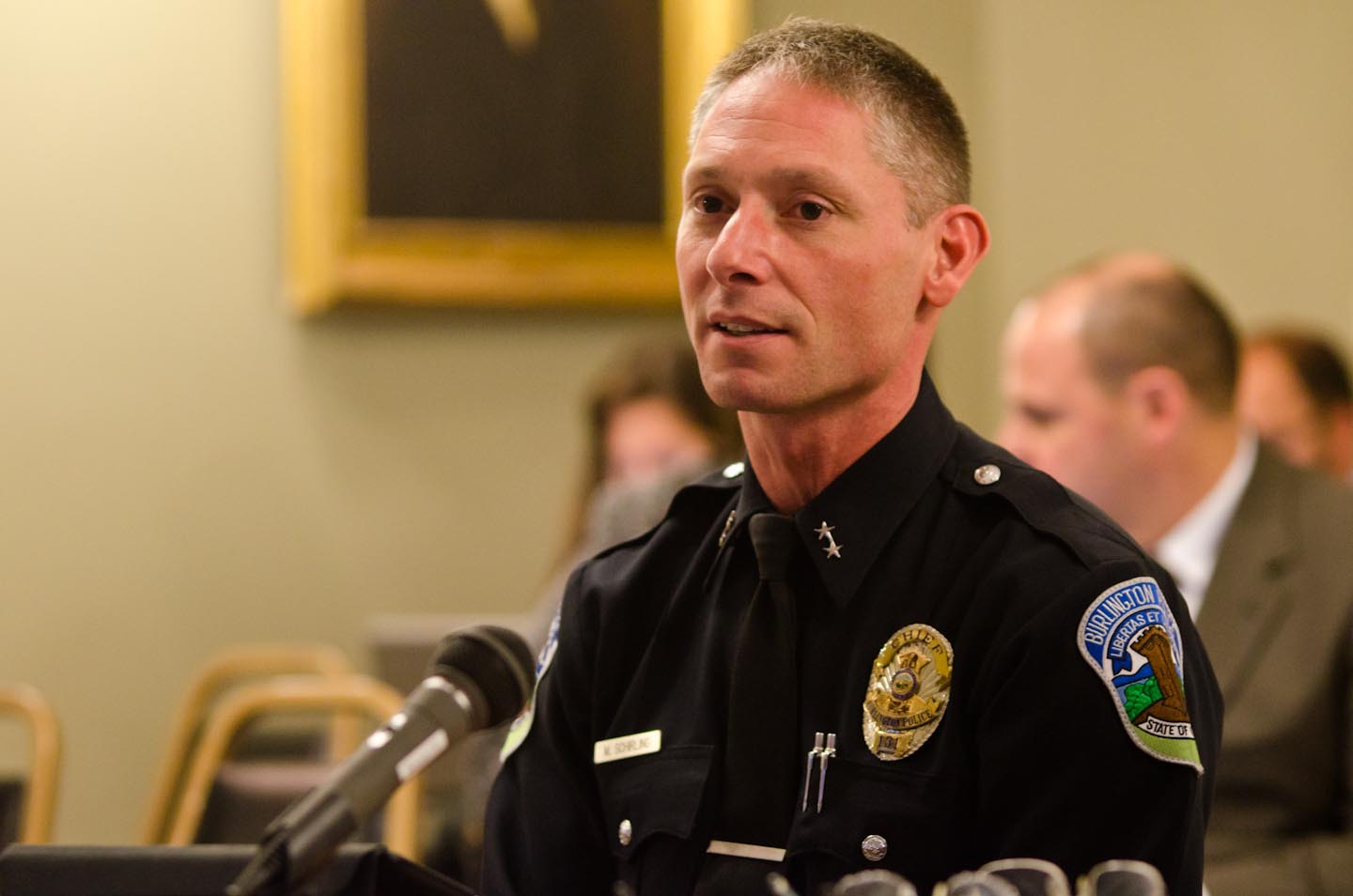
A report to the Burlington Police Commission on a July 29 confrontation with protesters at the Hilton Hotel places responsibility for the use of rubber pellets and pepper spray on the “actions of just a few people,” and claims that officers involved “showed exceptional professionalism under adverse, complex, and rapidly evolving circumstances.”
But four members of the City Council have joined local activists in calling for an independent investigation to answer lingering questions and “help build public trust in our police force,” according to a letter sent to Mayor Miro Weinberger last Friday.
The department’s “preliminary after action report” will get its first public review when the Police Commission meets at 6 p.m. on Tuesday at Burlington Police Department headquarters on North Avenue.
More details are emerging about the incident and especially events leading up to the moment when buses were blocked the day before a conference of New England Governors and Eastern Canadian Premiers. Public records requested on behalf of the protesters meanwhile reveal that Gov. Peter Shumlin was briefed days in advance about the planned protests and that a “Unified Command with Burlington PD” was established with the state police and other agencies.
In a separate statement Weinberger says that he attended a briefing with 50 police officers on the day of the incident and “repeatedly directed a posture of patience, non-confrontation, and respect for the rights of protesters to demonstrate.”
The plan, according to the police report, was to “ensure the safety of the participants” rather than confront them by controlling traffic, “providing vehicle escort, blocking of intersections and the closing of major roadways.” Things went smoothly for several hours, as activists gathered in two city parks, marched through downtown, and created a “human oil spill.”
Shortly after 5 p.m. however, a smaller group of demonstrators blocked a hotel driveway as buses were taking conference participants to a dinner off-site. At this point Lt. Arthur Cyr, who leads the department’s crisis negotiation unit, called in a “crowd control team” equipped with shields, batons, and weapons including pepper spray and 37mm rubber pellet launchers.
The report acknowledges that “the number of officers assigned to the arrest team and the manner in which that team operated was insufficient to achieve the desired goal – to make individual arrests as needed on a case by case basis, with full control of the arrestee quickly and effectively.” It also states that the use of pepper spray to defend an officer who had fallen and “protect his tools and weapons from exposure to demonstrators” was not advisable.
The report repeatedly asserts that several demonstrators “actively resisted” and were both verbally and physically aggressive, grabbing officers to prevent arrests. Responding to the report over the weekend Jared Carter, an attorney with the Vermont Law Center who has been speaking for two of the protesters, said he “doesn’t take the account seriously” and questioned the report’s release late on Friday. “This was a missed opportunity to have accountability,” he said.
Carter, who also coordinates a Cuba study program at Burlington College, has explained that he is not officially representing anyone yet. But he has advised Jonathan Leavitt and Marni Salerno, who were struck by rubber pellets, not to speak publicly about details of the incident. Leavitt is a Burlington College teacher and Salerno has been a student there.
The report states that the munitions were not fired at the entire group of demonstrators or used to disperse them, but rather were employed in response to specific situations and the actions of Leavitt, Salerno and a few others.
In addition, the 83-page report, which includes dozens of still photographs and video links to support its version of events, addresses several of the questions that have been posed by both protesters and members of the City Council.

One key question is why the response to this protest was different than at many previous events. The report argues that in the past those engaged in civil disobedience made a conscious decision to be peacefully arrested. In this case, some in the group “openly spoke of and appeared to have come prepared for and appeared to have been actually seeking a more substantial conflict. It was this smaller group of demonstrators who knowingly and intentionally impeded the movement of approximately 200 conference guests who were on buses attempting to get to a dinner event and who were verbally aggressive towards law enforcement personnel.”
Another lingering issue is why arrests were not made at the time. According to the report, attempts to arrest several people were physically resisted. That became a “precipitating factor in the escalation of the event.” A criminal investigation is under way and arrests are still possible.
The official version
The report describes the day’s events in detail, starting with the preparations and several frustrated attempts to open discussions with the protesters prior to the confrontation at the Hilton. But the main focus is on two incidents that lasted a total of less than three minutes.
Around 5 p.m., after the “crowd control team” moved into position, demonstrators began to chant, “The whole world is watching.” As the line of police moved forward to clear the road, the chant shifted to the Imperial March theme from “Star Wars.” When officers reached the demonstrators, the report states, “the demonstrators actively resisted being moved and began to push back against the crowd control team members’ shields.”
The situation escalated when Cyr attempted to arrest one protester, Thomas Buckley. The report states that Buckley locked arms with two other men, including Leavitt, and stiffened his body. At this point another protester, Ethan Waterson, allegedly placed his hand, “holding a black flag affixed to a long pole adjacent to Lt. Cyr’s duty belt while he was occupied with Buckley.” The report asserts that this posed a serious danger to Cyr and others.
Cyr could not complete the arrest “and succeeded only in dragging the three men but not separating them.” Meanwhile, other demonstrators moved closer, some “carrying signs affixed to wooden sticks and other items that could have been utilized as weapons.”
Eventually, Cyr released his grip on Buckley, who jumped to his feet and began to run down College Street. But Cyr was still holding onto Buckley at the waist, and as a result was pulled along for at least 20 feet, the report states.
Officer Nathan Harvey meanwhile struggled with Leavitt and others, including a protester he was trying to arrest. At that point, Harvey tripped over a sign and fell. His helmet came off and his pellet launcher fell to the ground. When Corp. Daniel Gilligan saw another protester approaching Harvey he shot a round of “pepper balls.”

Officer Tyler Badeau also saw Harvey fall and noticed that his pellet launcher was “unattended within a lungeable/grabbing distance from demonstrators.” In response he fired a rubber pellet round consisting of 42 pellets at Leavitt, who acknowledges he was there but claims he was walking away with his hands raised at that moment.
At this point most of the protesters moved back from the driveway. But a protester identified later as Carter Walker “was observed shoving crowd control officers and punching at their shields.” In response, another officer released a burst of Oloeresin Capsicum, otherwise known as pepper spray, to Walker’s face. He backed away briefly, then charged the officers “pumping his fist, screaming and swinging his arms.”
Only a minute and 45 seconds had passed.
The next incident occurred about 23 minutes later as police attempted to clear the road for the departure of the remaining buses. The report says that Salerno “positioned herself directly in front of Sgt. (Paul) Glynn and pushed back, then grabbed his baton. When Corp. Daniel Gilligan saw this, he discharged two pepperball rounds, striking Salerno near her elbow and hip.
After the incidents, some demonstrators remained in the area. The report states that they “engaged in profane, verbally aggressive behavior towards the officers,” and also notes that despite repeated taunting, “the crowd control team did not respond in any way and remained standing at their location.”
In a final commentary, the preliminary report disputes recent claims that the handling of protesters in this case marks a dangerous shift in local police tactics and has, in the words on Carter and Leavitt, “torn the social fabric.” Instead, it places responsibility on” the actions of a few individuals seeking conflict by infringing on the rights of others to move freely and by engaging in aggressive verbal and physical actions toward police officers.” This “should not and will not be condoned or tolerated,” the report states.
Seeking more answers
A few days after the incident Barry Kade filed a public records request with local and state police on behalf of several activists, seeking emails, documents and any other communications in the days leading up to the protests. As VTDigger has reported, FBI agents attempted to interview at least one activist in Burlington prior to the protests.
Kade also asked about the policies governing use of “less-lethal” force and the removal of name tags and badges while on duty. Although the Department of Public Safety responded to several questions and requests, the letter accompanying the material declined to release e-mail communication with the FBI because “those records are protected from disclosure under Title 5 USC Section 552a, the Privacy Act.”
The exemption cited covers “material reporting investigative efforts pertaining to the enforcement of criminal law.” Kade questions whether the federal exemption applies to documents generated by a state agency and emailed to the bureau. “I would think not,” Kade argues. “They may be exempt from federal disclosure, but I don’t think it would rub off on the state.”
Four members of the City Council, independent Sharon Bushor and the council’s three Progressives, are requesting an independent investigation and have their own set of questions. For example, they want to know what training was provided on “de-escalating protests,” whether all means of dialogue had been exhausted, why rubber bullets and pepper spray were used if no arrests were made, and whether Weinberger authorized their use.
In his statement, Weinberger says that he directed Police Chief Michael Schirling to keep him informed during the day and “received numerous updates by phone between noon and 4 p.m. indicating that the day was proceeding smoothly.” Schirling also updated Weinberger later that “an impasse was developing.”
Weinberger continued, “We agreed that the police would provide safe passage for the buses and attempt to do so with as little conflict with the protesters as possible. We did not discuss operational details of how the police would proceed. Upon receiving the first report from Chief Schirling that conflict between protesters and the police had occurred, I returned to the Command Center and remained there until after 11 p.m. overseeing efforts to communicate accurate information to the public about the incident as quickly as possible.”
The police report, which is available online and will be reviewed publicly by the Police Commission on Tuesday evening, addresses several of the other questions being raised.
Preliminary After Action Report link:
http://www.bpdvt.org/July%2029%20After%20Action%20Report%20-%20Preliminary/July%2029%20After%20Action%20Report%20-%20Preliminary.pdf
