


Tropical Storm Irene may be 10 months in the rear-view mirror, but Gov. Peter Shumlin Thursday told Vermonters that recovery from Irene’s devastation is still very much ongoing.
Calling together a wide array of officials from the private and public sector who are still dealing with the storm’s aftermath, Shumlin provided an “update on the progress and challenges” in Irene recovery and delivered a simple message: “I’m urging Vermonters to continue to be generous, to give, to not forget,” he said at a news conference at the state capital.
The price tag for damage for the state’s worst storm in 84 years, is expected to be $733 million; the state’s portion is $110 million.
For those settling in to enjoy balmy weather and carefree summer days in areas unscathed by Irene, Shumlin urged they become tourists in their own state and visit areas hard hit last August – and then open their wallets or volunteer.
“There’s still a lot of damage, a lot of work to do, and we’ve got to get it done,” said the governor.
Citing the latest figures that estimate the total spending on damage could reach nearly three-quarters of a billion dollars, Shumlin announced that he has asked Irene Recovery Office Sue Minter to continue working in her post another six months until the end of the year. She is on leave from her position as deputy secretary of transportation.
He said one of the biggest needs is to raise $10 million to help homeowners, businesses and farmers who were devastated by the storm and are still struggling to get their footing.
“For those who got hit so hard, lost their businesses, lost their belongings, lost everything they materially cherish, this is very tough, and will be a long recovery,” Shumlin said.
According to Jennifer Hollar, deputy commissioner of the Economic, Housing and Community Development department, around 800 families remain in need of housing assistance of some kind. Around 1,400 Vermonters were displaced by the storm, she said, and 3,500 homes suffered some level of damage.
According to Jennifer Hollar, deputy commissioner of the Economic, Housing and Community Development department, around 800 families remain in need of housing assistance of some kind. Around 1,400 Vermonters were displaced by the storm, she said, and 3,500 homes suffered some level of damage.
Minter stressed that the recovery is a “constantly evolving situation” that involves new issues and a sustained effort to “not leave any Vermonters behind and also look aggressively to make sure we don’t leave any dollars on the table.”
Chris Graff, a member of the Irene Long Term Recovery Group, told a story that underlined the nature of the continuing challenges. He said last weekend a homeowner in Northfield, who thought she had finished dealing with the damage from Irene, called to report her house was now filled with mold and she may have to move out. He said those involved in the recovery effort face a constantly “moving target” in assessing Irene’s costs and damages.
“This is a puzzle that has many moving parts,” he said.
Graff urged Vermonters to buy “Vermont Strong” license plates, whose $25 cost goes to Irene recovery. Referring to a recent flap over how many the state said it had sold, he said he was sure 20,391 were sold and another 6,500 are spoken for. Noting Ben & Jerry’s has agreed to sell them at the Waterbury factory store, he predicted the state would sell 50,000 and meet its goal of raising $1 million.
The update report released by Minter Thursday touches the same bases as a report issued in January on the recovery effort.
She said while many may have forgotten Irene today, those dealing with recovery are still wading deep in its impacts.
“We’re working as hard today as we were on Aug 28. It is continuing to be a big and daunting challenge,” she said,
Transportation Secretary Brian Searles cited a recent survey of 435 of the 672 structures and roads repaired after Irene. He said it found 222 of the repairs were stable and did not require further work but 213 will require further effort, from minor ditching to culvert replacement and major construction.
“This is not unexpected,” he said, noting that more than 200 bridges were damaged and 34 closed after Irene. Completing that work will take more than two years, he said.
While much of the meeting focused on the effort to recover from Irene, officials also cited the work the state is doing to mitigate future damage from 100-year floods and establish a lasting model for disaster recovery. Searles noted his agency has used the lessons from Irene to institutionalize faster ways to do bridge construction, fox example.
Commissioner of Economic, Housing, and Community Affairs Noelle Mackay said communities and planning agencies were brought together by Irene to plan better for disasters and recovery, and take steps to mitigate future flooding. She said hard-hit communities, such as Wilmington in the Mount Snow area, are moving from a “place of loss” to excitement at rebuilding their communities better, which makes it essential the state do all it can to help.
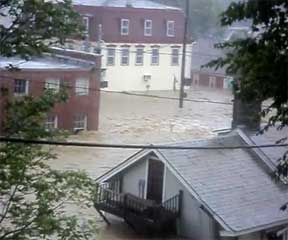
According to Mackay, 243 Vermont businesses were swamped in some way by Irene, and some still need help to rebuild.
Administration Secretary Jeb Spaulding said roughly three-quarters of the money for recovery is expected to come from the federal government, and he praised the state’s congressional delegation and President Obama for working to get FEMA to agree to up its disaster funding from 75 to 90 percent. The Legislature last session agreed to pay half of the remaining 10 percent, which is required to be split by towns and the state, saving cash-strapped towns some $30 million, Spaulding said.
“There’s still a lot of uncertainty” also on FEMA funding for the new 25-bed state hospital in Berlin and the reconstruction of the state office complex in Waterbury, where 1,500 state workers were flooded out by Irene. Spaulding said the complexity of the projects and extensive nature of the damage make it unclear how much reimbursement the state will get.
The state plans to demolish some buildings, restore others, move the power plant, the agriculture lab, build a new office building for 1,000 or more workers, and regrade the property, a process that has created “95 worksheets.”
But he said the state still expects “significant FEMA participation” in defraying the costs of the Waterbury rebuild, which are expected to top $100 million in all.
Wrapping up the meeting, Minter returned to the theme that 10 months post-Irene, people are still in need and money and volunteers are still needed.
“We are working hard to make sure this is not an invisible disaster,” she said.
“People are still coming forward (for help). That’s the story,” she said.

