

Stable housing is essential. In fact, it is “as important for mental health as therapy,” said state Agency of Human Services Secretary Doug Racine last week in response to a question from Vermont Interfaith Action.
After eight years of local effort to address the problem of homelessness, a new Vermont Interfaith Action report concludes that more transitional housing is needed for single parents and people dealing with substance abuse, coordination between agencies could be better, and data collection does not sufficiently focus on what works.

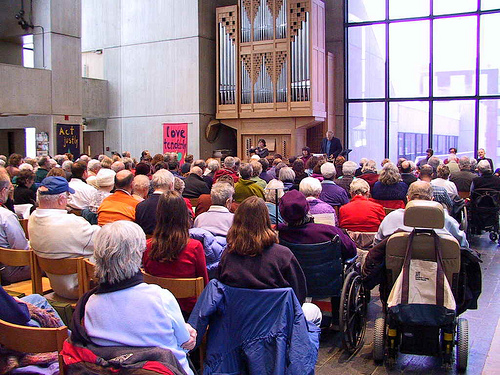
Founded in 2004 by clergy and lay leaders from a dozen faith communities to “bring about systemic change in institutions,” Vermont Interfaith Action recently reviewed its research on homelessness with Racine, Burlington Mayor Miro Weinberger and AHS Director of Housing Angus Chaney during a Burlington briefing held at St. Paul’s Episcopal Church.
The group urges local and state officials to “move from crisis response to a focus on retention and prevention” by reallocating funds. Other recommendations include changing the overall approach to case management, making data collection more outcome-oriented, and empowering Burlington’s Continuum of Care Committee “with more authority to guide and coordinate services.
Asked about the coordination issue, Weinberger said he “fully supports” a larger role for the city’s Community and Economic Development Office, which co-facilitates the federally mandated Continuum of Care with the United Way. The Vermont Interfaith Action report points out that many service providers also work together through the Adult Local Interagency Team (A-LIT), which includes representatives from the Community on Temporary Shelter (COTS), Community Action, the Howard Center, Turning Point, AHS and several other agencies and organizations.

One of the challenges is figuring out how best to distribute housing vouchers, the report explains. There are seven different voucher programs, some linked to specific properties but most of them portable, as well as 10 different housing authorities across the state. The Burlington Housing Authority serves 2,500 households and has about 2,000 people on a waiting list. The Vermont State Housing Authority distributes about 3,700 vouchers.
Since the demand exceeds the supply, staff must decide whether to distribute vouchers on a first-come, first-served basis or focus instead on assisting new people. “It is a dilemma,” the report states, “and different authorities think differently about how to prioritize.”
In Chittenden County COTS has the only family shelter and provides the largest number of emergency beds. A recent “point in time” census counted 707 homeless adults and 182 children, both figures lower than last year. There are 63 “unsheltered single adults,” who represent about 9 percent of the total homeless population. Two-thirds are in emergency shelters, with most of the rest helped via transitional housing. The income level of those who need housing assistance is $13,000 or less.
Racine agreed with the report’s conclusion that, in order to move from crisis management to housing retention, resources need to be shifted away from emergency motel placements. “That’s a dead end for people,” he said, adding that a better job also needs be done on prevention. “And it’s not just a Chittenden County problem.”
The meeting also featured statements by two men who have experienced homelessness firsthand. Charles Knoll, a single father, described the frustrations of dealing with a poorly coordinated bureaucracy. Jack Kearnan, who was homeless for 16 months after losing his job and being forced into bankruptcy, described the despair that can result in moving detail. “People become irrational in such unstable situations,” he said.

According to Chaney, the new director of housing at AHS, “Being without a place to call home can bring with it a sense of shame and a cruel loss of hope. Making real progress in our fight against homelessness will require renewed resolve.”
Racine noted that Gov. Peter Shumlin has requested $1.6 million in housing replacement funding to compensate for lost federal dollars.
Karen Davis, who led the questioning for Vermont Interfaith Action, noted that funding itself is not the main problem. “It’s the way the funding is used that has a bigger impact,” she explained. “The Agency of Human Services is making a shift in their thinking, and we’re happy to see it.”
One of VIA’s recommended action steps is “a case management system that is mobile rather than desk bound.” The report acknowledges that this may require an increase in staff. “We urge the organizations involved, along with the city and the state, to look carefully at what the best configuration of staffing would be.”
Supportive, field-based case management can help people “build the skills to stay in their new homes and overcome life obstacles that cause them to lose their homes,” it adds.
In order to understand the issue, a Vermont Interfaith Action team reviewed previous research and met with officials from various agencies and groups like the Howard Center’s Street Outreach Team. “Some of the persons that this team encounters are dealing with severe mental illness, while others have recently been incarcerated and are on probation,” says the report. “Still others have chronic alcohol and drug abuse problems, including a growing number of those with prescription drug addictions. Some have physical disabilities. Most have difficulty with personal financial management.
“Many homeless persons face multiple challenges, and the lack of stable housing only serves to provide yet another barrier to overcoming these difficulties,” Vermont Interfaith Action’s research concludes.
