


Praise for Donovan, but no endorsement
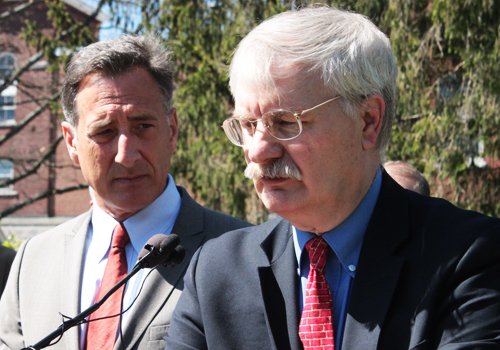
At a press conference celebrating TJ Donovan’s recognition for the rapid intervention community court program he pioneered in Chittenden County, Gov. Peter Shumlin refrained from endorsing the attorney general candidate, but he wasn’t shy about giving him praise.
“So one of the reasons that we’re reducing corrections spending in Vermont,” Shumlin said, “is because of the extraordinary success of this program that was hatched and created by the vision and leadership of TJ Donovan, Mary Alice McKenzie and other providers here in Chittenden County.”
The program uses rapid intervention – a pre-charge system through which non-violent offenders are directed to a community-based mental health or substance abuse counseling center – to keep people out of the state corrections system and use rehabilitation to reform the problem behavior.
“Since this program went into place, 624 offenders with 833 charges have been diverted from our corrections system,” Shumlin said.
When asked if his presence at the press conference was a tacit endorsement of Donovan’s campaign for attorney general, Shumlin said, “As you know, I’m staying out of any primaries among Democrats. I can tell you that TJ has been an extraordinary prosecutor for Vermont and has really been an extraordinary leader.”
Though Donovan did not mention his run for attorney general at the press conference, he said in an interview that he would implement the program statewide if he won the race.
Donovan said the Vermont Center for Justice Research, headed by Max Schlueter is analyzing the program’s success on a U.S. Department of Justice grant. Donovan said he expects the report will tell him what he already knows: The program works, and it’s worthy of statewide implementation.
Shumlin, having just come from a bill signing attended by current Attorney General Bill Sorrell, was walking a line with his public appearances Tuesday.
“I should point out that the current attorney general has been at two of the press conferences today, so, you know one of the joys of being governor is that we have a lot of friends … we hope,” Shumlin said.
Whatever his actions said on the day, his words seemed to back Donovan’s hope for the rapid intervention program’s future.
“As governor, I want to see it applied to every courthouse in Vermont,” Shumlin said.
Name that building
What’s in a name?
As Shakespeare asked the question, a sweet-smelling rose.
As the Vermont Legislature asked it, a job for Michael Obuchowski, Vermont commissioner of Buildings and General Services.
Two jobs actually.
Thanks to Tropical Storm Irene, lawmakers dumped a lot of work on the department responsible for all the state’s buildings: Oversee the construction of a new state hospital in Berlin, the restoration of the state office complex in Waterbury, and the Agency of Natural Resources’ move to new space at National Life in Montpelier, and finish efforts to co-locate a new Department of Health lab with a UVM Colchester research facility.
And while you’re at it, they said, come up with a name for the new lab, and also for the new 25-bed state hospital planned for Berlin near the Central Vermont Medical Center.
That job came as a surprise to Obuchowski, a former House Speaker and powerful longtime representative from Windham County who knows the ins and outs of the Legislature.
“I didn’t know about this responsibility, but I don’t think it would have kept me from taking the job,” he joked Thursday.
According to the capital bill, the commissioner “shall present three potential names” for the new health lab by Jan. 15 of next year, giving preference to “Vermonters who have made significant advancements in the field of public health.”
Obuchowski is tasked with the same responsibility for the new state hospital building, “giving preference to Vermonters integral to the advancement of mental health care in the state.”
The commissioner said he wasn’t aware of any precedent with these naming responsibilities but plans to create a couple of committees staffed with people long conversant with the fields of health and mental health and ask them to oversee the process and suggest names.
Health Commissioner Dr. Harry Chen and Mental Health Commissioner Patrick Flood will both be asked to be on the respective panels along with other officials and well-known citizens in the two fields, he said.
“You’re going to be doing us a big service by writing about this,” he said, saying he’s eager to hear suggestions of names from the public.
“The more the merrier,” he said. Anyone with suggestions can call his office at 828-3519.
“Where the panels go with this, I don’t know,” he said. But the Legislature will have the final say after he submits the three name finalists.
~ Andrew Nemethy
Blood donor age lowered
An amendment to existing law has lowered the legal age at which a teenager can donate blood without parental permission from 17 to 16.
Rep. Ann Pugh, chair of the House Human Services committee, said the amendment reflected a policy change favored by the Red Cross; 38 other states have already made the change.
The Red Cross advocated for the change since it will help meet the increasing need for blood for medical purposes — they conduct 75 blood drives at high schools around the state each year and estimate an increase of 1,000 pints of blood annually from the lowered age limit — and introduce the next generation of blood donors to this public service at an earlier age.
Pugh said the side benefit of increased “civic and community involvement” by young people had encouraged the passage of the change, along with testimony from the commissioner of health and the medical community that showed no health risk related to lowering the age limit. Red Cross policy is still to require parental permission for donation by a 16-year-old.
The change became law upon its passage in April.
~ Kate Robinson
