


The conference committee for a bill aimed at addressing what Gov. Peter Shumlin calls an “epidemic” of drug addiction made no progress today, with conferees locked in disagreement about law enforcement access to the Vermont prescription monitoring system (VPMS).
The Senate conferees got a boost this afternoon when Shumlin stepped into their corner, holding a press conference in which he sternly warned House conferees to adopt the Senate plan to allow law enforcement officials to get information from VPMS without a warrant.
“It’s a solvable problem,” Shumlin said. “It’s imperative that the House accept the Senate’s good work in ensuring that we give our four law enforcement officers in Vermont the ability to have the information they need when addicts are pharmacy shopping.”
Under the Senate proposal, four Vermont State Police officers tasked with special drug investigations would be allowed access to information from the VPMS database without a warrant by going through a hearing officer. The hearing officer would grant the requested information if there was “reasonable suspicion” of criminal activity.
“That’s what warrants are for,” countered Rep. Ann Pugh, D-Chittenden. The House argues that the prescription monitoring system, created in 2006 to “provide an electronic database and reporting system for electronic monitoring of prescriptions for Schedules II, III, and IV controlled substances” should not be used for law enforcement purposes.
The 2006 law states that law enforcement officers “shall not have access to VPMS except for information provided to the officer [by a medical official who suspects a doctor is breaking the law].”
Under current law, officers can go to a pharmacy and request records without a warrant, but the legislation regarding the database does not provide similar access.
Supporters of the Senate proposal say a warrant requires “probable cause,” a tougher standard for officers to meet. They say that bar is too high.
“Reasonable suspicion is a lower standard than probable cause,” said Allen Gilbert, executive director of the Vermont American Civil Liberties Union. “It offers less protection.”
Rep. Robert Lewis, R-Orleans, spoke at Shumlin’s afternoon press conference as a supporter of the bill and a 34-year law enforcement veteran.
“They do not realize the amount of work it takes to get the probable cause to get a search warrant,” he said. “I get the feeling from them they watch too much television, where you have a half-hour or an hour show and within that time period they get their search warrant, they get their DNA, they get the whole ball of wax. It takes a lot of work.”
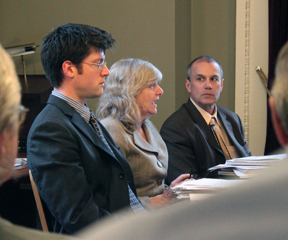
Shumlin and the Senate hope to cut down on the weeks of effort it can take for officers to establish probable cause by reducing the standard, but Gilbert, Pugh and other opponents say doing so would be unconstitutional.
“We have a situation where the police have said ‘because we can’t meet the probable cause standard, we shouldn’t have to get a warrant,’” Gilbert said. “It makes the fourth amendment look like a laughable afterthought.”
Pugh looked to Article 11 of the Vermont Constitution, which protects against unwarranted search and seizure.
Both sides pulled from a 1992 lawsuit, State of Vermont v. Judy Welch, in which the Vermont Supreme Court supported warrantless access to pharmacy records. Sen. Richard Sears, D-Bennington, said such a ruling supported the Senate’s view. Pugh said the lawsuit predated the database and could not be applied to it.
As the conference committee met in the early evening, it was beginning to look as though they couldn’t agree on whether they even agreed.
Pugh noted that the bill, of which law enforcement access to VPMS is just a small part, was the result of work in both the House and the Senate, and it was worth further development.
“We have found agreement on all but one area,” she said, “and we have done as the House and the Senate incredible work in fighting the issue of prescription drug misuse and overdose and we treat this very seriously. We just don’t see the relationship between access without a warrant to a health care database.”
Sen. Kevin Mullin wasn’t so optimistic.
“We haven’t found common agreement on really attacking what is a pervasive epidemic in the state of Vermont,” he said. “I would hope that while we’re squabbling here that people aren’t enduring additional break-ins to their property, theft of their personal property to fund the purchase of drugs and I would hope that nobody has to die on the streets again because we’re not willing to do what is necessary to take the steps to reduce this problem in the state of Vermont.”
Pugh insisted that the House and Senate did, in fact, agree.

