

Editor’s note: Jon Margolis is a political columnist for VTDigger.org.
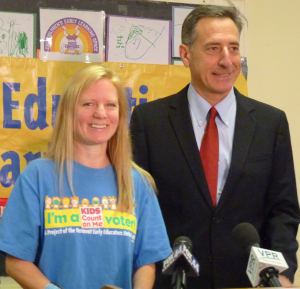
It was a union gathering to support a bill, but any doubts about it being an unconventional union gathering ended when the first speaker, Catherine Ste. Marie, said, “This legislation is not about us.”
John L. Lewis never said any such thing. Neither did Walter Reuther or Cesar Chavez. Neither does AFL-CIO President Rich Trumka. Union leaders have not been shy about declaring that their goals were all about their workers, and that what they wanted, in the celebrated and pithy description of 19th century labor leader Sam Gompers, was “more.”
So do the members of Vermont Early Educators United. But there’s one major difference, which was clear despite Sen. Richard McCormack’s invocation of famous lines from old labor anthems. It was a “which side are you on,” state of affairs, McCormack said, and he was “stickin’ with the union.”
But a traditional union organizing drive pits the workers against their employers, often called “the bosses” in the songs the Bethel Democrat was quoting. In this organizing drive, the union members are the bosses.
They are the operators of independent child care centers. The collective bargaining rights they seek are not vis-a-vis their employers. They have no employers. Some of them have employees, and the bill before the Legislature would not give those employees bargaining rights vis-a-vis their bosses. Instead, the amendment proposed by McCormack would give the operators the right to bargain collectively with the state, which subsidizes most of the cost of day care for lower income parents.
It’s an unusual concept which has aroused some opposition. So far most of the opposition has been muted. Proponents, including Gov. Peter Shumlin, the Vermont Democratic Party, and several lawmakers have praised the bill (H. 97) that passed the House last year and that is almost identical to McCormack’s proposed amendment to another labor bill. With one exception, opposition tends to be whispered rather than proclaimed around the Statehouse.
One reason so many Democrats support the measure and so few oppose it – or, perhaps more accurately, why so few will say they oppose it – is that Vermont Early Educators United is affiliated with the American Federation of Teachers, which contributed both money and shoe-leather to Democratic campaigns in 2010.
According to Senate President Pro tem John Campbell, a Quechee Democrat, at a meeting in February, the AFT’s Vermont president, Ben Johnson, slid a piece of paper across a table to Campbell, on which was written the amount the AFT had provided Vermont Democrats during the last election.
Perhaps not a wise move. Campbell is the one exception, the only senior Democrat who never supported the collective bargaining bill, worrying that if the state starts subsidizing “someone who just receives a subsidy, hundreds of other groups could do the same thing.”
Campbell said he considered Johnson’s reminder of the union’s financial backing a form of “intimidation,” strengthening his determination to block the bill. But it might be hard for him to stop McCormack’s amendment from coming to the Senate floor. It appears germane to the workers compensation measure it would amend, and many members of the Democratic majority would no doubt find it difficult to vote against an amendment with strong backing from unions and from their own party organization.

Another reason few legislators are vocal in their opposition to the legislation is that most of them would like to help the women (and very few men) who care for two-, three-, and four-year-olds while their parents are at work. The child care workers may be independent entrepreneurs, but they are hardly in the top 1 percent of income-earners. Most are probably not in the top 50 percent.
Anna Gebhardt, who describes herself as a registered, licensed, “early educator” in Burlington said the most she can charged is $210 a week per child, as much as $110 of which could be paid by the state. Child care providers can have as many as six children in their care during the school year, which would bring in $1,260 per week or about $45,000 for the school year. Providers could gross as much as another $20,000 during the summer, assuming their facilities were full all summer.
But that assumes that the day care facility will be full for the entire school year. And that’s gross income. The care providers obviously have expenses. Gebphardt, for instance, has one employee. All the providers have to buy equipment and furnishings.
Like the other providers, Gebhardt said money was not as important is being “respected as a professional,” and being “treated as the true experts” in early childhood education.
But respect and income are related in this country, and despite their rhetoric (and t-shirt slogans) insisting that their chief concern is for the children, all of them acknowledge that a higher income is one of their goals.
They have rejected suggestions, including, reportedly, one from Campbell, that they accept more money in return for dropping the collective bargaining demand. No doubt this position is encouraged by the AFT, which wants more dues-paying members. But the child care providers are also serious about playing a role in forming early childhood education policy.
Ste. Marie, a home provider in North Troy, said that the state recently changed its bonus payments plan for providers like her who qualify for the STARS (Step Ahead Recognition System) designation, in which providers with superior credentials and performance get slightly higher subsidies. The state increased the bonus, she said, but gave the increase to the parents, not the providers.
“It was a wonderful thing to do but the wrong way to do it,” she said.
Asked what would be a better way, she said, “I don’t know, but I want (the provider community) to be part of the process for making those decisions.”
This raises the possibility that officials from the Department of Children and Families, the agency that arranges the subsidies to the providers, are not in favor of the collective bargaining bill. No such opposition has been voiced, but government officials rarely like to see any reduction in their ability to set the rules as they see fit.
Though collective bargaining between states and independent businesses is rare, it is not unheard of. Martha Braithwaite, an organizer for the union effort, said 14 states have similar systems of collective bargaining for child care providers.
The final outcome remains uncertain. Campbell has reportedly indicated to some that even if the amendment passes, he might refuse to name Senate members to a House-Senate conference committee to resolve the differences in the two measures. That could effectively kill the bill for this year.
If that happens, expect Early Educators United and the AFT to be back next year, when (if Statehouse scuttlebutt is to be credited) there might a different Senate President. The providers insisted at their demonstration Tuesday that they were determined, and they appear to be, inspired, perhaps, by one of the few old labor song lines Dick McCormack did not recite for them: “Don’t mourn. Organize!”
A child care provider’s possible earnings figure was corrected in this story on April 18 at 10:23 a.m.

