

In This State is a syndicated weekly column about Vermont’s innovators, people, ideas and places. Details are at http://www.maplecornermedia.com/inthisstate/. Dirk Van Susteren of Calais is a freelance writer and editor.
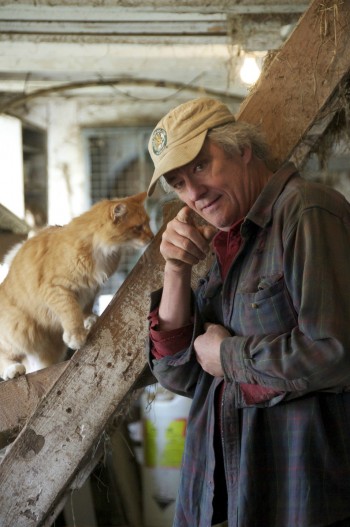
It is 9 a.m., and George Woodard, doing his barn chores, has just served a heifer a scoop of tasty organic grain. A question: Will the unfortunate animal now have to endure one of Woodard’s jokes, like, say, this cornball classic: “If a cow laughs, will milk come out her nose?”
Perhaps his captive audience will hear the one about the guy who falls from plane, lands in a haystack and eventually beds with the farmer’s daughter. Or, who knows? Maybe a rubber chicken will fly across the stanchions. George does rubber chickens pretty good. A physical comic, he mimics real birds too, drawing himself up and scratching and twitching with the best of them.
Woodard respects his farm animals, his 25 cows, 11 other heifers, three barn cats, two of them extremely personable, and one incurious but friendly overweight dog named Patches. He will talk to them, pet them, and on this Saturday morning, at least, he’s sparing them his humor.
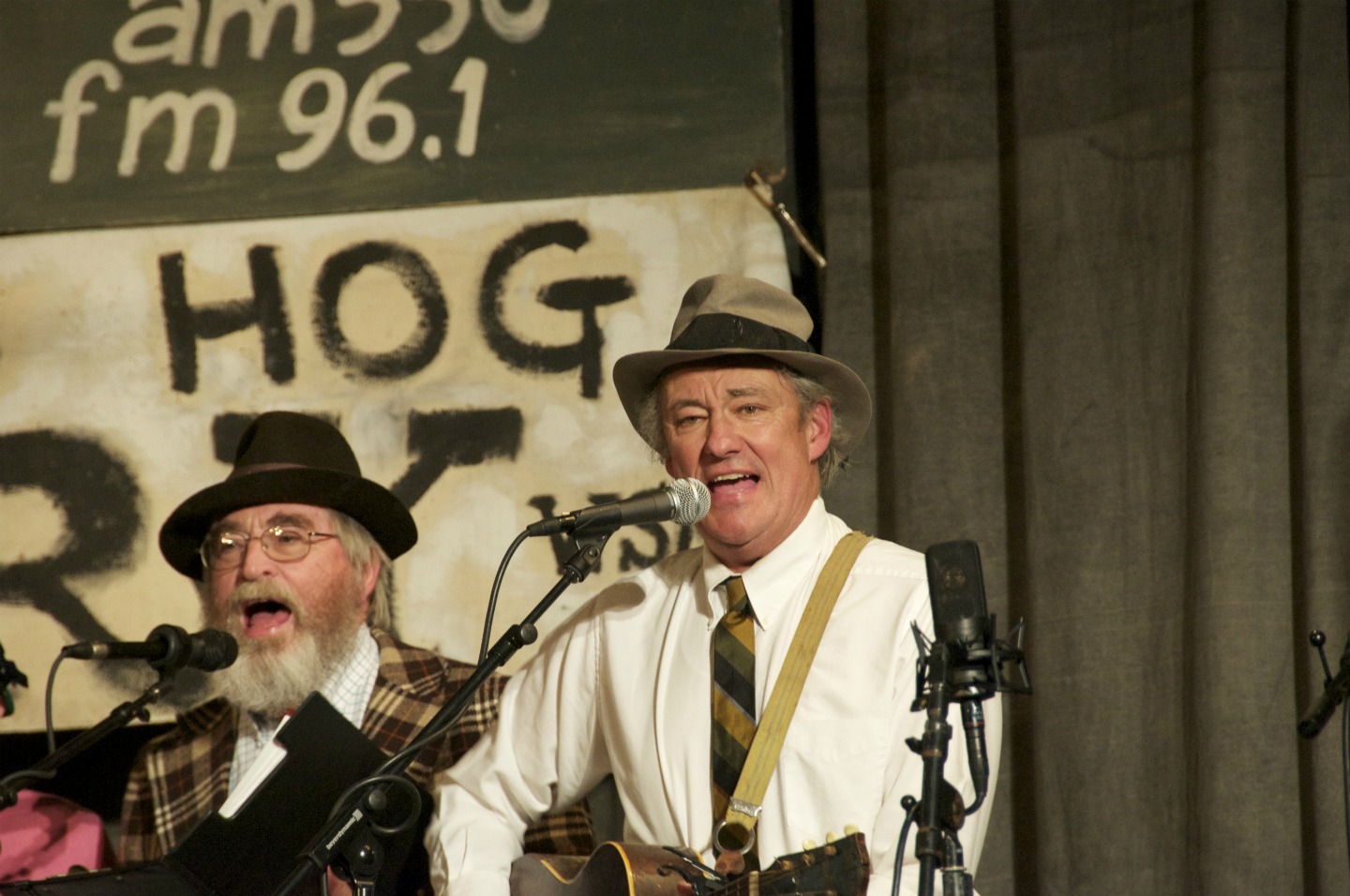
Not so humans. An audience of 550, a sold-out crowd, groaned and laughed heartily at his antics just two weeks ago at the grand finale of the 2012 Groundhog Opry in Woodard’s hometown of Waterbury.
The Opry, the ersatz variety-radio program that makes its way around central and northern Vermont every few years, features a cast of amateur actors, delivering jokes and performing irreverent skits, and musicians, including Woodard (vocal, piano, banjo and guitar), singing and playing bluegrass.
Woodard has organized this show with fellow musician and thespian Al Boright of Middlesex. The two over the years have recruited all sorts of characters for the Opry, with varying degrees of talent, among them (one year) state Supreme Court Justice Marilyn Skoglund, a singer, and Stowe’s Rusty DeWees, the actor and comic who later launched his own persona and show, “The Logger.”
Woodard says his inspirations for the Opry were the old TV show “Hee Haw,” especially when Grandpa Jones did his acts; colorful programs like “Music To Go To The Dump By” that air on his hometown radio station WDEV; and the 1960s television sitcom “Andy of Mayberry.”
“I looked forward to watching the ‘Dillards’ (bluegrass group) on the show,” says Woodard, his graying hair sticking out from under his barn cap. “There was the father, his daughter and the four boys, all playing and singing bluegrass, and they looked dumb and dirty, and they were fantastic.
“I figured I could do that,” says Woodard.
Later, he learned, he could, and he started keeping a guitar on “a little garbage can” in his bedroom, so “I could grab it quick.”
Woodard says the performance in Waterbury was his last, but then he hastily offers an amendment. “It is over perhaps only for a few years, because it does take about two months to get it going, and there’s the month of the tour itself, and I have other things I want to do,” he says.
Among them: keep up the milking.
Woodard, multi-faceted, is at home not only in the barn and on stage but also behind and in front of the camera. Eight years ago he directed, shot and acted in his movie, “The Summer of Walter Hacks,” working with his friend and occasional milking partner, Gerianne Smart of North Ferrisburgh. She is a marketing specialist, who became the movie’s producer.
“The Summer of Walter Hacks” came out in 2010, and was shown at various Vermont venues and out-of-state film festivals before Woodard decided to reel it in for additional editing. Now the movie just had a fresh debut this weekend at the Hyde Park Opera House, which is where Woodard and Boright first began performing, independently, some 40 years ago.
“The Summer of Walter Hacks” is a sobering, coming-of-age piece, with some violence and a chase scene that would have made Steve McQueen blink. It’s set in rural Vermont; the year is 1952, and the show stars Woodard’s own son, Henry, who was 11 when the filming began. Woodard is in the movie, playing the dramatic role of Walter’s debt-plagued father. So is Woodard’s nephew Matthew, who plays Walter’s brother. The cast includes other familiar Vermont actors.
The black and white movie was filmed largely in Woodard’s home, his barn and on his fields, and it reflects many of his boyhood passions.
Walter, in the movie, is obsessed with cowboy films as was George when he was a lad. There are scenes of Walter racing down paths and across fields on his bicycle, as did George while growing up. Walter is tight with his brother, and George was greatly devoted to his late brother, Steve, a respected Waterbury veterinarian.
In the movie, Walter performs in a fiddling contest in hopes of winning $150. And in real life, in 1976, George and Steve, on a whim, entered a band contest at the Barre Auditorium and, to their surprise, were judged the best and pocketed $75 apiece. “There were 40 bands, and we won the damn thing, and we weren’t that good,” says George with a laugh.
“We had a good time putting on a show, just a couple of goobers trying to sing.”
The goober persona works perfectly for Woodard in performances like the Groundhog Opry. But over the years he has played all kinds of roles, many serious, on stage and in other Vermont films, including “Ethan Frome,” “Mud Season,” “My Mother’s Early Lovers,” “Time Chasers” and “Nothing Like Dreaming.”
Woodard learned film skills back in the mid-1980s, when he moved to Los Angeles for three years, finding bit parts, building and painting sets, and doing camerawork. He learned, then returned home to the farm, which Steve had been tending.
At 59, though still wiry and youthful, Woodard has begun worrying about the future of his 200 hillside acres. It’s at the base of Hunger Mountain and offers exquisite views of Camel’s Hump. His grandfather bought the land exactly 100 years ago. For most of the last century the place was a dairy farm, but Woodard says neither his son nor any of Steve’s kids wish to farm.
“I am sort of at a crossroads,” he says. “This is a beautiful little farm with meadows and woods; this place means a lot to me.”
He doesn’t want it developed. Nor, apparently, did his dad.
There’s another scene in his movie that’s autobiographical. In it, an agent for a ski company motors up to the Hacks’ farm in a big car, finds the boys in the yard and presses them to locate their dad, so he can persuade him to sell.
Woodard was on hand on a day in the mid-1960s when a fellow, who Woodard figures also was a ski-area representative, arrived with an offer for his own father.
“I remember they had an option to purchase the land above and below us, and we were in the middle, so they needed our place,” says Woodard. “The man said ‘You name your price,’ and my father said ‘no.’
“He left and they built Bolton Valley instead,” says Woodard, referring to the nearby ski resort.
Woodard says he’ll do his best to keep the land open, maybe hope for help from the Vermont Land Trust or some other nonprofit organization.
Cows or no cows, his farm makes for good filming … and bad jokes.

