

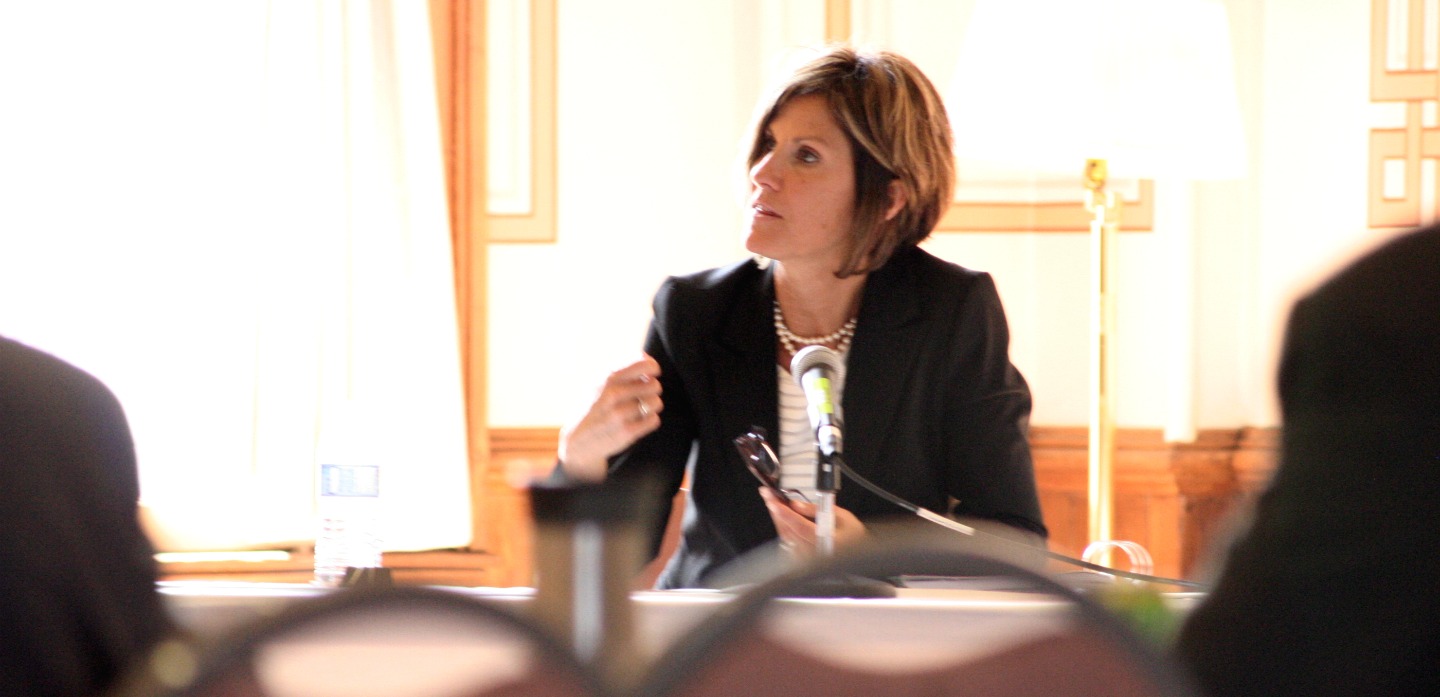
Technical hearings begin in GMP-CVPS merger proceeding
The Vermont Public Service Board held its first technical hearings Wednesday on a proposed merger of the state’s two largest utilities.
The PSB, the Department of Public Service and intervenors questioned the heads of Green Mountain Power and Central Vermont Public Service on the gritty details of the monumental merger the utilities propose. The two utilities, which make up the lion’s share of the state utility market, would be owned by Canadian utility Gaz Metro, which already owns Green Mountain Power and Vermont Gas Systems.
Attorneys for the DPS and for other utilities pressed Green Mountain Power CEO Mary Powell and CVPS CEO Larry Reilly on the governance of the state’s transmission system. The combined utility would control more than three-quarters of Vermont Electric Power Co., the utility that manages the state’s electric transmission system, and parties have questioned the utilities on the makeup of VELCO’s board.
GMP and CVPS offered a plan that would put one-third of the share of VELCO into a low-income trust, but the state wants a public role in the oversight of the company. Smaller utilities, including Stowe Electric Department and Washington Electric Cooperative, also want a seat at the table.
Powell and Reilly were questioned on how the utilities will account for the $144 million in savings they say will be returned to ratepayers in the first 10 years of the merger.
The AARP, which is pushing for CVPS to return $21 million to ratepayers as a result of a bailout in the early 2000s, said testimony Wednesday revealed that Gaz Metro, Green Mountain Power’s parent company, was always prepared to pay that money.
The utilities initially said the $21 million in “windfall” money was included in the $144 million in savings the company initially proposed. They later offered to invest the money in an efficiency program. The AARP wants CVPS to pay current ratepayers back in cash, split up based on the amount of electricity they use.
“We heard rumors that if we insisted on the $21 million paid to ratepayers we’re doing a disservice to the people of Vermont and that we’re going to skunk the deal,” said Jim Dumont, an attorney representing AARP. “Now we heard on record that’s not true.”
Michael Dworkin, former chair of the Public Service Board, and other witnesses representing the Department of Public Service will testify next week.
DPS Commissioner Elizabeth Miller said, “It’s been a long process, but we are looking forward to going through the technical hearing and ensuring the merger, if approved, provides a real and significant value to Vermonters.”
Dorothy Schnure, a spokeswoman for Green Mountain Power, said the hearings give the parties an opportunity to dive into the details which have already been laid out in hundreds of pages of written testimony.
Hearings continue Thursday, and the board has reserved 11 more days for additional live testimony.
~ Alan Panebaker
VPR seeks state funds to eliminate southern dead zone
VPR can be heard in four states and Canada, but its reach is still shaky in some parts of Vermont, VPR president Robin Turnau told the Senate Institutions Committee yesterday.
The radio station is asking the state for $150,000 to expand its access throughout all of Vermont. Windham County, including the Brattleboro region, is the last radio dead zone for VPR, as 16,000 of its residents don’t receive a signal.
Turnau said many residents of the region would benefit from access to VPR, including state-specific programs like “Vermont Edition.”
“Windham County residents have been asking for years, decades really, for us to serve that area with a strong signal. And they really want to be able to participate in the statewide conversations that VPR convenes,” Turnau said.
The project will cost $300,000, the other half of which will come from VPR. The money will go towards purchasing an antenna and transmitter, which will broadcast from an existing tower. The signal will reach 32,000 Vermonters.
However, the station may have trouble finding funding, warned Sen. Dick Mazza ,D-Grand Isle, because the state budget was “hit for $18 million” to pay for damages from Tropical Storm Irene.
VPR also missed inclusion in the governor’s budget in January because the station still needed to get a broadcast license and assess the technological requirements of expanding its signal.
VPR, unlike public radio stations elsewhere, does not receive funding from the state. The last time it received a grant was in 1999 and then again in 2000, when it expanded its coverage to St. Johnsbury and Bennington County.
~ Erin Hale
Accessibility in emergencies focus for FEMA, Red Cross
Representatives from FEMA and the Red Cross spoke at the Vermont Disability Awareness Day press conference about recent efforts to improve the state’s emergency response mechanisms to meet the needs of Vermonters with disabilities.
Larry Crist, a member of the Vermont and New Hampshire Valley Red Cross, said upgrade efforts have focused on improving accessibility in shelters and expanding the state’s cache of emergency functional needs equipment. The Red Cross has worked on this project with Disability Rights Vermont.
“A shelter needs to be functional for everyone who uses it and that goes for the full range of an individual with no apparent disability, to an individual with a challenging disability,” Crist said.
Crist described the different experience of two towns during Irene, both with populations with functional needs. One contacted the Red Cross prior to the storm, while the other did not.
“Fortunately because of functional needs equipment we had purchased we were able to get 25 medical cots to the town, the town found volunteers within town, and later that night that building did, in fact, flood. We had 50 people housed, 22 required use of medical cots,” Crist said.
“The next day another town contacted us – [they said,] ‘We have 30 some odd individuals with fairly significant functional needs; can you open a shelter?’– but it was too late. The town was cut off.”
The goal during emergencies, according to Crist, is to ensure that shelters are as accessible to individuals as their homes.
Crist said that nine regional sites have been identified as full-access shelters, which can include municipal buildings or schools, which are usually already up to code. Funding has also already come from Citizen Corps and Americorps, as well as the Center for Disease Control.
The Red Cross and Disability Rights Vermont are also in the process of writing a training manual for volunteers in how to best assist disabled Vermonters during emergency situations.
“In Katrina and what we identified more so with Tropical Storm Irene, that the Red Cross has lots of wonderful volunteers who show up and operate our shelters, these are your neighbors, many from the next town over. But many of those folks have not had a great deal of contact in working in shelters with individuals who have certain support needs,” Crist said.
~ Erin Hale
