

Editor’s note: This op-ed is by award-winning journalist Telly Halkias. It first appeared in the Bennington Banner on Feb. 29.
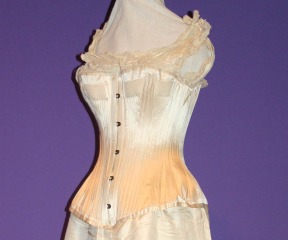
No, the Bennington Museum won’t be giving Victoria’s Secret a run for its money. Later this month, however, it will take a peek under the skirts of historical Bennington’s fashionable females when it opens the exhibit “Revealed: A Century of Women’s Underwear.”
The museum’s curator of collections Jamie Franklin said the show’s name, as well as its intimate subject, carry a double entendre.
“As a museum that has been collecting objects of regional historic interest for 85 years, we have remarkable troves of material that rarely get seen,” Franklin said. “An exhibition on a topic that rarely gets discussed or seen in public during its useful life, but plays such a significant daily role, makes for a perfect subject. The show will reveal that which is hardly ever seen during its life as a functioning garment, but also gives us an opportunity to reveal an aspect of our collections that few people, if any, knew we had.”
Franklin added there is more to fashion than what one sees on the surface. So the show will attempt to answer a range of historical questions such as: How did Victorian women create the illusion of such impossibly tiny waists? How did they maintain hoop skirts of such epic proportions on the eve of the Civil War? Why are our whites white?
Victorian images
The ideal female body changed repeatedly between 1800 and 1900. The stiff figure of the 1700s gave way to the lithe Empire style of the early 1800s, which transitioned to the wide-bottomed Civil War figure, to the wasp waists of the early 1900s, to the slim youthful ideal of the 1920s.
Exhibit curator Callie Stewart, the museum’s collections manager, said the natural female body has remained the same over the centuries, but undergarments made these changes in fashion possible.
“Corsets cinched in the waist, which was further accentuated by a large skirt held out by multiple petticoats,” Stewart said. “Corsets and stays were well known for their ability to thrust up or keep down alluring breasts. Whether the breasts were up or down depends on the decade.”
Stewart said “Revealed” will deal primarily with the Victorian period, and one of the things she’d like to do is challenge people’s view of that time.
“Yes, they were prudish, and all of those layers of underwear were not necessarily meant to be comfortable, but there is so much more going on here,” Stewart said. “The corset is holding the body stiff and proper. It’s emphasizing feminine curves and creating an intentionally sexy silhouette. The Wonderbra has nothing on some of these pieces. Petticoats might hide the shape of a woman’s legs, but the detailed embroidery and lace on the bottom suggests that someone was meant to see them, if only fleetingly.”
Underwear served other important functions. At a time when doing laundry was backbreaking, and bathing infrequent, a chemise, or shift, protected expensive dresses from body odor and sweat. Underwear was plain white cotton or linen, which could be bleached to remove stains. Unlike the dress, the chemise was changed every day, giving some semblance of freshness to its owner.
Local flair
During the 19th century, clothing manufacturing shifted from home to factory, and is reflected in the era’s underwear. In 1800, shifts and stays were either made at home or by specialized artisans. By 1900 corsets and union suits were manufactured in mills.
According to Stewart, underwear companies in Bennington included H.E. Bradford, EZ Mills, Cooper Manufacturing Co., George Rockwood & Co., and others. Unlike other New England mill towns that made woven cloth, many of Bennington’s mills specialized in knit underwear. It was no coincidence that Charles Cooper’s machine works on East Main Street manufactured the knitting machines and needles used in the town’s factories.
“The manufacture of underwear in Bennington can also be looked at as a microcosm of the textile industry in the U.S. as a whole,” Stewart said. “In the 1700s most clothing was homemade, often using locally produced cloth. By 1900 almost everyone bought some of their clothing ready made. The textile mills in Bennington sold their knit union suits and undershirts all over the country. The H.E. Bradford Co. was around for over 100 years.”
The Industrial Revolution found Bennington’s growing middle class with disposable income for the first time. No longer forced to work in the fields, the Victorian woman was the guardian of the home and family’s moral compass. Restrictive clothing hindered physicality, visually asserting her status as a symbolic and decorative figure. Corsets, bustles and hoop skirts weren’t comfortable, but ease was secondary to her respectability.
Logistics, logistics
Stewart, who holds a graduate degree in museum studies from George Washington University, landed the Bennington Museum job in 2005, right out of school. As collections manager, she is the institution’s historical logistician, and she has been lauded for her complete inventory and cataloging of the museum’s collection. This is her first solo curated show, complete with problem solving.
“Clothing is made to fit a human form, and it can be difficult trying to make it look good on a stiff mannequin,” Stewart said. “The corsets are particularly problematic since they are designed to mold the human body by moving the flesh around. To make them look correct, I had to use our smallest dress forms for the slim waist, and then stuff the bust and hips to give them the correct shape. The material is old and sometimes fragile, so I don’t dare put as much pressure on them as they were originally designed for.”
Stewart said another interesting challenge has been trying to keep the exhibit from being dull and academic without letting it get indecent. She said it was easy to get carried away with risque puns, but then had to strike an appropriate balance for propriety’s sake.
In all, Stewart is eagerly anticipating the debut of “Revealed.”
“I’m happy to talk about historic underwear all day long,” she said. “It’s not just about granny panties!”
“Revealed: A Century of Women’s Underwear” opens March 17 at the Bennington Museum and runs through May 15. For more information, call 802-447-1571 or visit benningtonmuseum.org.
