

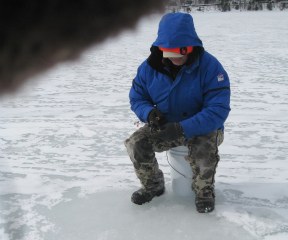
As I pulled my sled, loaded with three jigging rods, a big yellow bucket and an ice auger, I stopped and looked down at a small pressure crack winding its way across the 8-inch-thick ice.
It was late February. I could see open water, perhaps two inches wide, along the opening of the pressure crack. Veteran ice fishermen had warned me about the danger of such cracks, so I stepped wide as I went over it.
A lone angler, 500 yards across the ice, was bundled up, his back against a fierce, late-afternoon northern wind.
Crossing the ice, I struck up a short conversation with the young man and learned that, about a week earlier, he too had come upon a pressure crack in the ice. Using his auger — a device that drills a fishing hole through the ice —to gauge the strength of the ice a short distance from the crack, he came down with a solid blow.
The next thing he knew, the ice under him collapsed and he floundered, chin-deep in the water. He managed to pull himself from the icy waters and quickly rushed home. Another ice fisherman I have fished with, arriving on the ice a half-hour later, confirmed the man’s story. Even ice that is good and thick can separate, due to pressure cracks.
As it grows colder, the ice expands and, when warmer weather arrives, it contracts. You can hear the ice moving and changing and cracking, particularly with the onset of warmer or colder temperatures. It is a strange, rumbling, unsettling sound and often very loud.
Jim Lynch, a fishing pal of mine, likes to joke about how that sound of can make any ice fisherman’s heart do a little dance. That loud crack, moving along the ice, sometimes right under your feet, keeps you aware of the uncertainties of constantly moving ice.
There is a wide array of dangers, other than pressure cracks, out there. A host of things can go dreadfully wrong in the outdoor world.
Hunting for whitetail deer or wild turkeys one or two miles back in big woods can be an exhilarating experience. But danger could be lurking over the next ridge. One wrong step and you could suffer a broken leg. Even worse possibilities are out there — a heart attack, becoming lost, falling from a tree stand, even being shot by another hunter.
Jeremy Baker, until recently a member of the Vermont Fish & Wildlife Board, knows all too well how things can go very wrong in the woods of Vermont. In 2007, while spring turkey hunting on a mountain in Mendon, Baker experienced what he calls “a freak accident.” While climbing down a steep bank, the Rutland man stepped on a log that dislodged a huge boulder.
The 300-pound boulder knocked him over backwards and rolled over him. Only the quick-thinking of a hunting companion, who called for help over a cell phone and then directed medical treatment his way, saved his life, Baker says.
Baker, who looked like he had been beaten with a baseball bat, received more than 100 stitches to his face, five staples in the back of his head, a fractured eye socket, a broken nose and a fractured cheek.
Nevertheless, later that month, Baker was back in the turkey woods.
Many young men and women, it has been said, take risks that suggest fearlessness in the face of extreme danger, a folly of belief that they are somehow indestructible. As we age, however, most of us grow much more cautious.
I took a long, hard look into the dark cavern of danger many, many years ago, at the age of 20. A year in Vietnam shook any concept that it was manly to take big risks.
So I take to the woods and waters with more than a little caution. But that doesn’t mean that I haven’t experienced some very some dangerous moments.
Once, while fall turkey hunting near my home in Castleton, I heard a limb snap about me. Before I could react, a large porcupine landed mere feet away. I could only imagine the consequences of that porky landing on my head.
Some 40 years ago, while hunting in another state, I heard a loud shot and then the sound of a bullet whizzing by my head. I hit the ground, in pure terror. Then I shouted. I remained there for a brief while.When I rose to my feet, I saw nothing. Whoever came this close to killing a man had vanished.
One morning, many years ago in the Vermont deer woods of November, I found myself trembling from the cold. I sat, nevertheless, wiggling my toes and slowly moving my numbing fingers. I was not aware that hypothermia had set in. Perhaps a half-hour later, I began to shake uncontrollably. I shook, for most of the half-mile walk back to my home, then sat all-too-closely next to the old wood stove in the kitchen.
On another occasion, I was perched in a tree stand, more than 20 feet high, just below a huge pile of stones. I spotted, then shot, a four-point buck. As the buck tumbled over, I lost my balance. Only a nailed brace, chest-high, saved me from what would have been serious injury or death.
As a boy of about 10, I would ride my bike several miles to pretty bass pond, located about two miles from my home.
One sunny day, I waded out on a shallow end of the pond, casting plugs and catching bass. After the action slowed, I decided to head to the other side of the pond.
After I climbed a small hill, I neglected to notice that a barbed wire fence was electrified. When my soaking wet pants came in contact with the fence, a fierce jolt of electricity went through my body. It was shocking, to say the least.
There is plenty of danger out there, some predictable, some not. Most of the time, a simple dose of common sense will put you out of harm’s way.
But not always.
