


Editor’s note: Anne Galloway contributed to this report.
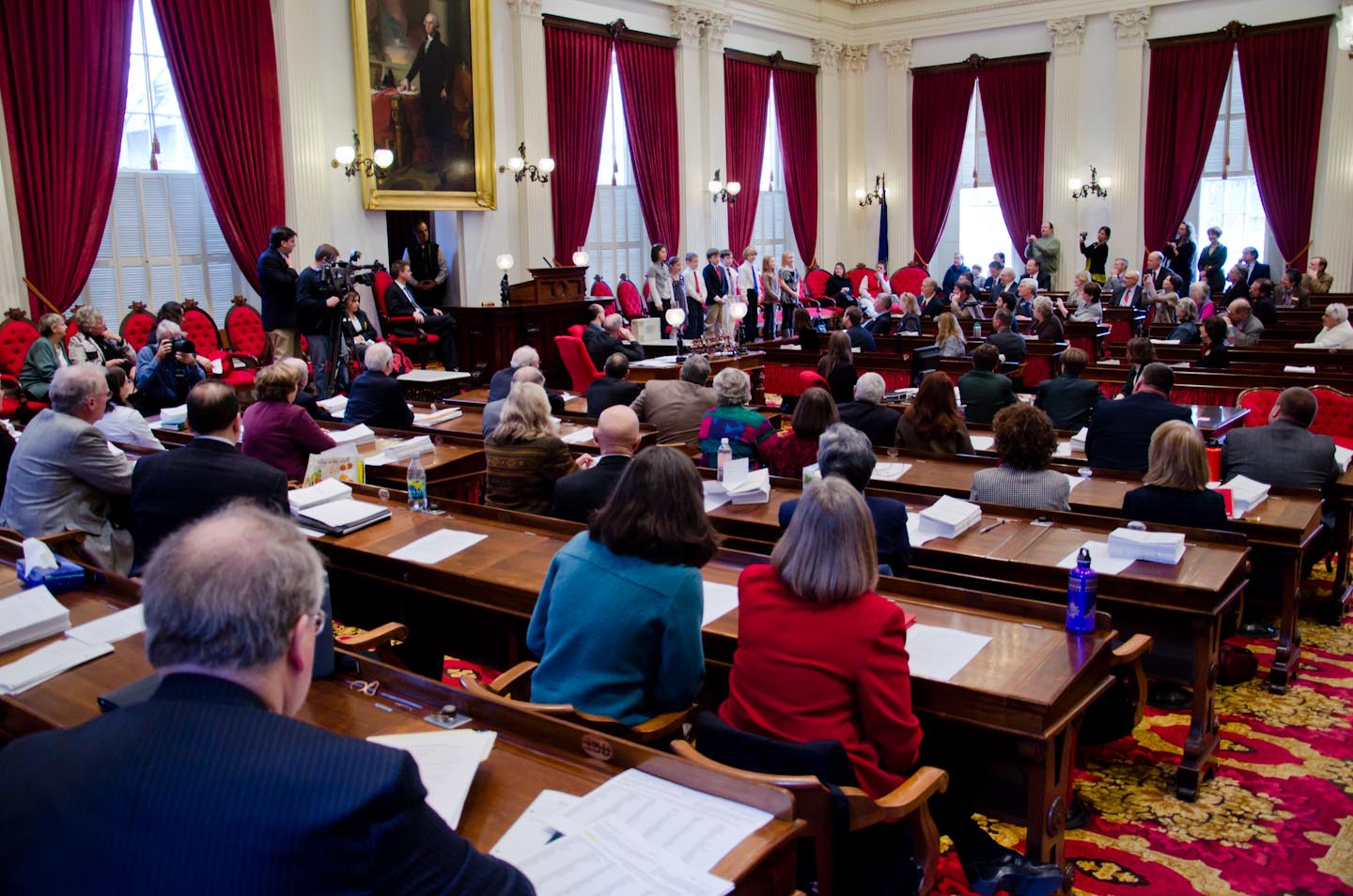
Lawmakers were in hail-fellow-well-met mode on Tuesday as they convened the 2012 legislative session, but they wasted no time getting down to business. Both chambers of the Statehouse introduced lists of new bills, lined up members of key committees and listened to briefings about the state of the state’s finances and efforts to rebuild after Tropical Storm Irene.
House Speaker Shap Smith gave a brief speech acknowledging the can-do spirit of Vermonters who “put on waders” and helped their communities recover from the worst natural disaster the state has faced since 1927. Lawmakers gave a standing ovation in honor of the people who “answered the call” to rebuild the state after Irene.
Smith framed the long-term impacts of the storm on the state’s infrastructure as an opportunity to re-imagine the state’s mental health system, the Vermont State Hospital and the state office complex, which until Aug. 28 housed 1,500 workers. “We can’t plan for just today’s projects,” Smith said.
“The work we do today will usher in a stronger economy,” Smith said. “We owe it to Vermonters to rebuild Vermont so they have a better place to live.”

Smith asked lawmakers to put partisanship aside in the interest of ensuring Vermonters’ needs are met first. No matter what party members of the General Assembly hail from, he said, “I know people here will do their best for the state of Vermont.”
The Speaker asked for a moment of silence in remembrance of retired Republican Rep. Bud Otterman who passed away on Monday and Rep. Mark Mitchell, a Democrat, who died last fall. Smith also swore in a new member — Jean O’Sullivan, a gubernatorial appointee from Burlington who replaces Mark Larson — and announced committee reassignments (see list at the end of this post). Gov. Peter Shumlin will also need to name a replacement for Rep. Rachel Weston who will formally announce her decision on Wednesday to leave the Legislature to work for the National Democratic Institute in Jordan. Rep. Kesha Ram, D-Burlington, will take her place on the powerful House Ways and Means Committee.
The first day being the first day, a crush of lawmakers, lobbyists, Shumlin administration officials, constituents, activists and reporters mobbed the Statehouse in the morning. Committees went to work right away on initial preparations for the session, but by mid-afternoon, the People’s House was largely empty of visitors. Only one committee was still hard at work after 4 p.m. — House Appropriations.
In its first day back, the Vermont Senate had its hands full with the introduction of 135 bills and sparks right out of the gate over redistricting.
The Senate approved a special seven-member committee to address reapportionment of legislative districts much to the chagrin of Democratic Windham Sen. Peter Galbraith.
Senate President Pro Tempore John Campbell proposed a resolution to appoint seven senators to enact an apportionment system for the coming decade. The Legislature takes up this task every decade in response to demographic shifts reported by the U.S. Census. While the House allows the Committee on Government Operations to address the reapportionment process, the Senate opted to appoint a special committee.
Cambpell’s resolution passed with a majority of votes, but not without a fight from Galbraith who opposed formation of the committee.
Galbraith, who sits on the Senate Committee on Government Operations, said, “This can only be interpreted as a vote of no confidence in the Government Operations Committee and its chair.”

Campbell fired back, “I have full faith and confidence in government operations and its chair. This is an extremely important issue that comes up once every 10 years. It is logical and common sense to have a diversified group.”
Galbraith and Sen. Jeannette White, the chair of the Government Operations Committee, are both from Windham County. One of the reasons for a special committee was to include senators from across the state.
The Legislature reapportions voting districts to reflect the changing demographics of the state. The seven-member reapportionment committee will consist of: Sens. Jeannette White, D-Windham; Richard Sears, D-Bennington; William Doyle, R-Washington; Richard McCormack, D-Windsor; Vince Illuzzi, R-Essex-Orleans; Tim Ashe, D/P-Chittenden; and Peg Flory, R-Rutland.
Doyle and White, who will both serve on the special committee, supported the resolution. Doyle was involved in reapportionment 10 years ago. He said the grueling process deserves a special committee.
“If you have a diversified representation from all areas, you get a better result,” he said.
Galbraith said unhappy towns or counties could challenge the special committee’s decision on the grounds the Senate changed the rules at the last minute.
“It’s a slap in the face,” Galbraith said.
All members of the Senate who were present voted to approve the special committee, with the exception of Galbraith. Illuzzi was absent.
The Senate also took up the issue of a veto override of a bill passed last session by the Legislature that would require property owners to test new drinking water wells for arsenic, lead and other harmful pollutants. In May, Gov. Peter Shumlin issued a surprise veto of the bill.
The bill was prompted by the arsenic poisoning of a 3-year-old boy in Whiting.
The governor’s veto explanation stated that mandating the testing of every well would cause a hardship on individual property owners, particularly when the majority of the state’s well water is clean and safe.
“We have a responsibility with every bill that we pass to ensure that we are not imposing costs on hardworking Vermonters in rural areas,” the explanation states. “Every mandate from Montpelier must be balanced with this reality.”
Sen. Phil Baruth, D-Chittenden, was the only senator to vote to override the veto. He voted for the original bill along with a strong majority of senators, and he said he saw no reason not to vote for it now. He said the debate was whether it was more important to protect Vermonters from increased costs or ensuring safe drinking water.
“Both sides feel like they’re protecting Vermonters,” he said.
Whether that means protecting people financially during hard times or protecting individuals from health hazards, Baruth said, those who opposed the bill and those who supported it saw their view as protecting residents.
He said, however, “The public benefit was so demonstrably necessary that it outweighed that [the financial burden] for me.”
Sen. Ginny Lyons, D-Chittenden, encouraged her fellow senators not to override the governor’s veto. She introduced Senate Bill 183, and a similar bill was introduced in the House — both contain the same provisions as the bill the governor vetoed.
Lyons said when the Legislature took testimony during the last session, the Department of Health supported the bill, but there was apparently not a comprehensive communication between lawmakers and the governor’s office.
“Something slipped through the cracks when the governor got the bill,” Lyons said.
The Legislature and administration will vet the bill fully this time, she said, before it goes to the governor’s desk.
Another piece of legislation dealing with concussions in young athletes was ordered to lie.
House committee appointment reshuffling:
Rep. Vicki Strong, R-Albany, who served on Health Care, was assigned to Judiciary.
Rep. Patti Komline, R-Dorset, former assistant minority leader, will take Strong’s place on Health Care.
Rep. Kesha Ram, D-Burlington, was on Military, Housing and General Affairs. She will serve on Human Services for a short time before she is ultimately reassigned to Ways and Means.
O’Sullivan, D-Burlington, takes Ram’s place on General Affairs.
Rep. Mark Woodward, D-Johnson, will serve on Health Care in place of Mark Larson, who is now commissioner of the Department of Vermont Health Access, the agency that runs state Medicaid programs.
Rep. John Malcolm, D-Pawlet, will move from Agriculture to Natural Resources and take Mitchell’s place.
Rep. Teo Zagar, D-Barnard, recently appointed by Shumlin, will take Malcolm’s seat on the Agriculture committee.

