

Editor’s note: Tropical Storm Irene swept through Vermont on Aug. 28, destroying roads, bridges, homes and businesses. The economic toll is immense and impacts the finances of the state, towns, businesses and homeowners. We’ve identified some of the stories that capture the defining moments in the aftermath of Irene, as the extent of the devastation was revealed and we saw thousands of Vermonters roll up their sleeves to help their neighbors. Over the course of the next year, VTDigger will bring you updates on how the state is dealing with Irene’s lingering issues including the long-term effects on the state’s budget and infrastructure, planning for the state office complex and Vermont State Hospital in Waterbury, and proposed legislation regarding streambed mitigation and property loss.
Vermont devastated by catastrophic flood

VTDigger.org provided intensive coverage of Irene during and immediately following the storm. Consisting of video and moment-to-moment written updates, this article shows how the storm played out on Aug. 28 and 29.
UPDATE 12:55 p.m.
The Northfield Falls bridge is out.
The new Middlesex bridge near the VTrans building on Rte.2 is out.
UPDATE 9:26 a.m.
Julia Carlisle of Woodstockearlybird.com reports that Woodstock Inn was flooded out…and we’ll be following the 200 propane tanks from West Woodstock (Dead River Fuels) that are stuck in Quechee Gorge. Water is still out here and Route 4 to Killington/Rutland closed.
UPDATED 9:10 a.m.
Fire chief Bob Gowans said that the Marshfield Dam waters were not released last night as the flood was receding on its own. There was no major flooding in Montpelier. The State and Main street parking lot was flooded. Half a dozen businesses had water fill basements.
UPDATED 9 a.m.
Shumlin and Sen. Patrick Leahy, D-Vt., are touring the flood damage by helicopter.
UPDATED 8:20 a.m.
Gov. Peter Shumlin told Vermont Public Radio that “we’re going to be digging out for a long time.”
“Irene whacked us really hard.”
After Irene, Day 2: State in shock as officials assess erratic path of destruction
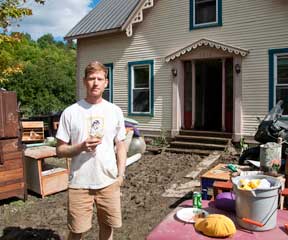
It is difficult not to use the language of hyperbole to describe the water damage that has affected every county of the state. Words like “unbelievable,” “epic,” “unprecedented” and “historic” are a few of the adjectives that Vermonters are using to describe the aftermath of Tropical Storm Irene.
Irene is the worst weather event to hit Vermont in 84 years (since the Flood of 1927). The storm left a trail of destruction that is difficult to comprehend. Though the heavy downpour of six to seven inches that fell on most of Vermont was consistent, the floodwaters that raged in one community or another appeared to be arbitrary.
When Sen. Patrick Leahy and Gov. Peter Shumlin toured the damage by helicopter on Monday, they found that towns just five or 10 miles apart were alternately among the stricken and the spared.
“I’ve not seen anything that has shocked me as much,” Leahy told reporters at the Knapp Airport in Berlin.
Stuck in Rochester without power, cell service or phone

Wanna go to Rochester? Be prepared for a circuitous backroad experience, because it’s not easy to get there from here right now.
If you’re coming down from Warren, take Brook Road into the mountains, make a right on Plunkton Road, bump along the washed out and eroded mountain road for a few miles until it joins up with Route 100 again. Turn left and head south for about two miles until 100 dissolves into nothingness, again, and make a left on North Hollow Road, another mountain road that at points is barely passable by car (Scion sports car). A few miles up make a right on Maston Hill Road, and slowly work your way back down the washed-out, glorified trail of a road until it meets Route 100 in Lower Granville.
Tropical Storm Irene turned this mountain valley village of 1,100 residents into an island. The main roads were washed out, and the village was all but inaccessible.
On Tuesday, a few people from outside Rochester were able to get through, according to Larry Strauss, the selectboard chair.
“I can’t confirm what traffic is getting here, but today there have been vehicles getting through,” Strauss said. “They’re mostly four-wheel drive vehicles going over very rough roads.”Wanna go to Rochester? Be prepared for a circuitous backroad experience, because it’s not easy to get there from here right now.
One month after Irene: A remarkable turnaround, and a long road ahead

If God helps those who helps themselves, Vermonters should be first in line for heavenly handouts (or at least disaster assistance from the feds).
The state’s residents, known for being a hardy lot, have proved their mettle over the last month as they have dug out of the mud, muck and debris left by Tropical Storm Irene.
The storm struck Vermont Aug. 28 and dumped as much as 11 inches of rainfall on the Green Mountains in a 24-hour period. Overnight, the deluge turned small brooks, roads and even open fields into raging rivers of water. The White, Dog and Winooski Rivers and feeder tributaries flooded mountain towns in the state’s interior.
Floodwaters ravaged historic downtowns, destroyed businesses and damaged more than 2,000 houses (more than 120 were completely destroyed).
State highways, bridges and local roads were gutted and in some cases became part of nearby river beds.
Irene’s major casualty: Vermont’s mobile home parks

Piece by soiled and muddy piece, the cozy, comfortable lives of dozens of Vermonters were being disassembled Wednesday at the Weston Mobile Home Park in Berlin.
Chairs and tables. Couches and refrigerators, big-screen televisions and small end tables, throw rugs and oriental rugs, cleaning products, clocks, pots and pans, dining room chairs and kitchen utensils, radios and bicycles — all the things that make a home a home headed into the Dumpster, along with large piles of crumbled sheetrock, batts of pink fiberglass insulation, wooden framing studs and damaged siding and particleboard.
For some of the poorest and most vulnerable Vermonters, this is the scene some two weeks after Tropical Storm Irene swamped the state.
Vermont municipalities rack up $12.26 million in damages to structures – so far

About 31 municipalities were reporting damage to town-owned property last week as a result of the floodwaters from Tropical Storm Irene that scoured low-lying areas in central and southern Vermont.
Steve Jeffrey, executive director of the Vermont League of Cities and Towns, said his office, which provides insurance, legal and logistical support for the state’s municipalities, is “still counting,” but as of Sept. 6, the rough estimate of the total damage is $12.26 million – so far.
“We’re still trying to reach out to some of these smaller communities,” Jeffrey said. “We started calling a week ago Monday, and we’re finally getting through to the end of line.”
The tally of municipal structures ruined by Irene is staggering: Eleven town offices, six highway garages, seven covered bridges, seven fire stations and five libraries. In addition, damage has been reported to a number of police cruisers, pump stations for sewage treatment plants, dams, swimming pools and water treatment plants, Jeffrey said.
The silver lining? Town-owned infrastructure is covered under insurance through the Vermont League of Cities and Towns. The league has a self-insurance policy with a $1 million deductible that covers all member towns statewide. The policy covers up to $9 million in damages for each town. Jeffrey said towns should be eligible for Federal Emergency Management Agency funding for costs related to structural damage that exceeds that amount.
