

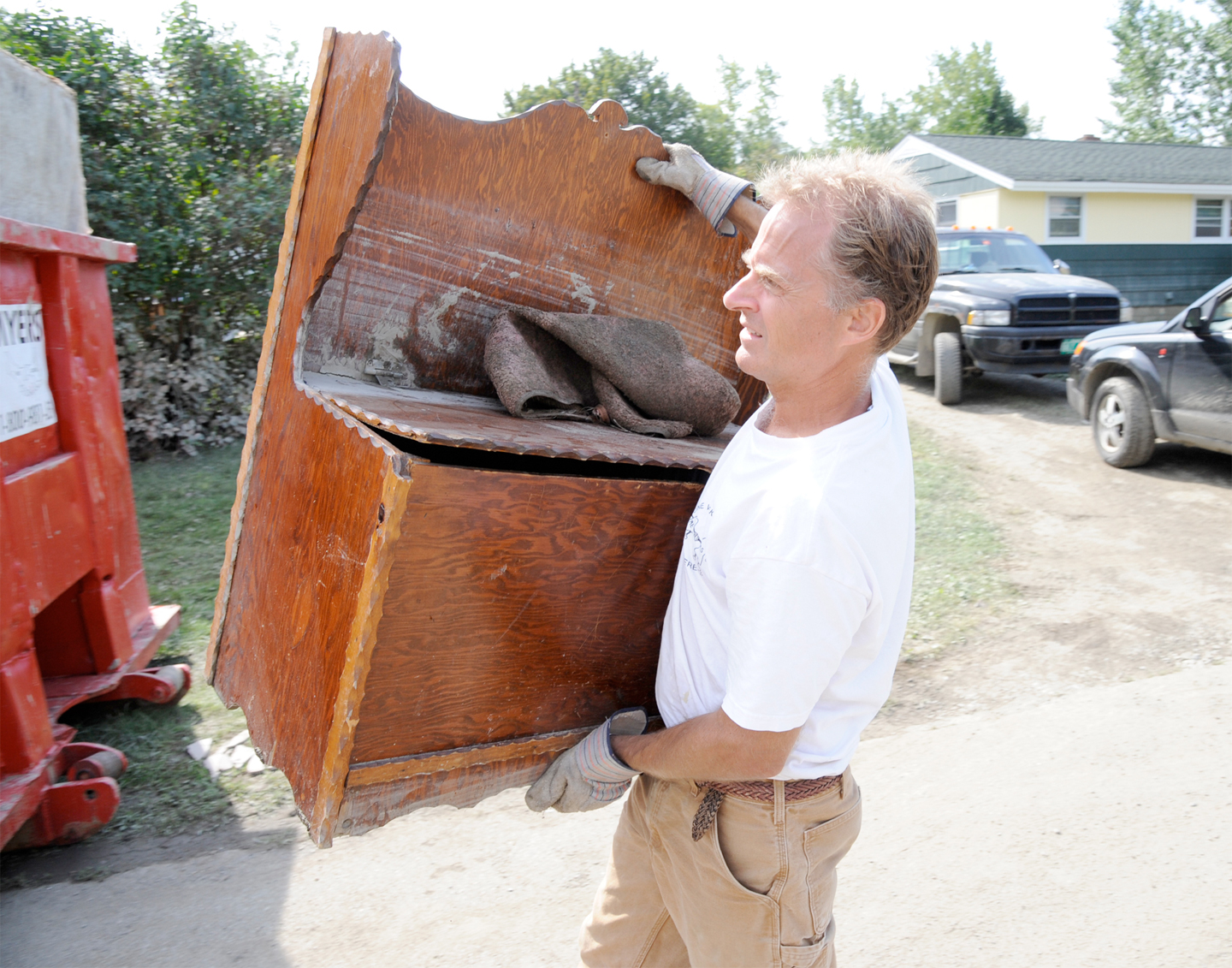
A minister worries about his community as winter arrives and Waterbury residents struggle post-Irene with debt and unmet needs
A week ago, the Rev. Peter Plagge ascended the altar of the Waterbury Congregational Church to give his sermon, just as he does each Sunday. This being the holiday season, congregants may have been expecting a homily about peace and joy. But Plagge, a soft-spoken man with an intense gaze, did not have a message of easy cheer. Almost four months after Tropical Storm Irene laid waste to downtown Waterbury, Plagge had a few other thoughts on his mind.
Plagge has had a front-row view of the Irene disaster. Everywhere I went during the first two weeks of the storm – from the food distribution center to the impromptu volunteer coordinating center at St. Leo’s Hall – there was Plagge, sleeves rolled up, quietly and unflappably making things happen and solving problems.
“The word minister means ‘to serve,’ and I try to encourage us all to think of ourselves as ministers,” he tells me. The son of a Michigan surgeon and nurse and a graduate of the University of Chicago Divinity School, Plagge moved to Waterbury in 2000 with his wife, Erin Mooney, and their two daughters to become pastor at the Waterbury Congregational Church.
Plagge’s ministry extends far beyond the pews. As the administrator of the Waterbury Good Neighbor Fund, Plagge has been seeing, hearing and feeling the often invisible struggles of community members. The exhausting work of disaster recovery led Plagge to pose an uncomfortable question that he’s been asking himself in recent weeks: “How can we bear up?”
“It’s hard to hold forth hope,” he confessed to his congregation. “It’s hard to talk about being comforted at this time of year … when the [Christmas] lights come out and we feel a sense that things will be OK.”
“It was feeling to me like that was a long shot, and I just said it,” he tells me. “I expressed what I thought was going through a lot of people’s hearts and minds.” Plagge looks relieved and smiles gently as he recounts the experience, and suggests that others would benefit from sharing their emotions about the storm and its aftermath. “It felt good to just sort of say it. To say I’m tired, to say I really don’t want to do this anymore. But we’ll carry on.”
Part of the weight that Plagge bears is that the 30-year old Good Neighbor Fund is nearly exhausted. “There are great needs relating to heating aid, and there is a constant line of people waiting to speak to me. People are feeling the stress and strain of the last three months just kind of crushing them.”
Plagge worries about unmet needs. Recently, he visited a man in his flooded home and noticed mold growing on the walls and river slime still on the floor. The minister suspects the man was living out of his truck, which was full of junk food. “That took my breath away,” he says.
Plagge tells me that he is “hearing people talk about a $25,000–30,000 gap between what they are getting from insurance and what it is actually costing them. People have burned through all their savings. And now winter is coming. It would be pretty nice if I could help them out with their heat.”
I ask him if he worries that the community is feeling compassion fatigue. “I worry about it, but I don’t worry about compassion disappearing. I think we’re pretty dedicated to each other, no matter what.”
Fatigue is something Plagge knows intimately. Last year, Plagge came down with what he thought was the flu. Within a day, he was in the intensive care unit at Fletcher Allen Hospital on the brink of death. He spent nearly three weeks in the hospital, where “extreme measures were used to keep me alive.” He was finally diagnosed with lupus, which now leaves him unable to work much past 6 p.m., and he must moderate his stress.
Plagge and the community to which he ministers has been tested, but his hope is unbowed. He has faith that the community will give him the resources he needs to continue helping.
“Trust in the good graces of this community. They’ve gotten us this far,” he says reassuringly. “We’ll be Waterbury and we’ll be as good as we’ve ever been.”
You can now read David Goodman’s flood stories and hear his WDEV radio specials about Irene on his blog, http://floodstoriesvt.blogspot.com/
