

Maybe the state should increase speeding tickets and penalties for driving under the influence to help fund health care reform.
How about a doughnut tax?
Which is more equitable: an income, a payroll or a property tax?
These were all ideas floating around at the third of the state’s four listening session on health care reform financing. Act 48, the law that sets Vermont on the path toward universal health care, requires the secretary of administration to consult with interested stakeholders to determine the various impacts of different financing sources on the state economy and report back to the Legislature in February. This includes businesses as well as the general public. The state also plans to use some of this data to inform finance system proposals it will introduce in 2013.
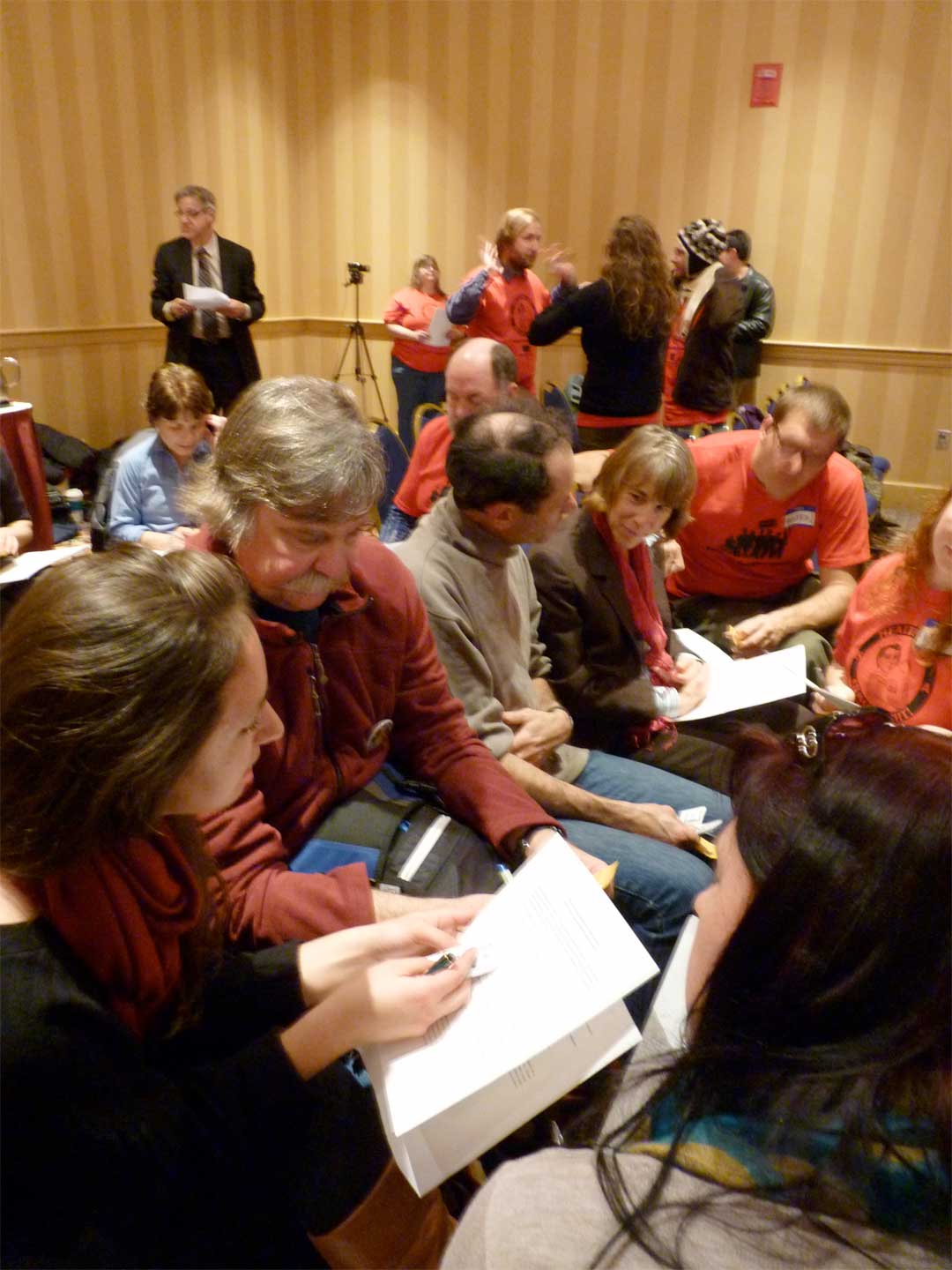
After getting a primer on health care financing, people broke into groups and eventually slipped Monopoly money into boxes labeled with eight different funding mechanisms. People discussed the principles to consider in funding health care that are included in the act. These are principles like equity, stability and affordability.
According to figures from the state Department of Banking, Insurance, Securities and Health Care Administration, the state will spend about $5.3 billion on health care in 2012. That is under the current system, not including covering an additional nearly 200,000 uninsured or underinsured residents. Right now the federal government pays 34 percent of health care costs in the state, according to the Joint Fiscal Office. Employers pay 29 percent and individuals 23 percent.
The Monopoly money is fake, but the issues are real. Is it more equitable to fund something like health care with a payroll tax that does not include unearned income like capital gains? Would a property tax unfairly burden people like farmers who may be land rich but cash poor?
Alma Arteaga, a student at the University of Vermont, was one of about 175 people who attended the Burlington listening session Wednesday.
“I got something out of it,” she said.
Her dollars went part to income tax, part to a consumption tax and part to a payroll tax (with a floor to protect small businesses).
Walter Carpenter, an outspoken proponent of health care reform and volunteer with the Vermont Workers Center, said there were a lot of ideas on the table to pay for a new health care system.
“We need to make it fair, equitable and transparent,” Carpenter said.
With some people who are insured paying $5,000 deductibles and those who can afford it receiving better plans, Carpenter sees an inequality in the current system.
Carpenter said he spread his money around but placed most of it on the income tax.
Dean Corren, a state representative from 1993 to 2000, showed up to pitch some ideas in a listening group. Corren worked on health care reform in the 1990s when efforts at the state and federal level fell short.
“It is inherently a complicated problem,” Corren said. “In attempt to structure and simplify it in a way that would get something done, always possible to oversimplify.”
The principles of financing an equitable, stable and affordable health care system have been debated for decades, and asking people to essentially prioritize them could be problematic, he said.
“The problem is the nature of the system and the nature of solution is that all those principles are critically important,” Corren said. “So what’s the point of having universal health care if it’s financed in an inequitable and unstable way?”
Robin Lunge, Vermont director of health care reform, said the basic idea of the listening sessions is to get a broad sense of people’s preferences, choices and inclinations for paying for a new health care system. She said about 70 people showed up to the first session in Brattleboro and about the same at the second session Tuesday in Rutland.
Lunge says the Monopoly money is by no means scientific, especially with some people coming to multiple sessions, but she said, “I think it will still give us a sense of where the general public is leaning on financing sources, and we’ll use that to inform our analysis.”
Despite the seemingly overwhelming number of members of the Vermont Workers Center, the group that ran the “Health Care is a Human Right Campaign,” at the Burlington event, Lunge said there has been a diversity of opinion.
“A lot of Vermonters are worried about how reform will affect businesses, but they also realize that health care is a big strain on business,” Lunge said. “Then there are individuals who are worried, but they think the way they are paying [for health care] now is not particularly fair.”
The final health care reform financing listening session will be on Jan. 12 at Catamount Arts in St. Johnsbury. It starts at 7 p.m.

