


Editor’s note: This article was first published by the Waterbury Record.”
The smoke is the first thing I see. As I come down Main Street in Duxbury, I see the fire. The half-century old Patterson’s Mobile Home Park is burning.
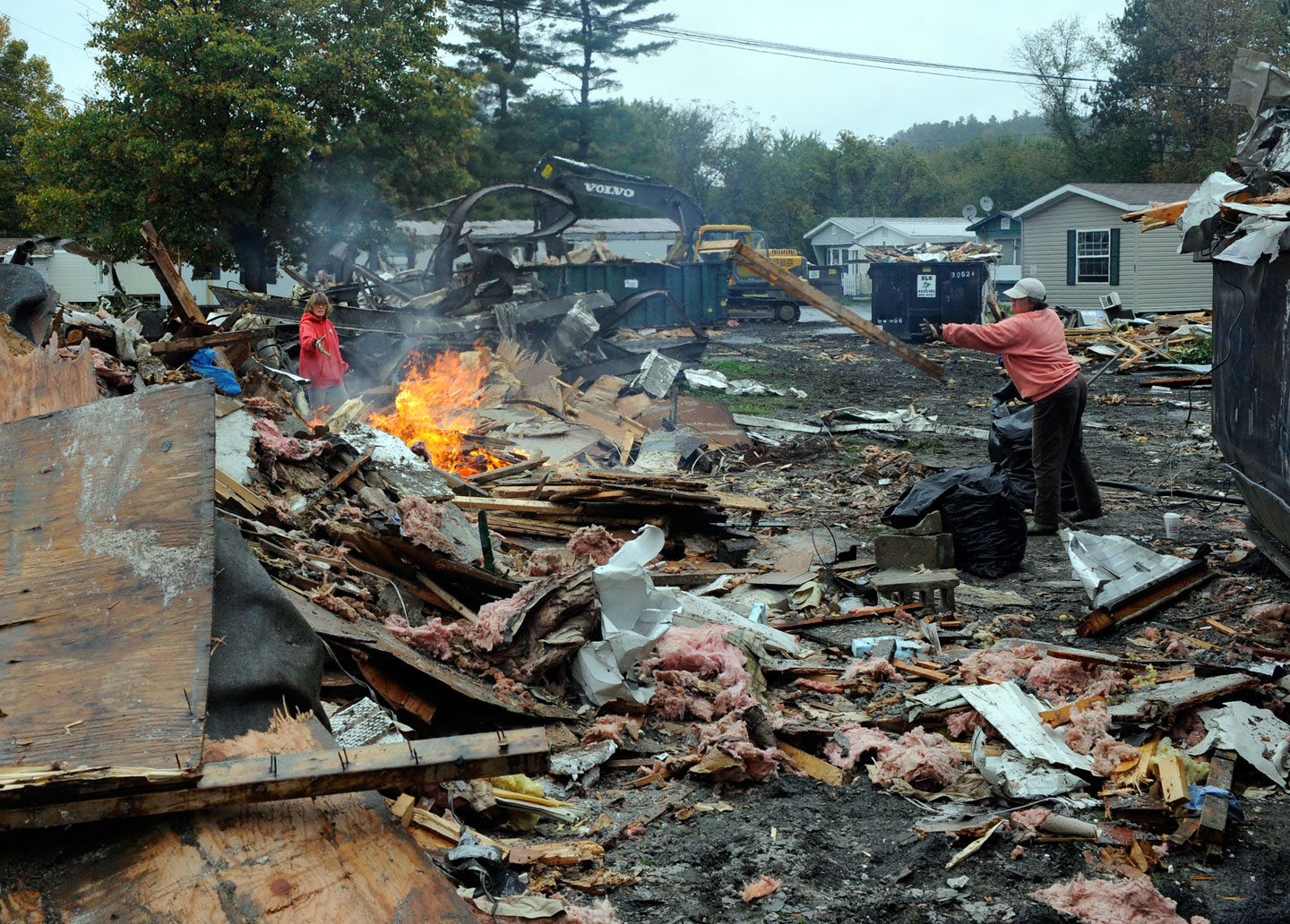
Inside the park, I find about a dozen people working feverishly under a light rain on this early October day. An excavator with a claw prowls the grounds like a predatory animal, tearing off large pieces of a mobile home. It is as if the machine is feeding on the forsaken structures. Entire walls give way with a loud crack, the final submission in a month-long, losing battle to survive.
Joe Preus, 40, is tending a brilliant orange bonfire that roars in the middle of what looks like a battlefield. Friends and relatives move purposefully around him, sorting the debris. Preus, wearing a rain-soaked New England Patriots hoody, feeds the fire by adding broken pieces of lumber. His face is streaked with rain and soot.
“This was our house,” he says, tossing a 2-by-4 into the flames. He explains that they are burning scrap wood in order to free up space in the three Dumpsters that stand nearby, now overflowing with the remains of five mobile homes.
“It’s upsetting,” says Preus, who has lived here nearly five years. “We did all we could to improve this home.”
For Joe’s wife, Kristene Preus, 37, owning her own mobile home was a dream. “I had no mortgage. I owned my own home,” she tells me proudly. As she speaks, she piles the remains of her shattered home into a heap. “I cried watching it go.”
Taking a direct hit
When Tropical Storm Irene tore through central Vermont on Aug. 28, Patterson Park took a direct hit. The Winooski River, which borders one end of the park, overflowed its banks and inundated all 19 mobile homes here. In desperation, neighbors in the mobile home park helped one another to flee the rising waters, and park manager Ed Patterson rescued a number of residents in his canoe. Many had less than 15 minutes to escape.
Patterson Park was built in 1957 “to accommodate the highway workers,” recounts Ramona Patterson, 86, the park’s namesake and owner. She says that the men who were constructing Interstate 89 had no place to live, “so my husband started digging and we put in a trailer park.”
Her house, which stands at the entrance to the park, was also flooded, and is now being gutted and put back together by her sons, Ed, Dave and Dick. Before opening the mobile home park, the Pattersons used the land to cultivate yellow beans that they sold to the Demeritt Cannery, which was located off South Main Street in Waterbury.
Patterson Park has survived blizzards and downpours. But Tropical Storm Irene unleashed unprecedented destruction. As I walk among the 19 empty homes, I step across soft warped floors and peer out open windows. A musty sea smell hangs in the air, and doors swing lazily in the breeze.
The roughly 35 residents have taken whatever of their possessions survived the frantic flight that night. The once tight community has now scattered, with residents finding temporary shelter with friends, family and in apartments throughout central Vermont. Many residents tell me that rent in their new locations is double or triple what it was in Patterson Park, pushing them ever closer to the financial brink.
The home demolition is a desperate way to save money. Many Patterson Park residents say they don’t have the $1,500 that it costs to dispose of a mobile home [see Author’s Note for update on this]. So Mike Lavigne, a heavy equipment operator who lives in the park, borrowed an excavator for the weekend and offered to tear down five mobile homes that belonged to him, his family and a neighbor.
It is a cruel twist that this community, already reeling and traumatized, must now wield the final death blow to their own homes.
Susan Lavigne, a seven-year resident of Patterson Park, is pulling out pieces of wood from the 10-foot high mountain of debris and throwing it into the fire. She pauses to wipe the rain from her round glasses and the soot from her face. “This is very, very hard. A lot of hard work went into this place,” she says, motioning to where her mobile home once stood. “I had top-of-the-line appliances. I had a brand new kitchen that my daughter and son gave me. Now it’s all in the Dumpster.”
Her daughter, Teresa Haskins, has just arrived from distributing clothing to other flood victims. Teresa hands out new Carhartt work gloves, donated by Lenny’s, to her mother and relatives. It’s a small act of kindness amid the misery.
Lavigne reflects: “We figured this would be our home forever. So we put a lot of money into it. And we lost it all in an hour.”
Mobile homes vulnerable
Mobile homes were especially hard hit by Tropical Storm Irene. Fourteen mobile home parks around Vermont were impacted, with five of them losing more than half their homes.
Our intentions are to reopen the trailer park. We haven’t received anything from anybody about the things we need to do before we can reopen.”
– Dick Patterson
Patterson Park is among the most devastated in the state, along with Whalley Park in Waterbury, which was also wiped out. Gov. Peter Shumlin visited Patterson Park shortly after the storm. “For a few days there, we didn’t think people even knew about us,” Mike Lavigne told the governor.
“We’re here for you,” Shumlin replied. “We’ll get through this together.”
Jennifer Hollar, deputy commissioner of the Department of Housing and Community Affairs and chair of the Irene Housing Task Force, explains that “mobile home parks are often located in low- lying areas, which makes them vulnerable.” She notes that mobile homes “can’t recover from water damage very well. It’s easy for mold to set in, so they are very difficult to fix or restore.”
Hollar adds, “It is often lower income folks who live in the parks, which makes it even more of a challenge for them to recover, and all the more heartbreaking.”
The devastation in the mobile home parks has highlighted and exacerbated the affordable housing shortage in the area. “More affordable housing was needed in the Waterbury and Duxbury area even before the flood,” notes Hollar. “It’s been difficult for folks to find alternative housing because there aren’t a lot of options within their own community.”
Vermont has one of the tightest rental housing markets in the country. Vermonters pay, on average, the 15th highest rents in the country, according to the National Low Income Housing Coalition. The state’s rental vacancy rate is about 3.5 percent. Experts consider a 5 percent vacancy rate to be the minimum level for sustaining a healthy rental market. Waterbury has only 54 affordable housing units, of which about half are reserved for elderly tenants.
Hollar notes, “There are many empty apartments or housing options for folks within a 25-mile commuting distance of Waterbury. But some people, because of lack of transportation or because they aren’t ready to leave their community, don’t feel like that’s a good option for them.”
“We are concerned that people are staying in campers or doubling up with family,” Hollar says. “That’s not going to work long term.”
State officials insist that housing and financial assistance are available to flood victims, but they must register with FEMA by Nov. 15 to qualify. “FEMA can provide them with rental assistance to help pay for an apartment, or in a pinch motels, until they can locate a better situation,” says Hollar.
FEMA assistance can be as high as $30,200. Reimbursements for mobile homes that have been totaled in the flood, however, are almost always much less because the structures depreciate in value.
Hollar notes that FEMA has already placed hundreds of people in homes and paid out over $15 million in housing assistance to Vermonters. If a housing placement is not working, flood victims can call FEMA back to seek further assistance. Hollar cautions that people should not tear down their homes until their FEMA settlement – including appeals – is finalized.
Moving on
The destruction of Patterson Park has left its residents and owners in limbo.
Kris Preus, who cleans houses in Stowe, is now staying in one of the vacation homes that she cleans. Her client has told her she can stay through the holidays if necessary; the homeowner offered to spend Thanksgiving elsewhere, if necessary. So Kris and eight members of her extended family are now staying temporarily in a palatial seven-bedroom, five-bath home, and paying a nominal rent.
Preus says she is grateful for the soft landing, but is still unsettled. “It’s really nice. But it’s not my home,” she tells me.
Tracy Towne and her family have moved from Patterson Park to an apartment on Butler Street in Waterbury. They have gone from paying $370 per month at Patterson Park, to paying an apartment rental of over $1,300 per month. The rent increase is an enormous strain.
The multiple traumas of the flood and the ongoing dislocation have been extremely stressful for some residents. One local volunteer helping people find temporary housing confided, “I feel like some people are starting to lose their sanity.”
“It’s really emotional,” concedes Towne, as she watches her home being destroyed. She motions to her 9-year-old son. “We moved here when Dylan was 1 year old. I felt safe, because I knew that people here were watching him. Everyone here was part of his family.”
Dylan Towne stares into the bright orange flames. I ask him how he’s feeling. “Sad,” says the soft-spoken fourth-grader at Thatcher Brook Primary School. “I’m gonna miss my house. I lost my stuffed animals, and I had a big Matchbox car collection that got lost, too.”
Ramona Patterson, the matriarch of the mobile home park, peers out a dusty window in the back of her house at the destruction going on outside. Then she vanishes, retreating inside. “It was heartbreaking,” she tells me later. “I couldn’t stand to watch it.”
The Pattersons are determined to carry on. “Our intentions are to reopen the trailer park,” says Dick Patterson. His family is thinking of opening a downsized park of just nine mobile homes next spring, but he is unsure how to proceed. “We haven’t received anything from anybody about the things we need to do before we can reopen.”
Patterson, tired from the grueling pace of helping his mother and park’s residents recover from the calamity, reflects, “It’s gonna be a lot of work to bring it back, to be sure.”
Author’s note: On Oct. 20, after these Patterson Park residents demolished their own homes, the state announced that it had secured funding to remove damaged mobile homes for free.
The day after this article was first published in the Waterbury Record, a man showed up in the principal’s office at Thatcher Brook Primary School in Waterbury. He handed a box to principal Don Schneider.
“This is for the kid who lost all his toys who was in the newspaper,” said the man. Inside the box was a collection of shiny new Matchbox cars. Schneider asked the man his name, and asked if he would like to personally give it to Dylan Towne.
“That’s not necessary,” said the man. “Just tell him it’s from a friend.”
