




Their frustration was palpable, their stories heart-wrenching, and their concerns numerous.
But the hardest thing facing mobile home owners flooded out by Tropical Storm Irene, judging from a meeting at the Old Labor Hall in Barre Wednesday evening, is that they feel “abandoned” while the rest of the state moves on with recovery.
“We have a right to housing and dignified lives like everyone else,” declared Sandy Gaffney, one of over 70 residents of Weston Mobile Home park in Berlin who were dislocated by the Aug. 28 storm.
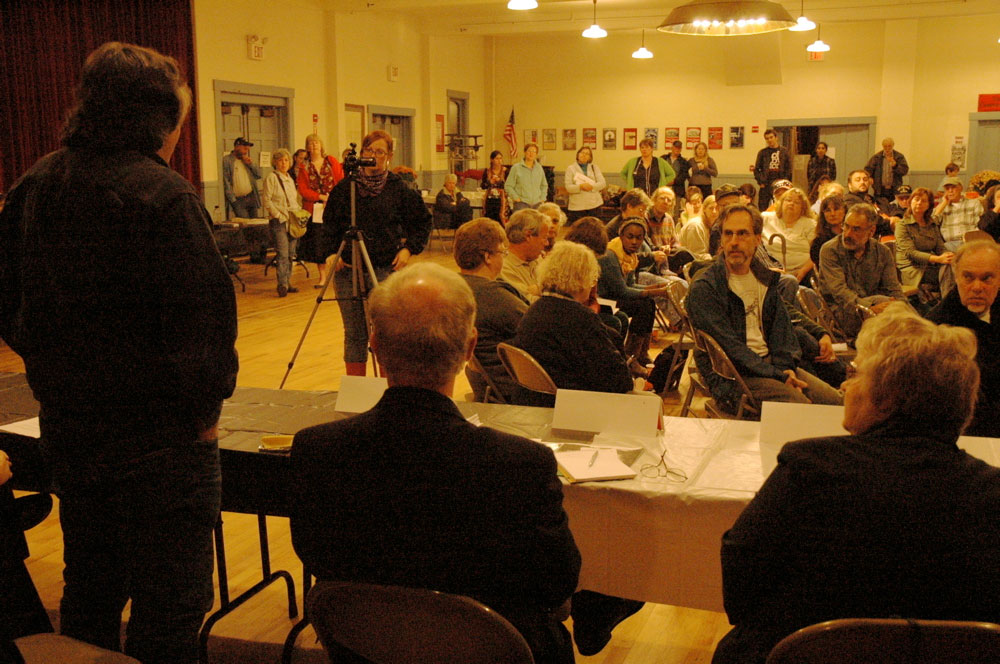
Around 40 flooded-out mobile home residents gathered with advocates, legislators and local and state officials Wednesday to detail their dire housing and financial situation and urge help for those Vermonters “least able to deal with the disaster,” as Gaffney put it. Many wore T-shirts that said: “We are survivors of Irene 2011.”
Gaffney, who “lost everything” in the flood, moderated as members of a new organization called Mobile Home Residents for Equality and Fairness told their stories. The group also discussed whether to hold “a demonstration encampment outside the governor’s office” this Saturday if action isn’t taken to help with the many challenges they face.
Thanks to an important, and rare, bit of good news, that demonstration was canceled.
The news — which brought rousing applause — was that statewide funding to remove their destroyed mobile homes at no cost has been secured and work will begin next week, said Shaun Gilpin, a mobile home advocate and organizer with Champlain Valley Office of Economic Opportunity, who has been doing yeoman work on the removal issue.
More than any other housing group, mobile homeowners have been whipsawed by the damage from Irene, and the home disposal issue has been a major problem. Living on fixed income and without major savings, many could not afford to dispose of their damaged homes, which the state estimates averages around $3,500.
They also faced the prospect of paying rent for their lots starting in November if they did not remove their uninhabitable homes.
Meanwhile, FEMA grants to mobile homes have been averaging $5,000-$10,000, often far less than their value, leaving many mobile home owners in a financial squeeze especially tough for low-income residents who have lost everything.
According to figures issued Monday by the Department of Economic, Housing and Community Development, more than 433 mobile homes were damaged or destroyed in 15 mobile home parks around the state.
Gilpin said that a plan developed by Lt. Gov. Phil Scott and the Vermont Agency of Commerce, working with the Vermont Community Foundation, has successfully raised $145,000 and hopes to boost that amount to $200,000 for the removal program.
“The fund raising for this project has been far beyond what I expected,” he said, admitting that the delays and confusion over how to accomplish the task have also been far beyond what was anticipated.
The plan, announced weeks ago, initially had hoped to use economies of scale to bring the cost of removal down to $1,500. Wednesday, Gilpin said it would cost “zero” and that crews are ready to go. Beginning Monday, they will start checking residents’ paperwork and marking homes at Weston Mobile Home Park.
“We want to get this going as soon as possible,” he said, noting that Weston will be the trial run for how it’s done in other parks in the state.
The stories residents told Wednesday repeated common themes about the difficulty of finding affordable housing and the emotional and financial damage experienced by residents of the parks.
Glen French, 66, a retired mechanic for the city of Montpelier, was typical of the Weston residents.. He and his wife, Donna, paid $320 a month for their mobile home lot and now face a tough situation trying to find housing.
“I lost everything, I’m starting from scratch,” he said. Flood insurance paid off the mortgage on his mobile home, but it will take all their savings to buy a double-wide they are now living in in Berlin. “This is making us feel very anxious,” he said. “Some days it makes it hard to function as we should.” Often, he added, his wife is in tears.
Another Weston resident, John Ashford, said he is living in a motel in Barre at a cost of $2,400 a month and has now spent $5,000 of the money he got from FEMA. He had put money into remodeling his mobile home last November but got nothing for the work or the contents in the FEMA payment.
He called rents in the area “outrageous” and said he didn’t know where he would end up.
“I loved my home, and now I am homeless, me and my son,” he said. “We’re down now to eating one meal a day,” he said.
Winter is coming. We need professional help. We need some money.”
– Mary Durland
Mary Durland told how her home suffered the same fate in Brattleboro’s Glen Mobile Home Park, where two thirds of the 33 homes were damaged or destroyed by normally placid Whetstone Brook.
They were buoyed when college students and volunteers came to muck out the park, but then efforts to clean up were halted because of concerns there was asbestos and lead in the park. She said residents are now “stopped cold” in cleanup and renovation efforts, and the emotional toll among residents has been dramatic: Two strokes, one heart attack, a nervous breakdown and a hospitalization for pneumonia.
“Winter is coming,” she said. “We need professional help. We need some money.”
“We’ve been pretty much abandoned,” she said.
Many of the mobile home residents at the meeting Wednesday were looking beyond the disaster of Irene to mobilize for more affordable housing for low-income Vermonters, also contending they are being ignored.
Carol Perry, one of the lucky ones whose Glen Park mobile home survived, said it was time to organize to bring their voices to the Statehouse. She noted many residents worked hard all their lives but retired with only Social Security for income and can’t afford housing today in Vermont, a situation she called “degrading.”
“We need help. All of us need help,” she said.
Sen. Anthony Pollina, D-Washington, won applause when he said those who earn low incomes have not just a right to decent housing but a decent wage so they can afford housing.
Rep. Helen Head, D-South Burlington, who chairs the legislative committee that oversees housing, told the gathering her panel was open to ideas on affordable housing and will work on the issue, which has gained considerable traction as a result of Irene’s devastation to the state’s housing stock. Her panel spent all of Monday at a hearing on housing issues that stem from Irene.
Tracey Towne, who lost her home in Patterson’s Mobile Home park in Duxbury, urged lawmakers and officials not to forget low-income Vermonters’ needs. Forced now to pay three times as much rent — $700 more a month — she said she has no idea how she’s going to afford the cost.
Don’t assume, she said, because Vermonters like her have a roof over their head now after Irene, things are fine. “It may look like we are OK, but we are definitely not OK.”
