

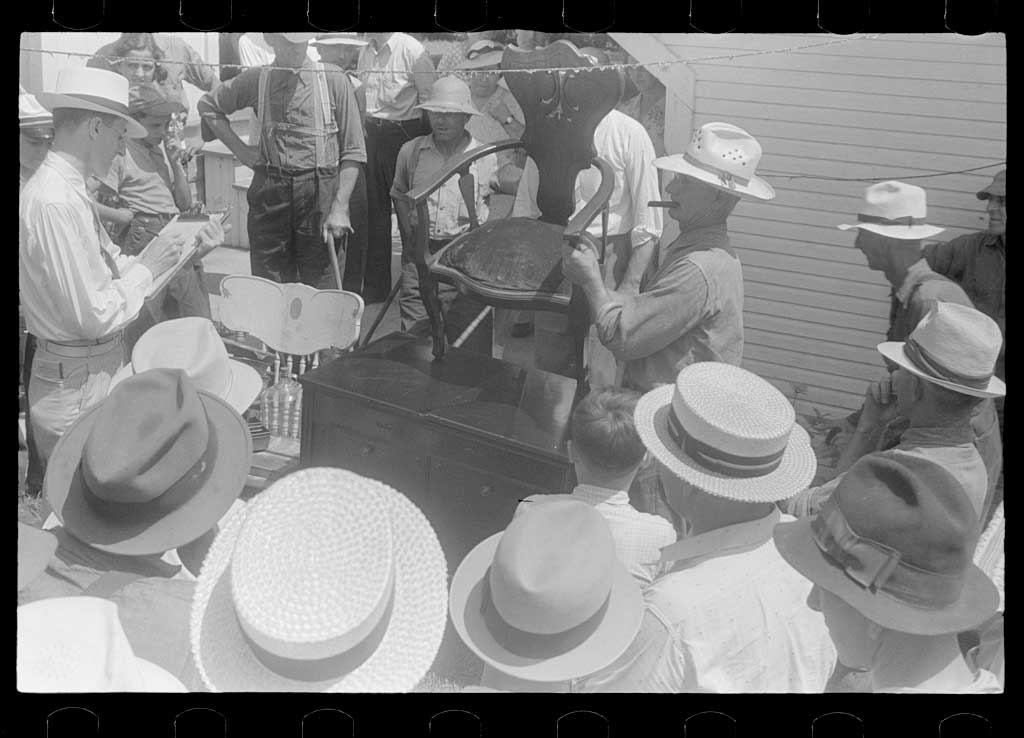
For decades, the green and white auctioneer’s tent and the sing-song chant and bang of the gavel were a signpost of foliage season as much as Vermont hillsides decked in bright orange and red.
Today, they’re going, going, gone.
Gone to eBay, Craigslist and online-auction sites. Gone to changing demographics, changing tastes, a changed economy and more elaborate auction regulations. And with the foliage auction’s demise, one more tasty slice of Vermont life is missing that hints at how the state itself has changed.
“I think the old-time auction, that’s an era that’s gone, that’s over with,” says Richard Woodard, 68, who did auctions for three decades in the Stowe area and owns Sir Richard’s Antiques on Route 100 in Waterbury Center.
Like many veteran auctioneers, he remembers well the heydays of the 1970s and 1980s when auctioneers set up their tents all around the state to sell oak hutches and mission furniture, roll-top desks, antique signs and tools and milk cans, lawn tractors and La-Z-Boy recliners, bentwood rockers, old storm windows and innumerable box lots filled with junk and treasures, the line dividing them as thin as an old Sorel bootliner (and dependent on the eye of the beholder — or box holder.)
“It used to be there were eight, 10 auctions on a weekend,” said Woodard. In fact, he got his start by going to an auction in 1978 and thinking, “that’s something I’d like to do.”
“The problem today with auctions is you can’t generate enough money out of the average house,” he says. Back in the 1970s, if you got $5,000-$10,000 out of an auction, you’d figure you were doing pretty good, he explains. Today, it’s an entirely different world, with all the costs much higher, from media advertising to insurance and liability and the costs of getting an auctioneer’s license from the Vermont secretary of state’s office.
“In the old days, you’d go in and pay like $150,” he says, and just about anyone with a gift of gab and an eagle eye — or perhaps a swindler’s eye — could get a license and get into the business. Today, under Vermont’s professional rules, you’d have to get 40 hours of apprentice training, pay a $100 application fee and $200 for a two-year license, just for starters. A tent can cost $10,000-$20,000; there’s handlers and staff to hire, and the list goes on.
But that’s just the beginning of what brought about the end of auctions as we knew them, says Tom Hirchak, whose Morrisville and Burlington auction company has adapted, grown and thrived with the evolution of the business.
Hirchak, now 69, has been running auctions for 33 years, and he is a former president of the Vermont Auctioneers Association. He’s had a front-row seat for the sea change in the business and tradition.
Vermont used to have hundreds of auctioneers, though he guesses about 90 percent were part-time. They were real, sometimes legendary, characters, who wore derby hats, spewed forth one-liners and wisecracks, and entertained as they sold everything from crap to collectibles, heirlooms to the ordinary, coaxing bidders in the crowd to value it all.
“The whole business has changed so dramatically,” says Duane Merrill, of Milton, another longtime auctioneer known for his high-end estate, art and other auctions. He recalls 400-500 auctioneers at any one time, selling everything from cattle to consignments and heavy equipment, most of them doing it as a fun and lucrative sideline.
“There was even one guy who was an undertaker, a Realtor and auctioneer,” he says (a combo that makes a lot of business sense in some ways, when you think about it).
Today, the secretary of state’s list of licensed Vermont auctioneers numbers around 170, and many are out of state.
Times have simply changed, says Hirchak. Besides auctions migrating on line, Hirchak says demographics have changed the market.
We’re selling live to literally anywhere in the world. The world is very small today in terms of reaching customers if you work at it.”
– Duane Merrill
“Young kids don’t buy old stuff to fill their houses,” he says, and the market is soft for all but highly valued antiques, making most country auctions just “not cost-effective.”
The economy hasn’t helped, either. Hirchak says some once-valuable items have seen bid prices drop 50 percent, even 90 percent, such as marble-top dressers. Merrill echoes that sentiment, calling the changes in the Americana market something he’s “never seen in his lifetime.”
He cites a Chippendale chest that today will only get half of the $5,000 it would have years ago. He surmises that the World War II generation and those who grew up in the 1950s had more connection to early American furniture of their grand parents and thus valued it more than the current generations.
Hirchak, who is well-known for his cars and real estate auctions, says he’ll still do some big estates, but in many cases, he goes with the flow. Which means? “We tell people to put stuff on Craigslist or eBay,” he says.
His company held 200 auctions last year but the auctions are specialized, featuring attractions such as classic cars or “high-powered coins.” Hirchak has also learned how to use the Internet to dramatically spread his reach, with auctions simultaneously offering live bidding by phone, Web and on-site. At one classic car auction, “we had two cars that ended up going to New Zealand,” he said. At another, a truck was bought by a buyer in Mexico.
Adding Internet bidding requires more detailed descriptions, photos and vetting of material to protect his reputation, but it certainly works, he says.
“That’s something we’re going to be doing more of,” he says.
Merrill, who emptied many an old farmhouse and city house of its lifetime accumulations, misses the thrill of the auction tent scene and especially of being invited to explore attics where you never know what you’ll find for the auction catalog. He’s found historic maps and documents dating back to Colonial times that made him feel like “a kid at Christmas.”
“It’s an exciting business, I was raised in it,” he says, noting his father was “kind of a natural historian who bought his first antique in 1917” and in 1938 opened an antique shop in Williston on Route 2.
But like Hirchak, he’s adapted and today finds a different kind of lucrative excitement in a wired world, working with two sons auctioning everything from guns and dolls to buttons and ephemera (maps, postcards, paper goods) along with an occasional landmark estate.
“We’re selling live to literally anywhere in the world,” he says, citing a list that contains 700 online bidders in 25 countries.
“The world is very small today in terms of reaching customers if you work at it,” he says.
Fortunately, the attic surprises keep coming — just collected from many houses, not one at a time. And the bids keep coming, too. An antique cup made from rhinoceros horn drew a bid from China of $30,000, he says. A Russian painting found in a house in Grand Isle was snapped up for a stunning $340,000, he says.
The auction tents sprouting up in the countryside under blazing maple leaves may be gone, and along with it the crowds and the camper van selling coffee, doughnuts and hot dogs until the last item is sold, but in the virtual world, the auction business goes on.
“We’re the oldest recyclers in the world,” says Merrill, then showing he hasn’t lost his auctioneer’s touch of humor: “We’re also the second-oldest profession.”

