


Thanks to Tropical Storm Irene, Waterbury Municipal Manager William Shepeluk’s office these days is a cluttered, noisy former grade-school classroom where he works elbow to elbow amidst a tangle of computer wires with half a dozen staffers.
Lawrence Sayah’s home is now a construction zone, its interior stripped and gutted as he labors to restore his once-elegant house on badly flooded Randall Street.
As for Green Mountain Coffee Roaster’s handsome historic railroad building cafe, it’s a piece of unintentional irony: A big “Welcome” banner blocks the entrance, noting underneath that the cafe is undergoing flood renovations.
A month after Irene delivered one of its harshest blows to the village of Waterbury, swamping many homes and businesses and forcing evacuation of a massive state complex that was home to more than 1,500 state workers, signs of closure and upheaval, renovation and reconstruction, are everywhere.
What separates this town on Route 2 about 10 miles north of the state capital from every other town where Irene upended life and property is that here, many worry the worst blow is yet to come: That state employees may not come back.
That prospect, which could drain economic lifeblood from the historic village center and cause long-term disruption to the lives of state workers, has prompted a flurry of action by lawmakers from Washington County where many of those workers live.
Reps. Tony Klein, D-East Montpelier, Janet Ancel, D-Calais, and two Waterbury Democrats, Rebecca Ellis and Tom Stevens, have written Gov. Peter Shumlin a letter that urges that any decision on the state offices strongly consider the importance of those workers to the Waterbury economy.
Klein said Thursday that House Speaker Shap Smith has also agreed to the idea of calling a meeting to brief all legislators from Washington and Lamoille Counties, where most of the displaced state workers live.
A downtown and state workforce at risk
Klein said besides the economic implications for Waterbury, he wants to make sure the state considers the potential harmful impacts to productivity, communications and morale for already down-sized state workers if state agencies whose departments were housed together at Waterbury end up being “fractured” and housed in different towns.
Klein acknowledged there are “serious and expensive decisions” to be made about whether it’s a good idea to rebuild in Waterbury in a flood-prone area. He said the lawmakers simple message is: “Please think about everything. We’re not criticizing anything you’re doing.”
Meanwhile, the Waterbury Selectboard has voted to allocate up to $25,000 to hire lobbying help to advocate for reopening the state complex.
“Everybody I talk to talks about the state office building,” said Rep. Ellis, who is also chairwoman of the local selectboard. “This is a critical juncture in the history of Waterbury,” she told the Burlington Free Press.
According to Ellis, KSE Partners in Montpelier has been hired for $3,000 to do a 14-day media push to make the case that the bulk of state government offices should remain in Waterbury.
MacLean, Meehan & Rice, another Montpelier lobbying firm, will be paid $2,500 for a month.
Ancel said the letter wasn’t aimed at pressuring the administration of Gov. Peter Shumlin, which she acknowledged has its hands full with disaster recovery issues.
“They have a lot of things to weigh,” said Ancel. “This is just our statement to keep the concerns of the town of Waterbury and state employees in mind,” she said.
Ancel once lived in Waterbury and worked at the Vermont State Hospital as a social worker and in the Human Services Agency there. She said she feels the anxiety of those in town at seeing the complex empty and cordoned off with Jersey barriers and yellow police tape.
“I can understand why people feel emotional about it,” she said.
No one feels that anxiety more than Shepeluk, who confronts daily the fiscal, economic and social impact of the closure of state offices on his town. Like everyone else, he wonders, will it reopen?
“That is the biggest long-term issue we are dealing with,” he said. “Moving away all the state employees is a huge concern.”
Stabilizing buildings
State officials are currently “stabilizing” the office complex to the tune of $20 million-$25 million to protect the state’s investment in the buildings and the State Hospital also at the complex. They have said it will be months before any decision is made whether to renovate and restore the complex, sell to private investors or do some mix of both. No cost figures for any option are available so far. Built around the 1900s, many of the office buildings are considered historic, which may complicate restoration efforts.
Tom Sandretto, deputy commissioner of Buildings and General Services, said Thursday that 161 state employees will be back into the two least-damaged offices by Monday, the public safety offices and forensics lab. The state has been finding leased or other state office space for the remaining state employees all around the northern tier of Vermont.
While he doesn’t have firm dollar numbers, removing well over 1,000 people from the town is a giant hit, said Shepeluk.
“All I can tell you is that it’s a huge component of the local economy,” he said. He figures there are approximately 4,000 jobs in the local economy, so roughly a third are now lost to the region. But that’s just the start of the impact.
Tax base and budget impacts
He said he wouldn’t be surprised if tax delinquencies double or more. There’s also a long delay before FEMA or other funds will reimburse the town for expenses incurred, such as $135,000 for removal of massive piles of sodden damaged belongings and equipment after Irene. The town is likely also going to face a deficit.
“Property taxes is a big concern of mine,” he added, noting 210 buildings in town were affected. These run from the Northfield Savings Bank to the popular Alchemist brewpub and the town and police offices, where an oil tank overturned in the basement, adding to the difficulty of cleaning up the structure. Almost three dozen private homes on Randall Street near the state offices and the entire Whalley Trailer Park beside the I-89 off ramp to Route 2 were flooded as well.
In all, Shepeluk said 70 families in town were still homeless and many of those may not be able to move in for a long period, which worries him as much as the state office situation.
Lawrence Sayah, 72, is one of those displaced from Randall Street, where the waters surprised him on the night of Aug. 28.
“I’ve watched the water come up time and again like it did that night,” he said. Only this time, it didn’t stop short of his house. In 20 minutes he said it rose three feet and poured into his house, just lapping at the bottom of the windows in the handsome 1912 structure.
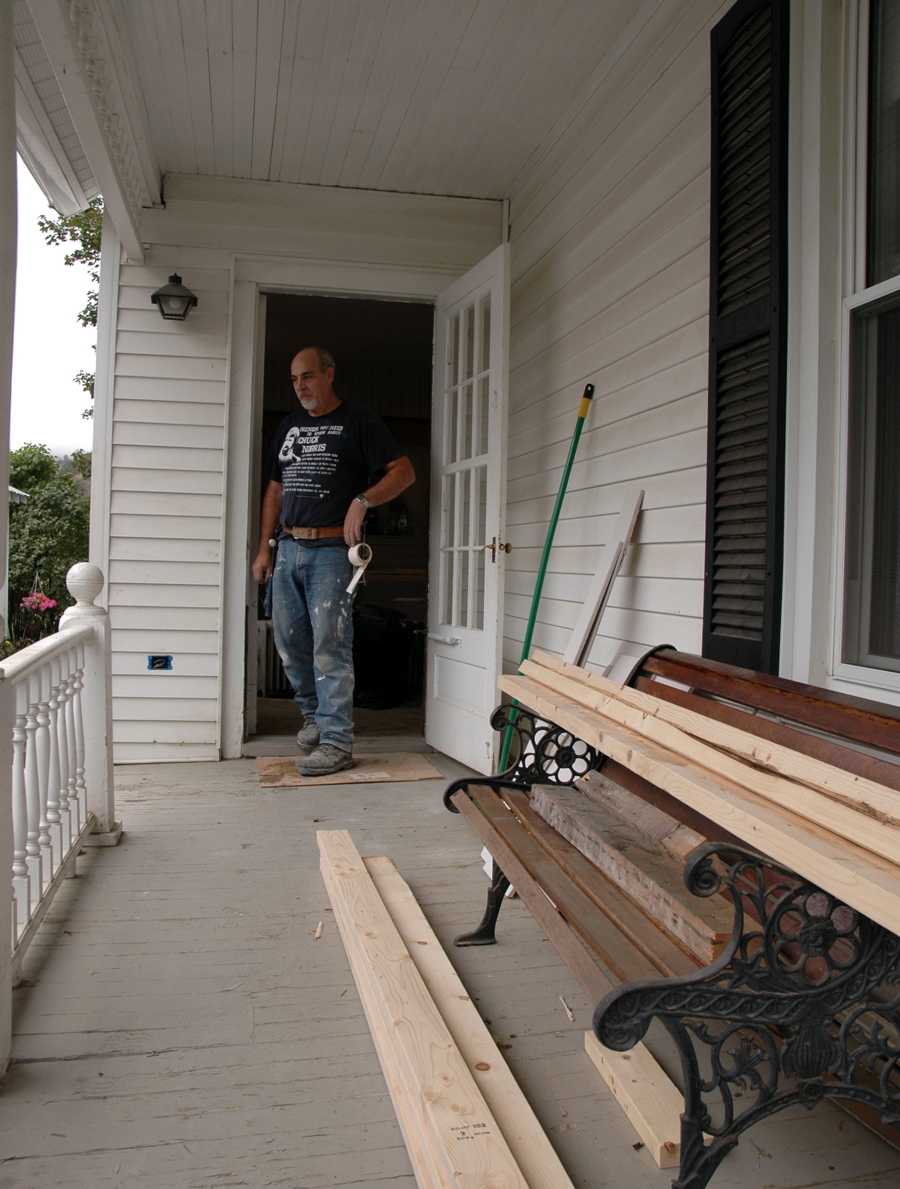
Inside, he wanders around a house partially gutted and exposed inside now, the old plaster and lath removed, as were the lovely hardwood floors and everything in the basement, which was filled with several inches of mud.
“I retired and thought I’d have nothing to do,” he quips, his sense of humor undaunted by the task ahead of him.
He and his wife are living in Waterbury Center with family and he considers himself in far better shape than others. The house is salvageable, he’s getting some money from FEMA, and the repair costs are manageable, around $50,000, he thinks.
He was planning to replace the plaster one day anyway, he said: “It was my retirement project. I didn’t think it was going to happen in such a hurry.”
Rep. Klein said the state is in a tough spot having to hurry to try and provide some clarity for state employees, the town of Waterbury and its hard-hit business owners, who may be wondering about reinvesting.
“I think the decision, whatever it is, needs to be made rather quickly,” he said. “Sooner rather than later.”

