

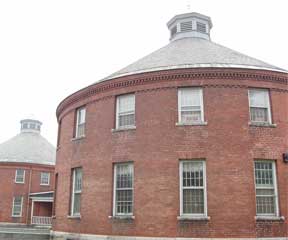
Does it make sense to pour $1 million in federal dollars into renovating a vacant, flood-damaged state office complex in Waterbury?
That’s what the state of Vermont is doing this fall, despite the fact the future of the Waterbury office complex is up in the air as the state evaluates whether it will be used again to house nearly 1,600 state workers.
“The project is fitting in with the mission that we have to preserve the buildings,” said Tom Sandretto, deputy commissioner of the Buildings and General Services Department.
The red brick buildings in the state office complex were built around the turn of the 19th century to house around 2,000 mentally ill patients. In the 1970s and early 1980s, as the state was deinstitutionalizing patients from the State Hospital, Vermont began converting unused space to house and consolidate agencies of state government.
The state sought federal stimulus funding from the federal government after the recession took hold and won $1 million to replace windows and add insulation to lower the cost of maintaining the complex.
That project was ongoing when the flooding from Tropical Storm Irene hit, displacing 1,586 state employees assigned to work at the office complex, which housed the large agencies of Human Services and Natural Resources, as well as corrections and public safety staff, workers employed in the forensics and agriculture labs and some other smaller departments.
Administration Secretary Jeb Spaulding has said the state will not make a decision on the future of the complex until the Legislature convenes in January.
In the interim, the state is investing money to restore basic infrastructure such as power, heat, sewer and water to preserve its options as Vermont heads into winter. And it is continuing with the major energy efficiency upgrade, Sandretto said.
Sandretto said the latest estimate is that it will cost around $25 million to accomplish a basic “stabilization” of the buildings in the complex. Earlier officials had estimated it would cost $17 million-$20 million.
Sandretto said the energy efficiency project, which mostly involves insulation and window replacement in the Weeks building and public safety building, began last spring. Due to the historic nature of the buildings, all the windows had been specially manufactured by window company Marvin for the project.
Jeff Lively, general counsel for the Buildings Department, said state officials were well aware that some might ask whether it’s worth it to continue a renovation project on a flood-ravaged complex the state isn’t sure it will use again.
“It’s a great question, and one we started asking ourselves,” he said. After the Aug. 28 flooding from the Winooski River hit, he said, state building officials began reviewing all their contracts at Waterbury to see what could be postponed or canceled. Considering “the reality of where we were with that project,” Lively said, officials decided it made sense to continue.
The state had already ripped out many of the windows in the complex, which were now boarded up, and removed considerable insulation, he explained. To heat the building this winter, the logical thing was to finish the project, he said.
He added that the federal stimulus funds had to be used by Dec. 31. And if the state decides not to reoccupy the complex, the renovations will help the state if it decides to sell it, he said.
According to Sandretto, work is progressing on fixing the infrastructure. One potential casualty of the flood, however, may be the state’s 1980s-era wood fuel biomass heat system. Sandretto said the state now has repaired one fuel oil boiler to provide heat, but he said the state is still awaiting an engineering assessment to determine if the biomass system is salvageable.
He added that power has been restored to a main electrical loop and the sewer system is now functioning again.
Sandretto said around 200 people have been employed in the massive cleanup and infrastructure repair operation at the complex, including “complete gutting” of severely damaged areas. Work has also included identifying and mitigating hazardous materials and contaminants, “mucking out” the floors, power washing and sanitizing, airing buildings and monitoring mold, and fixing alarm and sprinkler systems, he said.
Because most of the Waterbury complex is expected to be out of commission for several months, state employees have been dispersed to work at numerous locales around the northern tier of the state, including Winooski, Essex Junction, Barre and Montpelier.
