Editor’s note: This story was written by Ingrid Rosario, Stacy Tatman and Anne Galloway.
Tropical Storm Irene dumped record rainfalls on Vermont on Aug. 28 – between 5 inches and 8 inches. Mendon, just south of the Green Mountain National Forest, received more than 11.23 inches of rain in one day – the all-time record in Vermont, according to Weather Underground. The torrent that ripped down from the mountains cut away a long section of Route 4, turning the state highway into chasm that fell away to rubble and rock.
A half-dozen towns in the White River Watershed, to the east of the 400,000-acre forest, also saw significant damage as the water poured off the mountains and engorged tributary streams.
South Royalton was one of those communities. The village, with its quaint green and 19th-century-era shops, wasn’t dramatically affected. Nor was its main employer – the Vermont Law School. But just a few miles away, along South Windsor Street, the public high school, a dairy farm and about a dozen homes bore the brunt of the storm damage.
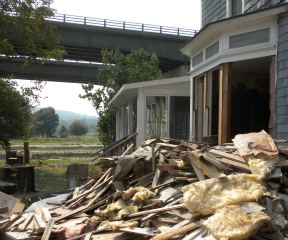
On a stretch along South Windsor Street, the White River coursed through the high school, destroyed homes and wrecked the Perley-Severance dairy farm. Floodwaters reached 4 feet inside the high school, which sustained $300,000 worth of damage. About a dozen homes were contaminated by floodwaters, and several of the owners said their houses couldn’t be salvaged. The Perley-Severance Farm lost 25 of out of 65 cows, an entire hay crop and seven vehicles, including the farm tractor. The homestead was also significantly damaged.
On Sunday, volunteers from area towns and students from Vermont Law School and Vermont Technical College came to the rescue. They dug out the barn and gutted houses. At the South Royalton High School, 80 volunteers removed 6 inches to 8 inches of mud clinging to the floor of the building and threw out everything the water touched, including band instruments, art supplies and books. (The school is scheduled to reopen on Tuesday).

Gov. Peter Shumlin, who has been visiting flood-ravaged communities throughout the state, visited the area with Richard Serino, the deputy administrator of FEMA, and U.S. Rep. Peter Welch, D-Vt., on Sunday.
Shumlin said he “is not going to rest until Vermont is put back better than Irene found it.” He praised the can-do “spirit of Vermont” and told residents here that more help is on the way.
Gov. Paul LePage of Maine has committed to sending an additional 200 engineers from the Maine National Guard to Vermont to review the more than 100 state highways that need to be repaired before winter.
By Sunday, all eight counties that were damaged by Tropical Storm Irene – Addison, Bennington, Chittenden, Orange, Rutland, Washington, Windham and Windsor — had received major disaster assistance declarations from President Barack Obama. Under the designation, individuals and businesses can apply for relief from the Federal Emergency Management Agency. The declaration also includes a 75 percent federal match for public infrastructure repairs to state highways.
Welch said he is committed to fighting for federal assistance funding in Congress, despite a push by Republicans to cut funding for the program as the House of Representatives resolves the growing federal deficit. Welch said Vermonters don’t have a problem sending their tax dollars to help other states designated as federal disaster areas. Now that Vermont is in need, he said, “We’re all in this together.”
Richard Serino, deputy administrator of FEMA, said his agency is “here for the long haul.” He stressed the importance of registering with the agency. Each individual who had property losses due to Tropical Storm Irene is eligible for up to $30,400. In order to qualify, victims of Irene must register with FEMA. A FEMA representative will be assigned to affected towns within a couple of days, but registration can be completed over the phone at 1-800-621-3362 or online at DisasterAssistance.gov.