

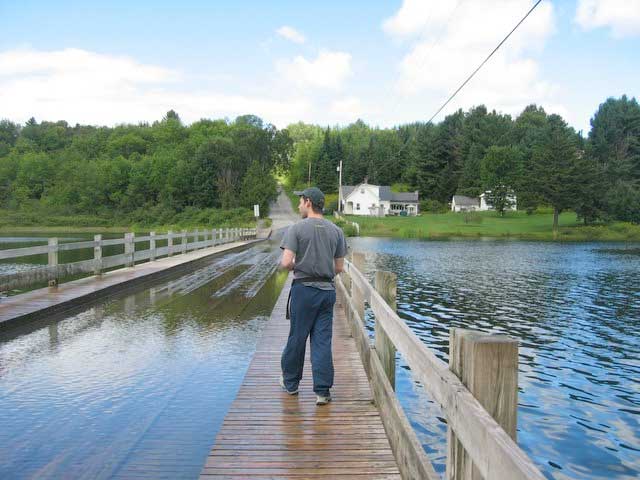
Stand in the heart of picturesque Pond Village in Brookfield, and you are looking at Vermont’s own “bridge to nowhere.”
Actually, the bridge does go somewhere — across Sunset Lake as part of Vermont Route 65. But in a figurative sense, it’s going nowhere: It’s been closed for four years, its deck is sunken and waterlogged and no one is sure when it might reopen.
This is more than just an inconvenience that has split residents in this hillside hamlet in Brookfield, requiring a 3-mile detour. It’s also a disappointment for the visitors from around Vermont and the U.S. who still arrive hoping to cross the historic floating bridge, one of only two in the nation (the other is a much larger one in Washington State.)
And more and more, it’s a source of growing frustration for local citizens, who can’t figure out why a famous piece of Vermont — on a state highway no less — has been allowed to slowly sink into both literal and figurative oblivion.
“It used to be a bridge to somewhere,” says Curtis Koren, a longtime resident of Pond Village. Now she says it’s a sad disgrace. “It’s really gross. It’s filled with algae and cigarette butts. It’s just horrible looking. It’s an attraction gone bad,” says Koren.
At noon this Sunday, residents of Brookfield, which is located about halfway between Barre and Randolph in the rural hills of Orange County, have scheduled a rally for their bridge to nowhere, inviting a host of politicians in an effort to build support for its repair.
They’ve asked Gov. Peter Shumlin and local leaders to visit and hear the sagging saga of the bridge, which unlike Alaska’s notorious bridge to nowhere, actually exists and has strong public backing. The event is coupled with a gala farmers market, silent auction and food festival put on by the Floating Bridge Cooperative, comprising restaurants, farms and businesses in the area.
“We want to show them how we feel about this bridge,” says Town Clerk Jane Woodruff, who has had an angry bee in her proverbial bonnet for a couple of years and has been instrumental in galvanizing the town to try and get repairs on track. “What other state road has any portion of it that has been closed for seven years, if they’re not going to do it until 2014,” she asks.
The fact the earliest repair would be possible is not until 2014 is just one irritant for Woodruff.
“This is something that attracts people in the summer,” she says. But not anymore. “Who wants to walk across a slimy bridge?” she asks.
And don’t even get the town clerk of 10 years and resident for 33 started on the cost, which has been estimated at $2 million by the Agency of Transportation, a figure many in town find mind-boggliing.
Ted Elzey, who lives just down the road from the bridge, has studied the issue and an engineering study done by Norwich University students under the direction of Prof. Greg Wight, a local resident. After a semester of work, they came up with a repair cost or around $215,000.
That’s a lot less than $2 million.
“A lot of us feel if they could find a new floatation system, the bridge itself is in pretty good shape,” says Elzey. Among the findings is that the styrofoam in the fiberglass flotation barrels now under the bridge after it was rebuilt in 1978 have absorbed water, and that’s why the bridge’s surface has submerged.
Another riled-up village resident, Denise Holmes, agrees the $2 million cost seems way out of line. Many in town want to see old-fashioned Yankee ingenuity provide a fix, not a one-size-fits-all solution to a simple bridge that’s been around for nearly two centuries.
“The question is how much is it really going to cost to fix. That’s the first question that needs to be answered,” she says, echoing Woodruff and others.
“There’s frustration this has gone on so ridiculously long,” she says.
It would be easy to pick the sprawling bureaucracy of VTrans as the villain in all this, but this is more a story about good intentions and dashed expectations, state highway money (or the lack thereof) and legislative processes. Call it a parable of our times and how it’s hard to get things done in this world, even in the small world Vermont.
First, a little history. A floating bridge has defined handsome little Pond Village since the 1820s. The first one, according to local historian Kit Gage, was built as a bridge of logs on top of the ice in the winter. When it melted that spring, Brookfield got its first floating bridge. Every few years new logs had to be added as the old ones became waterlogged and sank.
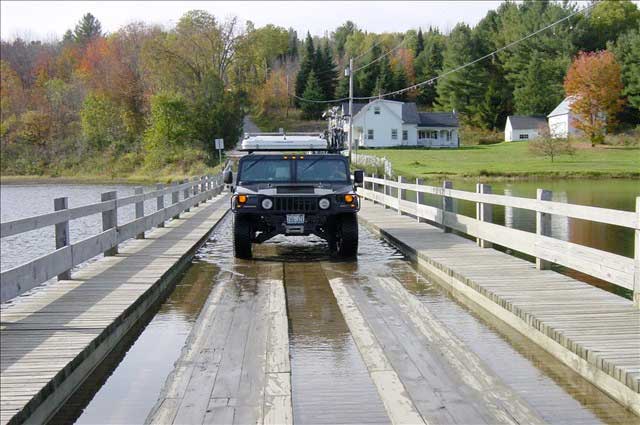
In 1884, Gage writes, Orlando Ralph devised a new flotation system using tarred, wooden kerosene barrels kept in place by the cribbing of the bridge and the roadway itself. Succeeding bridges kept this basic design until the present bridge was built in 1978 and eventually closed because of safety concerns.
Expectations were raised that money would be appropriated for its repair by 2011 and 2012, but for various reasons, including tight budgets after the 2008 recession, the bridge failed to win legislative support in the capital highway budget, despite efforts by local representatives such as Patsy French, D-Randolph.
Richard Tetreault, who as director of program development oversees the state’s annual road construction budgets, says the bridge currently is in a sort of limbo since the Legislature has not backed funding for repairs in its recent sessions. In 2010, then-VTrans spokesman John Zicconi said it was 133 on the state’s priority list based on such conventional measures as its daily traffic and usage and the fact it is closed in winter. Since the bridge was rebuilt in 1978, it couldn’t really be called “historic” either, he argued.
Tetreault says, however, that there has been an important development that could help advocates for the floating 330-foot span. The bridge has recently been ranked the number one priority by the Two Rivers-Ottauquechee Regional Commission, taking into account its historic nature and value as a tourist attraction. That provides some leverage that conventional traffic metrics do not, he says. But ultimately, whether it gets fixed or not depends on the Legislature providing the money.
As far as the cost issue, Tetreault says the $2 million figure for repair is based on conceptual and preliminary design estimates and is not set in concrete, as it were, for repair to a wooden bridge unlike anything else in the state. He added that he in no way “discounts” the study done by the Norwich engineering students but that the two figures may not be comparing “apples to apples.”
Both sides may well be off in their cost estimates.
“Maybe it’s somewhere in the middle,” he says.
For those in Brookfield who are frustrated at the sodden decline of their tourist attraction and severed link between townspeople, action can’t come soon enough.
“I would certainly like to have it functioning again. We have people coming from all over the United States who have seen information on the Internet. They are extremely disappointed to find out they can’t get over it,” says Elzey.
For Denise Holmes, it’s “offensive” that a state highway tying a town together has been allowed to deteriorate, splitting those on the other side of Sunset Lake from the village.
“Fundamentally, it’s disrespect we’re showing to our community by cutting them off,” she says.
Curtis Koren says the state’s inaction goes even further to the heart of the village’s identity, much as the loss of a famed local general store, church or town building might affect a community.
“Most people really are attached to it because it’s a historical bridge and they’re upset because they’ve just let it deteriorate,” she says.
Then she adds, it’s also what people do in town, go down to the bridge and hang out.
“People love to watch the cars cross. It’s big entertainment in Brookfield.”

