


A California firm specializing in education finance research was picked Thursday to do an independent study of Vermont’s much-debated system of paying for its schools.
Lawrence O. Picus and Associates, LLC, of North Hollywood, Calif., was the unanimous choice of a special legislative joint fiscal committee overseeing the proposed study, which was sanctioned and given a $200,000 budget by the Legislature last session.
Montpelier Sen. Ann Cummings, D-Washington, who chairs the committee, said Picus is a national expert on property taxes who has worked with many states to evaluate education funding mechanisms. Based on the interview conducted behind closed doors Thursday at the Statehouse, his firm was a clear choice, she said.
“I think we were all pretty enthused,” she said after the meeting, noting that was true even though the interview, conducted via Skype on computers, had its share of technical glitches.
The panel chose Picus over two other firms that were under consideration: Bud Meyers, Ph.D., director, James M. Jeffords Center for Policy Research; and Dr. David L. Silvernail, director, Evaluation Team Center for Education Policy, Applied Research and Evaluation.
The idea of a major study had strong backing in the Legislature last session, according to Cummings, who said it’s required to be finished and presented by Jan. 18, 2012.
”I think there’s an ongoing concern over property taxes in this state,” she said.
Education financing has been controversial in Vermont for decades, going back to the so-called “Miller Formula” in the 1970s and 1980s. The ground-breaking Brigham Vermont Supreme Court decision in 1997, which found that the existing education finance system violated the state’s constitutional guarantee to equal protection under the law, forced the Legislature to step in and overhaul the state’s method of education financing using property taxes.
The Brigham decision was driven by the inequity inherent in the ability of wealthy resort towns with large property tax revenues to support much higher budgets for schools than small rural towns. In response, the Legislature enacted Act 60 in 1997 and its successor, Act 68, in 2003.
The system under those acts instituted a statewide property tax designed to equal out inequities and an income sensitivity threshold to limit the burden on low-income Vermonters. But that system is now over a decade old and lawmakers want to take a detailed look at how it is working, what Vermonters are getting for their money and how changing demographics and economic conditions might be impacting the system.
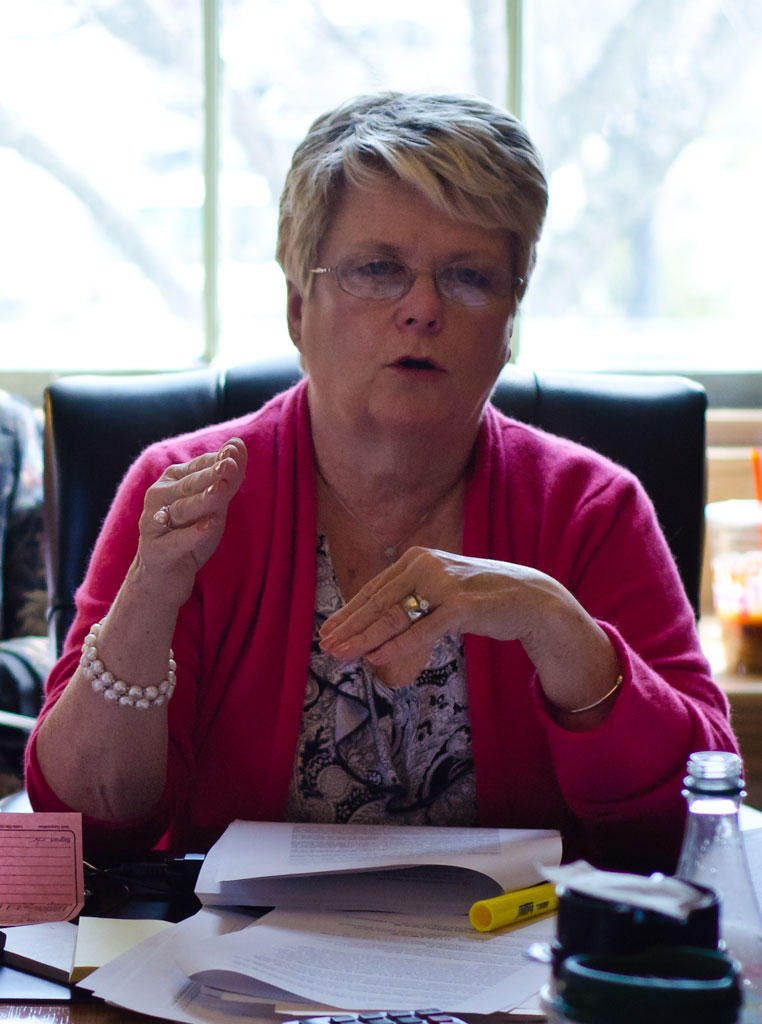
Rep. Janet Ancel, D-Calais, another member of the committee, said 1997 is like “ancient history” in terms of the changes that have occurred and it was high time to call in fresh and educated eyes to take a look.
“What we tend to do is get the same people (to do studies) and go over the same ground,” she said. “We tend to see the problems from the seats of our own perspective.”
Political debate over Act 68 has sharpened as Vermont school enrollment drops, class sizes grow smaller and per-pupil costs for education rise. Vermont ranks fifth in the nation for per-student spending in 2011, according to the Children’s Defense Fund, because of the small size of many of its rural schools.
Vermont currently has 96,000 students in grades K through 12 public schools, according to the Department of Education, a considerable drop from 1997, when enrollment reached a high of 106,000. Student population will continue to fluctuate between 90,000 and 100,000 for the foreseeable future, according to the department.
Recent efforts by former Gov. James Douglas to trim school costs have run afoul of cherished notions of local control. Vermont has some 280 school districts, an administrative structure that has been the target of cost-cutting without success for years. Attempts at the state level to curtail local school spending also have run into resistance among local school boards and teachers.
Ancel said she encounters myriad opinions on what the state should do and what the problem is.
“There’s sort of this knee-jerk feeling we need to do something but no agreement on what needs to be done,” she said.
Cummings said lawmakers hope a thorough and independent analysis will separate wrong assumptions and myths from the facts of how Vermont’s education finance system is working: “Is the system doing what we want it to do?” And, she said, “Where are the problems?”
“We may not hear what we think we’re going to hear,” Cummings joked, but she said, that’s fine.
Below is the formal charge adopted as part of the contract proposal:
(1) a review of the existing studies of Vermont’s education finance system since enactment of No. 60 of the Acts of the 1997 Adj. Sess. (1998) and No. 68 of the Acts of the 2003 Adj. Sess. (2004);
(2) a review of the existing data collected by the departments of education and of taxes related to the Vermont education finance system under Act 60 and Act 68;
(3) a review of education finance systems in comparable states with an emphasis on states in New England and states committed to equity.
(d) The evaluation will include comparisons between the communities within this state and between this state and other states based on the following factors:
(1) equity, which includes the opportunity for students, access to resources for schools and equal treatment for taxpayers;
(2) education quality, which includes a review of Vermont’s statutory outcome measures of performance and other state and national measures of performance based on existing data;
VT LEG 270103.1
(3) comparative costs, including spending growth overall and particular areas of spending (e.g., special education), understanding that No. 60 of the Acts of the 1997 Adj. Sess. (1998) and No. 68 of the Acts of the 2003 Adj. Sess. (2004) envisioned some increase in spending in poorer communities;
(4) funding reliance, which means the types of tax and revenues used to fund the education system;
(5) demographic issues, including the impact of demographic changes
independent of the state education funding system;
(6) economic impacts, if any, that the education funding system has had on state and local economies;
(7) the relationship between per-pupil spending and the total amount spent for each community; and
(8) the extent to which spending is correlated to community income wealth.

