

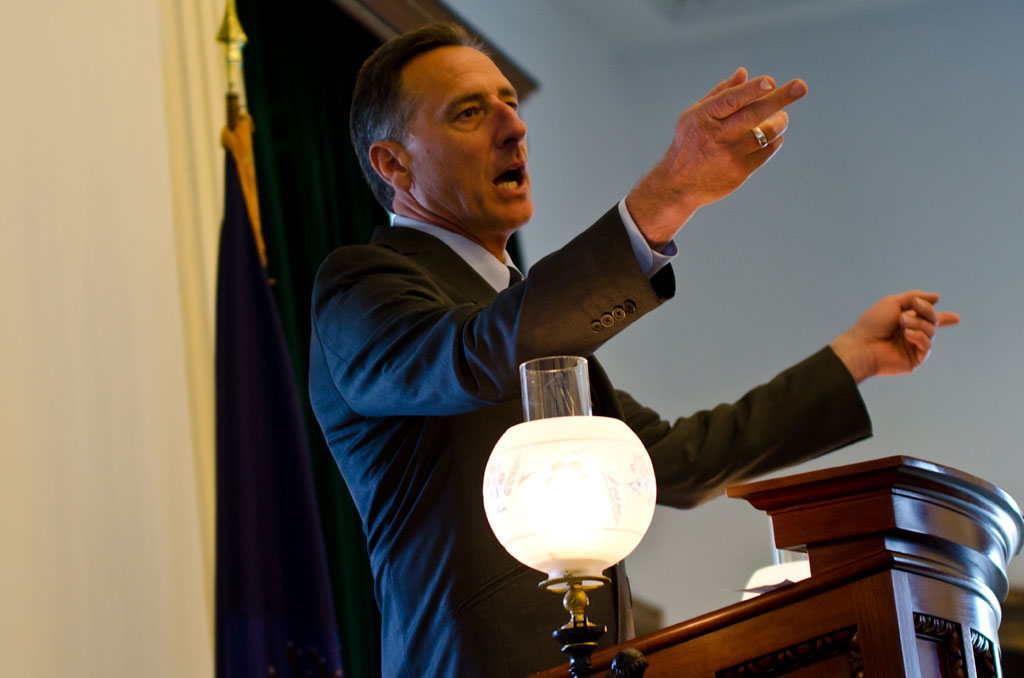
Now his troubles really begin.
That’s because most of the major bills passed by the Democratic majority in the House and Senate don’t change much in and of themselves. For the governor and his fellow-Democrats with big margins in both houses, legislating was the easy part. Implementation is going to be hard.
When a legislature passes and a governor signs a tax bill, some tax goes up or down as ordered. Passage of a criminal justice bill lengthens or shortens sentences for the listed offenses. As soon as a governor signs legislation establishing new parks, for example, land is set aside for a park.
Not so with most of Shumlin’s agenda. Passage of the telecom bill will not immediately bring high-speed Internet to anyone’s house. The jobs bill will not put anyone to work Monday morning, the energy bill itself will not produce a kilowatt hour of power, and not a single convict is likely to be released just because Shumlin signs the recidivism bill, which was finally approved by both houses Friday.
Most important, the health care bill – the most contentious and potentially the most significant part of the governor’s agenda – does not create a new health care system.
It creates a process and a mechanism on which a new health care system may be set up.
The telecom, jobs, energy, and recidivism bills also establish processes. The difference is that in these cases, the mechanisms already exist. The new bills assign new powers and responsibilities to existing agencies. The recidivism bill, designed to allow early release and alternative confinement for non-violent offenders, does not need a new bureaucracy; the Department of Corrections has been around for a while.
So has the Department of Vermont Health Access. But the health care bill given its final passage Thursday creates a new independent board charged with “reducing the per-capita rate of growth in expenditures for health services in Vermont…enhancing the patient and health care professional experience of care…recruiting and retaining high-quality health care professionals; and achieving administrative simplification in health care financing and delivery.”
A tall order, and senior officials of the Shumlin Administration have acknowledged that success is not guaranteed. Specifically, they recognize that if the new Board can’t accomplish the first of those tasks – getting those annual health care cost increases down – everything else in the bill will be for naught.
Perhaps that explains why the bill calls for the new Board to make its final report shortly after next year’s gubernatorial election. Nothing would be worse for Shumlin and the Democrats than a pre-election verdict from the Board that it couldn’t figure out how to control health care costs.
Not that the governor or his health care advisors are pessimistic on this point, and it isn’t hard to see why. Like the residents of the other 49 states, Vermonters pay roughly twice as much per person for health care than do the residents of other prosperous democracies. Considering that the people in those other democracies are healthier than Vermonters (and other Americans), figuring out a way to control health care costs should not be impossible.
But “not impossible” is not the same thing as “easy,” especially when there is still opposition to the health care bill’s vision of guaranteed, universal health care, perhaps (though not necessarily) in a single-payer system.
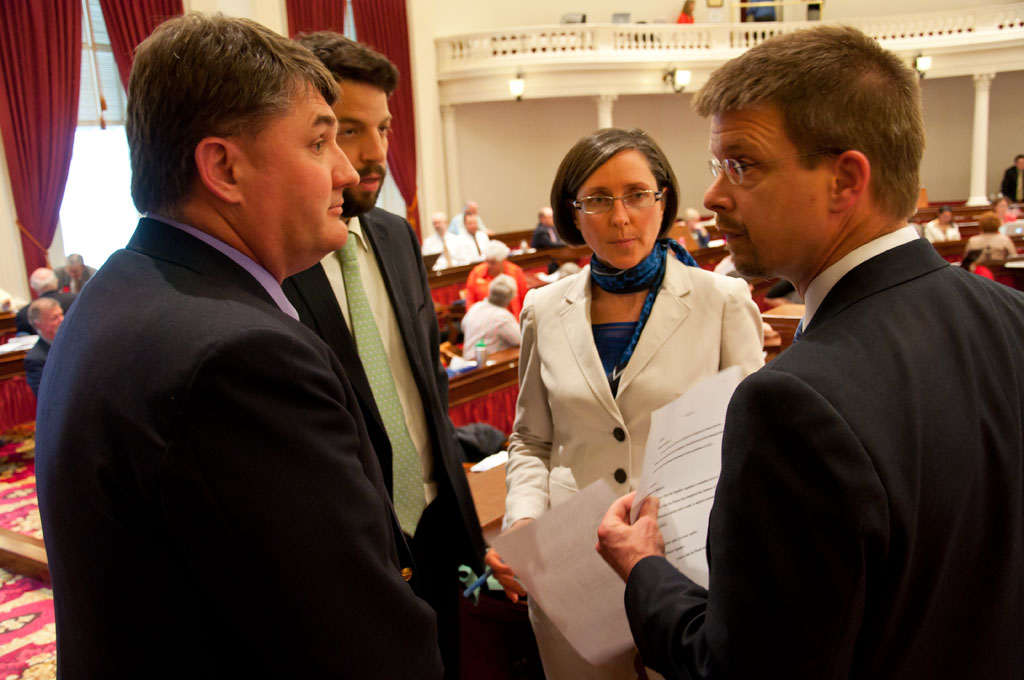
The health care bill, then, begins both a process and a gamble for Shumlin and the Democrats. The governor’s next big challenge will be appointing the board. To succeed, its members have to be committed to the process, but also be willing to follow evidence wherever it takes them.
Some bills that passed this week will have immediate impacts. In the session’s last hour, lawmakers agreed on legislation ordering tougher penalties for repeat drunk driving offenders. The Legislature also passed a law making it easier for citizens to get access to public records from both state and local governments.
And of course the lawmakers did balance the budget, no easy feat considering that they faced a $176 million shortfall when they convened four months ago. Here the legislators showed themselves somewhat independent of the governor, cutting his proposed reductions to social service programs almost in half.
“You took our budget and made it better,” Shumlin told House members in his closing remarks. After a pause, he added, “you never heard that from a governor before.”
As both the governor and the legislative leaders bragged, they made up the budget gap without raising “broad-based taxes,” meaning the sales and income taxes that almost everybody pays. They will face another budget shortfall next year, but it will be a smaller one, and they will almost surely once again not raise broad-based taxes. It’s an election year.
Even with the risks and the shortage of instant gratification from most of the major legislation, the session was by any measurement a triumph for Shumlin. At a time when most governors (and, indeed, the president), were cutting back and delaying innovative policy proposals, Shumlin introduced an extraordinarily ambitious agenda in January.
He got all of it. Not all of it exactly the way he wanted, but that never happens. Legislators have their own agendas. The governor has lots of challenges ahead, some of them because of passage of the bills he proposed. But in politics, nothing succeeds like success. This weekend, at least, Peter Shumlin is a big success.
