

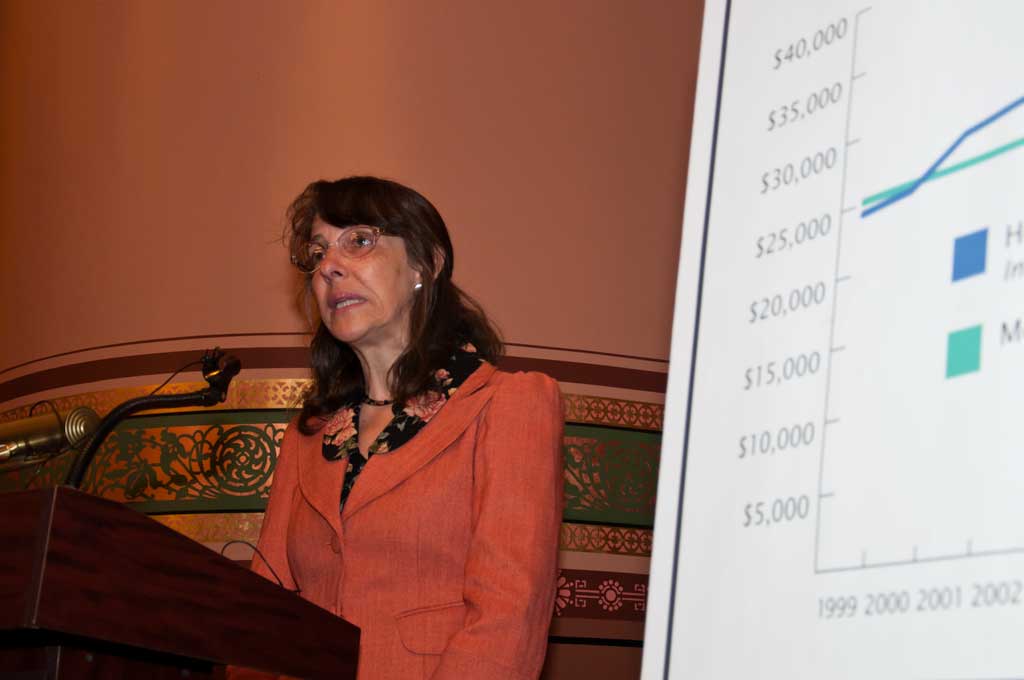
The national economy might be improving, but Vermonters still struggle to afford rent, according to a 2011 report from the Vermont Housing Finance Agency. A panel of state lawmakers and housing authorities painted a bleak picture of the future of affordable housing and warned that cuts in the federal budget could worsen an already dire situation, at a press conference at the Statehouse Thursday.
“Rental housing doesn’t seem to be aware that there’s a recession going on,” said Sarah Carpenter, executive director of the Vermont Housing Financing Agency. Citing stagnant income, low vacancy rates, and a 7 percent increase in rent over the last year, the report found a “growing gap” between wages and rental costs.
The study also found that owning a home remains out of reach for many Vermonters. Low interest rates on mortgages lessened the burden of buying, but housing prices have climbed 3 percent since 2009 while Vermont’s median income declined.
The gap between Vermonters’ incomes and affordable housing is nothing new, according VHFA research. Affordable rent slid beyond the state’s median wage earners in 2000, and home prices have outpaced Vermont’s median income for over a decade.
Federal budget cuts and expiring subsidies for Vermont renters, however, exacerbate an already tenuous situation. With a rising number of homeless families with children using emergency shelters—and finding little affordable housing available for a transition out of homelessness—the report concludes that Vermont has “cause for alarm.”
17th Worst in the Nation
Nearly half of Vermont renters and 38% of owners pay too much for their housing, jeopardizing their ability to afford healthcare and food, says the VHFA report. The numbers rank Vermont 17th worst in the country for affordable housing.

With incomes effectively the same for a decade, said Carpenter, the problem is on the rental side. “People are staying put, not buying,” which tightens the rental market. Since Vermont, unlike many western states, didn’t overbuild in the housing boom, vacancy rates in the state are exceptionally low.
Homeowners fared better by comparison, with the number of houses sold in Vermont rising 8 percent in 2010 and foreclosures remaining well below the national average. Foreclosures continue and closing costs are rising, however, and Vermont’s median home price is $195,000, up 3 percent from a year ago. A $6,000 gap persists between a mortgage most Vermonters are able to afford and what they’ll need to spend on a new home.
Sen. Vince Illuzzi, R/D-Essex-Orleans, highlighted the problems of homelessness. Although emergency shelters received more funding this year, the increase in services tracks with the increased demand: a state study found that the average stay at homeless shelters increased to 34 days in 2010, up from just 13 days in 2000.
“Despite our best efforts to increase our funding of affordable housing,” said Sen. Illuzzi, the state is failing.
“Our workforce housing”
Nancy Smith, a resident of Montpelier, moved to Vermont with her daughter in September and sought a two-bedroom apartment. Addressing the media at the press conference on Thursday, she said she found herself priced out of acceptable housing, touring rentals she described as “sub-livable.”
Smith and her daughter, Lilly, eventually rented from the Central Vermont Land Trust’s North Branch Apartments on Elm Street, a block of housing set aside for low-income renters. With the future of funding for housing subsidies on the line, she says many of her neighbors “aren’t going to be able to handle it if things get any worse.”
Lawrence Miller, secretary of the Agency of Commerce and Community Development, emphasized that Vermont rentals — “our workforce housing” — are worst hit, in no small part because of the high cost of heat. The VHFA reports that 74 percent of Vermont’s rentals were built before 1979 under lax efficiency standards and building codes. Nearly half of Vermont’s homes use fuel oil for heat, as compared to 7 percent nationally, making them susceptible to unpredictable prices.
The VHFA found that affording a “modest” two-bedroom apartment in Vermont requires a household income of $39,595—more than twice the state’s minimum wage at full-time employment. And while some households have more than one wage earner, nearly two-thirds have only one or fewer.
Compounding the issue is Vermont’s job market. In a survey, the VHFA tallied over half of the state’s non-farm jobs with median salaries below the $39,595 minimum. “An estimated 34,000 renting households…were paying more than 30% of their income for housing costs,” states the report. According to the VHFA, housing costs (including rent, mortgage payments, utilities and upkeep) must remain under 30% of a household’s income to qualify as affordable.
“We’re going to have to innovate”
With a longtime dearth of affordable housing, the VHFA report concludes that Vermont needs to invest in upgrades and new construction. While the VHFA report is sanguine about new homes — “construction is a great economic engine” providing jobs, wages, and $1.10 generated for every dollar invested — Carpenter says the private sector won’t invest in building until profits return.
With federal budget cuts looming and a large portion of the state’s 6,600 housing vouchers at stake, there’s little good news for Vermonters. Illuzzi said that the legislature hasn’t identified anything currently in existence that could solve the affordable housing problem. “We’re going to have to innovate,” he concluded.
