

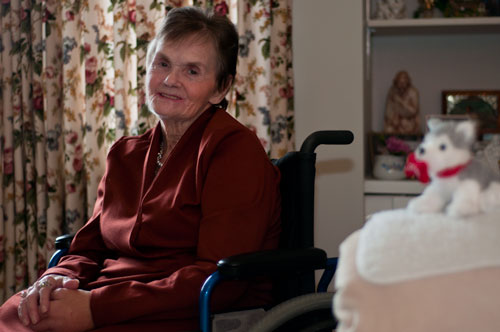
Carolyn Granai is a 24/7 caregiver: She works for the Northeast Kingdom Area Agency on Aging 30 hours a week, and when she gets home, she takes care of her mother who has Alzheimer’s disease. The only time Granai, of Newport, gets a breather is when a respite care worker comes in on the weekends.
Soon those breaks could get shorter — and further between. That’s because Gov. Peter Shumlin’s budget includes a sharp reduction in the number of hours available for respite care for elderly and disabled Vermonters.
As it is, Granai relies on family, friends and neighbors to help out. If the state programs she counts on disappear, she will have no choice, she says, but to send her mother to a nursing home. Granai also has a teenage daughter to take care of, and she uses respite time to spend time with her immediate family on the weekends.
“It’s very emotional for me to even think the hours are going to be cut,” Granai said. “I told my family if hours are cut I can’t guarantee I can keep her home. It breaks my heart to think I can’t keep her here just because of those hours.”
Her mother, Marion Bowman, is used to the familiarity of home — once she’s in a nursing home facility, Granai worries she’ll lose her sense of connection. But at this point, Granai has resigned herself to the possibility because she can’t afford to quit her job to care for her mother all the time.
Marilyn Gelinas’ father has lived in his own home for 65 years. Now that he has dementia at age 92, it’s more important, she says for her dad to stay at home. The few times he has been held in a nursing home, he had to be sedated because he didn’t know where he was.
Her dad is especially reliant on the individual assistance for daily living program, which pays for someone to do simple chores on his behalf — grocery shopping, laundry, light housework, meal preparation and other necessary tasks. He can’t get along without this help, Gelinas says.
“The purpose of Choices for Care is to keep elderly Vermonters in their own homes,” Gelinas said. “(The cuts) make it impossible to do this if cuts keep happening.”
Gelinas lives in Grand Isle — two hours away from her father.“He would probably have to go into a nursing home,” Gelinas said. “I do not have the means to do more than I’m doing right now. Trying to find private care it’s expensive and there aren’t any slots.”
Hundreds of Vermont families will be faced with a stark choice between home-based and nursing home care if two programs — respite and instrumental activities of daily living — for the elderly and disabled are cut 50 percent or more as proposed by Gov. Peter Shumlin.
In his budget proposal for fiscal year 2012, Shumlin proposed that the Legislature cut $2.3 million to Choices for Care programs for the elderly. The total impact of the cuts, including Medicaid, would be about $5 million, according to advocates.
Both programs are offered as part of a home-based-care option under Choices for Care, which was designed six years ago to give the elderly and disabled the ability to decide whether they wanted to stay in a nursing home, an enhanced residential care facility or at home.
The state’s objective, since it began Choices for Care in 2005, has been to increase the number of Vermonters who stay at home. It’s a twofer program: State officials knew from surveys that older Vermonters wanted to stay in their own homes as long as possible; they also were aware that if they could get a Medicaid waiver to launch the program, they could save the state a lot of money.
How much money? Every Vermonter who stays out of a nursing home and receives treatments and services at home saves the state $40,000 a year. (It costs the state about $30,000 a year to provide supports for elderly residents in their homes; nursing home care costs about $70,000 a year.)
When the program was first started, the state promised to reinvest that savings in the home-based program so that home health agencies and area agencies on agency could provide services to a larger number of Vermonters. Instead, according to John Barbour, head of the Champlain Valley Agency on Aging, the money has been absorbed by other budget needs.
Barbour says the home-based programs saved the state $5 million last year. He wants to know why that money wasn’t reinvested to prevent the formation of a waiting list. Fewer people have been getting home based services in high and highest need than a few years ago, Barbour said. The numbers peaked in 2008, and since then, it’s been level or declining slightly.
“Given a choice, many people would choose to receive care in a less expensive setting — that’s the frustration around this,” Barbour said.
Camille George, the deputy commissioner of the Department of Disabilities, Aging and Independent Living, said the administration would try to work with providers to minimize the impact of the cuts in services to the elderly and disabled.
“We just really had to look at where the least impact might be,” George said. “I don’t think there were any easy decisions in this process, so in looking at respite care and instrumental activities of daily living, we did what we thought we could to maintain supports but still achieve the savings.
George said “sometimes people can help out on an unpaid basis.” The state is looking into “other approaches” for people who don’t have friends and family for support, she said.
Caregivers and advocates interviewed for this story said family, friends and neighbors are already providing support and cannot take the place of paid helpers.

Rep. Patsy French, D-Orange, Addison, a member of the House Human Services Committee, said last week if 52 Vermonters end up in nursing homes this year the governor’s proposed savings would disappear.
Michael Sirotkin, a partner in Sirotkin and Necrason, a lobbying firm that represents the Community of Vermont Elders, said on average the cuts amount to about $2,000 worth of services to Vermonters in the program, many of whom live alone on incomes of $1,000 per month. About 2,500 elderly residents of the state rely on Choices for Care.
“All the fears we have had about statements of protecting the most vulnerable citizens turning into platitudes, are now being realized,” Sirotkin wrote in an e-mail. “Seniors and the disabled on our low-income long term care program are our most vulnerable citizens — needing assistance with such things as toileting, bathing, dressing and feeding themselves. What is being proposed in the new budget are dramatic, if not draconian, cuts to the supportive services that allow our seniors and persons with disabilities to remain in their homes and communities and not be forced into nursing homes.”
Sirotkin said the proposed cuts fly “straight in the face of the Choices for Care Waiver itself.” He said the point of the program was to provide elderly Vermonters a choice to stay at home if they wanted to. He said the “short sightedness” of the proposal will “clearly result in more folks needing of institutional care.”
“Clearly the promises made under this program by the legislature and past Administrations to reinvest savings from reduced nursing home admissions back in the community has been dishonored,” Sirotkin wrote. “The program has withered over the past few years with suspensions of new admissions to half the program. The cuts now being proposed add insult to injury.”
