

BURLINGTON – Last month Republicans in the U.S. House of Representatives voted overwhelmingly to fund the government for the rest of the 2011 fiscal year by making the largest cuts in history to discretionary spending.
House Appropriations Chairman Hal Rogers, R-Ky., declared that the cuts “will mark the beginning of a new trend of reductions that will take place throughout the next year. We strived to spread the sacrifice fairly,” he added, “weeding out waste and excess. …”
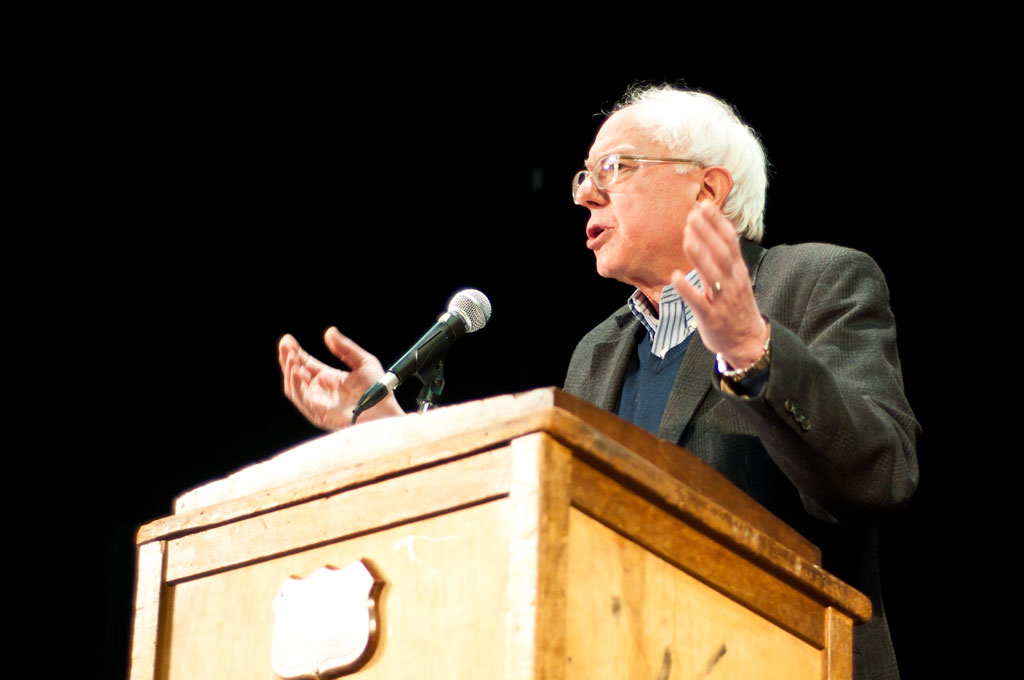
At a Monday morning press conference, Vermont’s Independent Sen. Bernie Sanders spelled out what the “waste and excess” included and introduced his own proposal to reduce the deficit — by spreading the sacrifice to the rich.
The cuts proposed in the House Bill, HR 1, Full-Year Continuing Appropriations Act, 2011, represent “a devastating attack on the middle class, working families, low-income people, the sick, the elderly and the most vulnerable people in our country,” Sanders declared, and added, “I think a lot of people are not aware of it.”
Sanders gave an overview of the national impact of the cuts, and a panel of Vermont program directors provided estimates of the effect on the people they serve.
Sanders said Head Start would be cut by $1.1 billion, or 20 percent, eliminating early education for 218,000 children and putting 55,000 Head Start teachers out of work nationwide.
Paul Behrman, Head Start director for Champlain Valley Office of Economic Opportunity, added that 336 low-income children and their families would lose services in Vermont, about 121 staff would lose their jobs and 25 Head Start classrooms would close.
“We estimate that in Vermont, Head Start is probably serving approximately 50 percent of the eligible children and their families,” Behrman said, “which means you probably have in the neighborhood of 1,200-1,500 low-income children and families who are currently not receiving the program. In the meantime, we have extensive wait-lists for our programs. So at a time when the program should be expanding … we’re threatened with the cuts to undermine the services which support some of the most vulnerable kids and families in the state.”
Sanders said that HR 1 would slash Pell grants – direct awards to the neediest undergraduate students – by $5.7 billion, reducing or eliminating grants for 9.4 million low-income students across the country.
Karen Madden, the director of academic support services at Johnson State College, said not only Pell Grants but federal TRIO programs are an “absolute necessity for Vermont students.”
The U.S. Department of Education funds seven TRIO programs that provide access and support services for 12,000 Vermonters who have low incomes, are first-generation college students or have disabilities. The programs serve students from middle school to graduate school. If the $25 million in proposed cuts take effect, she said, it’s likely that 2,000 students in Vermont will lose TRiO support.
The proposed cuts to the Pell Grant program would reduce grants to these students by almost $1,000 each, making it difficult or impossible for them to attend college. “Education is an investment in the future,” Madden declared. “These programs give Vermonters the ability to become successful, taxpaying citizens.”
Sanders said that HR 1 would reduce funds for community health centers, eliminating primary health care for about 11 million Americans at a time when 50 million lack health insurance. He noted that about 120,000 Vermonters rely on community health centers for their care.
Dr. Stephen Reville, Chief Medical Officer of Springfield Medical Care Systems, said his organization became a Federally Qualified Health Center in 2009 through the American Recovery and Reinvestment Act – the stimulus bill – and now serves about 22,000 people in several area clinics and Springfield Hospital. It has added some 2,000 new patients who never had a primary care provider before.
The FQHC has started a program to make prescription drugs available on a sliding fee scale, renovated an abandoned mill to create a primary care center in downtown Springfield, integrated care coordinators and mental health services into primary care practices and will soon be opening a dental clinic, “which is a desperate need in our part of the state,” Reville said.
“If these proposed cuts do go through, Springfield is one of the community health centers that is probably on the chopping block, because it was funded through the stimulus bill specifically,” Reville said. “Also, around the rest of the state, there’s another $1.5 million of health center funding that would be cut.” That would mean eliminating construction of three new community health centers and expansion of four existing community health centers.
“I think this could have a devastating impact,” Reville said. In other regions, community health centers provide health care access for the uninsured, he noted, but in Springfield, “the entire primary care network is part of our community health center and is at risk.”
Sanders denounced slashing $405 million from the Community Services Block Grant, which helps fund Community Action Programs for “the poorest of the poor.” Likewise, he condemned cutting the Low-Income Home Energy Assistance Program, known as LIHEAP, by $400 million. LIHEAP could be of life-and-death importance to senior citizens who live in states where temperatures can drop to -20º in the winter, Sanders observed.
Hal Cohen, the executive director of the Central Vermont Community Action Agency, explained that the Community Services Block Grant is the core funding for Community Action Programs. Last year the Vermont Community Action programs served 60,000 people with food, heating assistance and housing assistance.
“Should the core funding to the Community Action programs be cut, the unemployed, working poor, the disabled and the elderly would not be able to access these needed services, and the safety net for these Vermonters would be severely torn,” he said.
Cohen sketched an apocalyptic scene of the future without Community Action programs. Emergency food shelves would close throughout the state. Services at the state’s two largest food shelves, in Burlington and Barre, would be severely cut. Housing assistance would be drastically reduced, leaving no protection for families fighting eviction. Families whose electricity was shut off or who lost heat “would be left in the dark and the cold.” If LIHEAP were cut in half, he asked, “Who would be able to provide the heat for these people to get through the winter?”
Because the block grant leverages other funds, Cohen noted, “These cuts, which would be a little less than $2 million [in Vermont], would mean that the state would lose over $25 million in related services.”
Sanders observed that cutting the budget of the Environmental Protection Agency by 30 percent would affect not just low and moderate income people: “It impacts everybody that breathes.” (The EPA enforces the Clean Air Act.)
The American Lung Association is alarmed that HR 1 would “promote toxic air” by decimating the EPA’s ability “to protect the public health from life-threatening air pollution,” said Rebecca Ryan, the Vermont Lung Association’s director of health promotion and public policy.
Ryan declared the bill to be “bad for public health” because it ignores the well-being of Americans, and especially of those with lung disease. They include nearly 60,000 Vermonters with asthma and tens of thousands with chronic obstructive pulmonary disease.
Finally, Sander criticized the Republicans’ proposed $1.7 billion funding cut for the Social Security Administration, which he said would cause half a million elderly, disabled, widowed and orphaned citizens to suffer delays in receiving benefits they are legally entitled to. And he deplored a $750 million reduction in WIC, the supplemental nutrition program for low-income Women Infants and Children.
(A paper by the Center on Budget and Policy Priorities argues that the effect of the cuts will be even greater when inflation is taken into account.)
“These are devastating cuts against the weak and the vulnerable, which is not what America in my view is about,” Sanders said.
The senator agrees with his Republican colleagues on the need to address the deficit crisis. But, he said, “At a time when the richest people are becoming richer, we might want to talk about shared sacrifice.”
Consequently, on March 10 he introduced a bill – S552 – that would impose an emergency surtax of 5.4 percent on all household income over $1 million.
“When the wealthiest people are becoming wealthier, when their effective tax rate is lower than at any time on record, when they’ve received hundreds of billions of dollars in tax breaks, maybe they should participate in helping us move toward deficit reduction, and not simply the weak, the vulnerable, the sick and the elderly,” he proclaimed. Sanders noted that his legislation would also eliminate tax breaks for large oil companies.
Sanders calculates that the surtax would raise as much as $50 billion a year in revenue; ending tax loopholes for oil companies would add another $3.5 billion. The current Republican proposal would save around $61 billion.
Sanders believes his bill can attract support. The problem at this point is that the American people aren’t aware of what HR 1 would do, he says.
However, when they are asked “to consider whether we ask the wealthiest people to pay a little bit more in taxes after getting huge tax breaks, or whether we decimate programs for our children, for the sick, for the elderly, for the poor, … the answer will be pretty obvious,” he maintains.
For proof, he cites a March 3 Wall Street Journal/NBC News poll which found that 81 percent of respondents said they considered placing a surtax on federal income taxes for people earning over a million dollars a year to be “mostly acceptable” or “totally acceptable.”
The challenge is raising awareness. Sanders says that meetings need to be held all over the country by members of Congress and citizens to discuss the cuts proposed in HR 1. He is holding town meetings this month in Barre, Saint Albans, Bennington and South Burlington.

