

Editor’s note: The original version of this article, which has been updated for VTDigger.org, first appeared in Vermont Property Owners Report, a Montpelier-based subscription newsletter. Van Susteren is the former Sunday editor of the Rutland Herald and Times Argus. He lives in Calais.
‘Biomass’ may be the hot, new energy buzzword, but a century and longer ago most Vermonters depended on it exclusively. Our great-grandfathers cut, split and stacked eight or 10 or 12 cords of wood a year to burn in the parlor and kitchen woodstoves. The potbelly, eventually a Norman Rockwell trope, warmed and cheered one-room schoolhouses, town halls and general stores.
Cheap coal and oil became the preferred heat source as the 20th century advanced. Then, in the 1970s, during the Arab Oil Embargo, wood heat became trendy again. With a nod to nostalgia and self-sufficiency, Vermonters began dragging old woodstoves out of barns or buying them at yard sales, and hooking them up again. Tighter and more-efficient stoves appeared on the market, with fight-back names like the “Defiant,” “Vigilant” and “Resolute,” all manufactured by an up- and-coming company, Vermont Castings of Bethel.
These days “biomass” is more than firewood. It’s an inclusive noun that covers practically any plant matter that can be burned to produce energy — grass clippings, switchgrass, corncobs and corn stalks, you name it. And, of course, woodchips. Burning biomass is right up there with wind, hydro and solar power as a popular modern alternative to fossil fuels.
In Vermont, the “biomass” option is catching on big time, though there are naysayers who argue that biomass incineration requires unacceptable tradeoffs.
Dig Deeper
Links
More than 40 schools in the state are now burning chips or firewood to heat classrooms. For several years Middlebury College has been operating a co-generation plant that heats campus buildings while producing electricity.
Green Mountain College in Poultney last year began operating a biomass plant designed to meet 85 percent of the school’s heating needs and 20 percent of its electricity demand. The college expects to burn some 4,500 tons of woodchips to reduce fuel bills and greenhouse gas emissions.
Five cities, including Burlington, Randolph, Brattleboro, Middlebury and Montpelier are presently considering biomass projects of various stripes.
Last year Montpelier received $8 million in federal economic stimulus money for its plan with the state to upgrade the state’s boiler system and construct piping to heat city buildings in addition to the state buildings already being served. Montpelier has received preliminary bids on the project — from $13 million to $30 million — and is hoping that a heating system can be developed to warm City Hall, the police and fire stations, several schools and, possibly, downtown businesses.
“My sense is, Vermonters by and large support biomass as a source of energy, and that’s because of the reality that 75 percent of the state is forested,” says Chris Bray, a former lawmaker who served as the chairman of the state’s Biomass Energy Working Group, a committee formed by the Legislature to study the state’s biomass potential. The committee includes several legislators and state environmental officials, plus representatives from utilities, the forest products industry and environmental organizations.
“Vermonters also realize our forests are a great natural resource, and they must be used wisely,” says Bray.
Biomass baseload power?
Biomass entered the public consciousness in a big way just last summer when a power-generating company, Beaver Wood Energy, LLC, with principals in New Hampshire, Connecticut and Massachusetts, unveiled proposals to build two $250 million, 29-megawatt, woodchip-burning energy plants in two southern Vermont towns — Fair Haven and Pownal.
Together the baseload plants would produce about a 10th of the power generated by the Vermont Yankee nuclear power plant in Vernon. The plants would burn chips from trees on lands within a 50-mile radius of each plant, according to Tom Emero, director of development and operations for Beaver Wood and the company’s point person in Vermont. Excess heat from the plants would be used in adjacent facilities to manufacture wood pellets for home stoves and furnaces.
Emero and other representatives of Beaver Wood appeared last fall at a number of public meetings in both towns and nearby communities to offer assurances that the forestlands in the areas could sustain the power plants. He said the chips would come from low-value trees and “waste” wood from timbering operations. That would mean no net loss of trees. Together, the plants would employ 100 workers.
Beaver Wood, which is partnering with Bechtel Corp., the international engineering and construction corporation, is hoping each project can be financed with $52 million in economic stimulus money through the federal Department of Energy. Bechtel would have an opportunity to have a “small” equity interest, Emero said, but the projects would be financed largely through “traditional debt financing.” The company hired the Montpelier lobbying firm of KSE Partners (formerly Kimbell, Sherman & Ellis) to help with public relations and guide Beaver Wood through red tape. The projects will need approval under Title 30 Section 248 from the state Public Service Board for the generator and possibly an Act 250 land-development permit for the pellet plants.
Both permitting processes require public hearings at which Beaver Wood will have to make a case it can produce power economically without damaging the environment. Under Section 248, Beaver Wood will be seeking a go-ahead certification called a “certificate of public good.”
The proposal has been met with some skepticism. Residents at the public meetings have asked about air pollution, noise, truck traffic, and whether nearby forestlands can, in fact, meet the fuel demands. In Williamstown, Mass., just five miles from Pownal, some residents worried about excessive cutting and expressed concern the projects were being rushed to take advantage of federal funding. Beaver Wood has confirmed that to qualify for the federal funding some aspect of construction will have to start in 2011.

At a public information meeting in Pownal last fall, Josh Schlossberg, editor of an online newsletter “Biomass Busters,” said the plant would present a host of environmental and health problems. Studies demonstrate “there is no safe level of exposure to particulates,” he wrote in a letter to The Burlington Free Press.
Some residents worried about the plant’s impact on water tables as it draws water for cooling operations. The plant as envisioned in Pownal would use the nearby Hoosic River as a water source, but it would have to rely on groundwater when the river runs low.
Emero denies any health or environmental risk. He says the plants would use technologically advanced filters to keep emissions at or lower than levels allowed by state and federal law. Beaver Wood has reported that ash from the combustion would be put to good use — sold to farmers who will apply it to their fields to reduce acidity levels.
Earlier this month, in response to suggestions from the public, the company announced a hydrology firm would be considering the groundwater issue.
The company emphasizes that wood burning is considered a “carbon-neutral” method of combustion. While burning oil or coal releases carbon that had been stored over millions of years, burning wood releases only carbon stored during the short life of trees. Carbon is released as wood is burned, but then it is sequestered again as trees grow back.
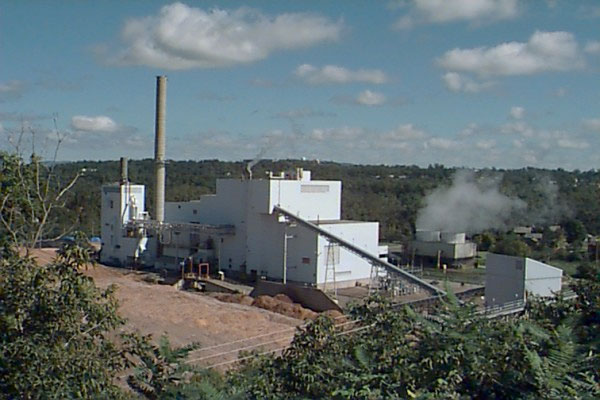
Large-scale biomass energy plants are not new to Vermont. The state already has two: the 50-megawatt McNeil Generating Station in Burlington, which has been online since the early 1980s; and the 20-megawatt Ryegate Power Station, which has been operating for two decades.
These plants play a small but significant role in Vermont’s electrical power mix. The state demands more than 700 megawatts, but most of it is imported, much from Hydro-Quebec in Canada. Vermont Yankee, owned by Entergy Corp., of Louisiana produces some 600 megawatts, only about a third of which stays in state.
With concern about the cost and environmental impacts of imported fossil fuels and with the future of an aging Vermont Yankee uncertain — its operating license is up for renewal next year — Vermont’s utilities and energy planners have been weighing green alternatives, including wind and solar, and biomass.
The wood to be chipped at the two power plants would come from dead, dying or low-value trees, or from the limbs of high-quality mature trees recently cut for veneer or saw logs. Emero said half of any cutting would still be left on the forest floor for wildlife habitat and to assure the forest floor is replenished with nutrient-rich decaying material.
He pointed out that state regulations already are in place to prevent clear-cutting abuses.
Income from “waste” wood
Conceptually, biomass has the support of many timberland owners. Other than to cut firewood, they now have few opportunities to sell low-value trees. With pulp mills having closed in Quebec, New Hampshire and Maine, there’s no pulpwood market.
Kathleen Wanner, executive director of the 1,000-member Vermont Woodlands Association, said that new demands for biomass would provide “some” additional income to timberland owners after logging for veneer or saw logs. Any demand for “waste” wood also would encourage timberland owners to cull their low-quality trees to make room for higher-value trees.
“For the owners of managed forests, biomass represents an opportunity to make a little more money,” she said.
But it would hardly be a windfall, she said, and wouldn’t be enough to encourage a landowner to cut his trees.
Tunbridge forester Paul Harwood, the association’s vice president, said landowners get only 50 cents to a dollar for a ton of low-value green wood. That would amount to about $2 or $3 a cord. “It is not a lot of money, but still it is taking a product that otherwise would stay in the woods.”
National group weighs in
Biomass efforts in Vermont have been getting a boost from a national organization headquartered in Montpelier. The Biomass Energy Resource Center conducts feasibility studies and workshops to help schools and municipalities with small-scale biomass projects. BERC, which has a staff of 12, provides information to anyone or any institution interested in biomass, says policy director Andrea Colnes.
Colnes says BERC doesn’t have an official position regarding the Beaver Woods proposals, but she did say it’s a plus that the company envisions using its waste heat to help make wood pellets. BERC encourages co-generation projects in which surplus heat either generates power, warms buildings or figures in a manufacturing process.
The forest sustainability issue that hangs over Beaver Wood, and any biomass project for that matter, looms big in Vermont; and to complicate matters, there are numbers to consider from various studies of various areas.
One recent BERC study, encompassing Vermont and nearby counties in New York, Massachusetts and New Hampshire, indicates that some 3.5 million green tons of wood are cut in the region each year for biomass boilers, home woodstoves and pulp mills. By comparison, the timberlands in the study area regenerate to the tune of 25 million tons — which suggests a lot of leftovers.
Local wood, or oil from the Middle East?
Bray, former chair of the state’s biomass study group, agrees there is plenty of wood in Vermont to support more biomass projects, but he also believes that plants or biomass burners must be located strategically, in non-overlapping spots around the state. That will help assure there will always be enough wood. Bray notes with some concern that the 50-mile radius that Beaver Wood draws around its proposed plants largely overlap.
Bray says a preliminary report by the study group (final report to the Legislature next November) recommends the construction of one — not two — 25-megawatt plants in southern Vermont.
He believes strongly that timberland owners do need new opportunities to sell their trees. The recession, foreign competition and the demise of the pulp industry have conspired against the timber business. “However dire the picture is for dairy farms, it is worse for the wood-products industry,” he says.
A healthy timber industry is good for the environment, Bray maintains. “If we don’t find ways to use these resources, the risk of development grows.” The fragmentation of land by housing development, he said, is as disruptive to wildlife habitat as it is to timber resources.
He says Vermonters want “working landscapes.” With biomass, he says, “every dollar spent on our own energy is a dollar not sent away for power from Illinois or Louisiana or oil from the Middle East.”
