

Editor’s note: This is the second half of a two-part series by Max Breiteneicher of The Commons.
Leland & Gray is a middle and high school in downtown Townshend. A side wall of the building is spray painted with what would be graffiti, were it not that it spells out a quote from As You Like It.
“All the world’s a stage, and all the men and women merely players,” the wall says.
Leland & Gray, which has been around in various incarnations since 1833, stands as an example of a relatively stable consolidated school district for 400 students from five member towns. It offers innovative programs and community support. The school is very close, geographically and otherwise, to the supervisory union.
Dorinne Dorfman started as principal in July. She’s energetic, young, and carries a walkie-talkie as she moves through the halls.
Dorfman first met students from Leland & Gray in the capital of Inner Mongolia, Hohhot. She was on an exchange fellowship through the University of Vermont.
“There I was, in this city where no one spoke English, at this arts school, and Leland & Gray showed up and gave a production on the history of jazz in America,” she says. “There were hundreds and hundreds of people in the audience.”

Dorfman’s introduction came through Journey East, one of Leland & Gray’s most popular programs. Every other year, 28 students apply for an intensive course of Chinese language, culture, and theater arts. They create a production that they perform throughout China for the month of April.
In another two-year program called “Hands on, Minds Engaged,” 12 students, some with special needs, who struggle in traditional classrooms, work together with two teachers to build boats. There is also a grade 9-11 independent study project, which introduces students to internships, volunteer activities, scouting, and exploration of post-high-school career opportunities.
These programs end up both saving and making money, Dorfman says, because placing kids with physical or learning disabilities or behavioral problems at other schools is very expensive — upwards of $60,000 a year per student for special education.
“We have three full-time professionals working with students in a way that’s different from anything else,” she says. “At a skeleton-staffed school, they have nobody and have big-time behavioral problems, and they’d just have external placements or expel kids. We may save the taxpayers a lot of money, because we have very few off-site placements.”
The programs also help attract kids from other schools who pay tuition to Leland & Gray, she says. “Even within our own supervisory union, there are students we still need to attract to Leland & Gray. That would prevent us from ever really having a skeleton staff, because then we can’t compete with Burr and Burton, or Brattleboro.”
Still, enrollment is declining, and the school has cut French this year to level-fund its budget.
“It just doesn’t look good. There’s a chart in the annual report that shows incredible drop-off,” says Dorfman. “So, if we look at the fourth-grade classes, there may be 25 percent fewer students in our towns like Jamaica, Townshend, and Newfane.
“When I talk to people who graduated from here 30 years ago, there were 30 or 40 kids in their class. So we are returning to what once was.”
The school has remained successful, she says, “because there’s a community here that believes Leland & Gray means something. It’s not about money, but it is about community investment. There’s very open communication and strong dialogue, and a shared vision that all the students are our students.”
This shared vision makes establishing the budget with the board and superintendent easier, she notes.
“Any major concern I have, particularly financially, I call them right away,” she says.
Dorfman says that a strong relationship between the school, the board, and the superintendent can make all the difference.
“There are certainly school board members in other districts who would like to see how every penny is spent, or who would love to see particular people fired, or who don’t believe in unions,” she says. “I remember attending a board meeting at a town and a board member said, ‘Well, can’t we just fire that whole department?’
“So, it can be very contentious, and for the school board chair and the principal and the superintendent to work against each other is a very poor prognosis for the district,” Dorfman says.
Making it work
David V. Dunn chairs the middle school, high school, and career center boards in Brattleboro — roles he’s held for seven years. Dunn has seen significant changes in governance over his tenure.
Dunn says that the Brattleboro high school board has overcome some of the challenges of governance in the recent past.
“The way governance is set up invites dysfunction,” he says. “Back in early 2000, the board had 17 members. There were members of the board who had children in private school. There were members who had specific agendas they were there to move through.
“We made the decision that the board was not functioning as it should, because of its size, so the board was decreased by a legislative act to nine,” Dunn says. “Since that time, the board has been very stable.”

Brattleboro has one of the largest high schools in the state. Enrollment is steady, and it is projected to increase a small amount over the next five years, Dunn says. But still, setting the budget is difficult, in part because the school board is forced to gauge community sentiment informally.
“The board’s role is to balance the needs of the school with the taxpayers’ ability to pay for it,” Dunn says. “It’s a constant balancing act, in part because the board doesn’t see a lot of public participation and, if we do, it’s in a private forum — people speaking to me or calling me.”
Dunn says that “it’s hard for the public to come out and say, ‘Cut education.’ I think that most people acknowledge that the school system is a crucial element in a successful community.
“So on one hand, people want to support it, but on the other hand, the ability to pay for it is constantly being challenged in the current economy.”
The board needs to be very clear on its role, Dunn says.
“You need a decisive board that does government and not management,” he says. “If the objectives aren’t being achieved, you need to make changes. That’s a difficult action for some board members, because you may end up terminating people. Some of these people are your neighbors.
“It’s also inexperienced board members who perceive that their role is to manage rather than to govern,” Dunn observes. “Once you get into management, you usurp your management’s power.”
Rizzo, the Windham Southwest Supervisory Union superintendent, was just hired this past summer, and he still likes to visit every school three times a week. His educational philosophy is “students first,” he says.
“I’ll get to know every kid, write every child a birthday card, go to their games, their plays. But we have seven schools, which, geographically, is challenging.”
Rizzo is charged with managing seven principals, including Aldrich in West Halifax. He works for seven school boards. He attends about 14 board meetings a month in seven towns.

Rizzo, who started as a principal in western Massachusetts 24 years ago, says that adjusting to Vermont’s particular governance system has involved a learning curve.
“In Vermont, you have this ability for school boards to hire and fire, so you literally have passengers flying the airplane, and it’s a recipe for disaster,” Rizzo says, predicting that most superintendents — 90 percent, he says — would identify governance as their biggest issue.
Local boards are charged primarily with setting policy, and the superintendents, principals, and teachers with carrying it out.
“How can that happen if the board has hiring and firing power?” Rizzo asks. “How do you leave emotion out? How do you not hold a grudge? I think Vermont could be one of the finest school systems in the country if we just corrected that.”
Any efforts to do so will be met with a mantra of “‘We don’t want to lose local control,’” Rizzo says.
“But what do you really want to control? It’s set up to fail. It’s set up to have problems,” he says. “If you’re on a board, and your kid comes home and says ‘Mr. Smith yelled at me,’ when it comes time to sign Mr. Smith’s contract, you’re going to think twice about it.”
On a school board, “you really have a blank check,” Rizzo says. “It’s a free ticket into crossing over into the operational realm.”
Rizzo’s district includes some of the smaller schools in the state, and he’s acutely aware of the challenges of providing quality education at many schools with declining enrollments.
“Something’s got to give, because we cannot continue to sustain ourselves. You can’t offer all these enhanced learning opportunities, because you can’t afford them,” he says.
“How do we look kids in the eye, and give them a really solid and comprehensive education, and yet still maintain local control? You can’t have your cake and eat it, too.”
Obligation of the state
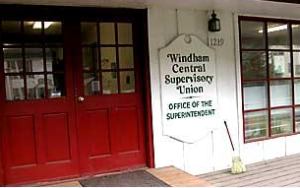
Steven John has worked as superintendent of the Windham Central Supervisory Union for two years. He is grandfatherly, lean, and chuckles frequently.
The union covers 365 square miles and has 1,000 students, 11 towns, nine schools, and 11 school boards with a total of 51 members. It is trying, with moderate success, to get its member towns to agree to explore Act 153, or the Voluntary School District Merger, that would establish a Regional Education District (RED).
Essentially, this law would create one board to run all the schools, and to get the schools to share resources, staff, and, perhaps eventually, space.
It’s been a tough sell.
In part, John says, that’s because “the elementary school boards value their own schools, in their own communities, and it’s the center of not only education but, in many ways, the life of the town. So, to study the possible formation of a RED is a very provocative, very formative adventure.
“The only reason to look at this is if you can increase the learning opportunities, not only in your community, but in your neighboring communities,” John observes, pointing out that the possibility of “some greater efficiency in terms of collaboration, in terms of education programs, sharing faculty, and other instructional resources is tempting.”
But John believes that efficiency isn’t sufficient motivation “for a town to consider no longer having a locally elected board that has control over their particular school.”
Merging the governance of the schools and, in the future, perhaps the schools themselves, would provide efficiency in leadership, John says.
As it stands now, his union office works with nine different boards to manage nine separate budgets and nine separate contracts with teachers, with food service, and with other entities.
“The ability to sustain such programs, and the support it takes from the WCSU office to support those individual boards, is where the state is certainly providing an opportunity for the small boards to consider forming a more collaborative, cohesive group,” says John.
John says that school boards are increasingly holding superintendents more accountable “for getting the best opportunity for learning and performance outcomes for their students. That really should require the superintendent’s presence in the buildings, and direct consultation and coaching of the principals. That’s my responsibility.”
But the current system holds him back from those efforts.
“If a superintendent such as myself is spending three or four nights a week at board meetings until nine or later, it’s an impossible workload to be able to cover the office and be present in the buildings to the extent that I aspire.”
This interplay of heavy workload and many bosses is one reason behind the high turnover rate for superintendents in Vermont. Historically — and currently — about 20 percent of the positions in the state sit vacant.
John says that the responsibilities of a union and superintendent were very few until federal money started funding schools in the late 1960s.”
“When the money started coming through for the Great Society — for Head Start and Title I — all that money had to come to the state. The states needed some way of holding accountable the individual districts and the boards regarding the use of funds. We became the local education agent.”
As a result, the more regionalized oversight of supervisory unions was imposed on a system largely governed by local tradition.
“There has been a tradition of autonomy, where the principal has been seen to be the chief employee of the board in a small town, and that can sometimes lead to more loyalty on the part of the principal to the local board than to the superintendent,” John says.
“I’m an obligation of the state, and not one, necessarily, that some of the small boards would choose to have,” he adds. “We’re facing that statewide. It’s not unique here.”
In that tradition of autonomy, getting everyone on the same page is uniquely challenging — perhaps even impossible.
Yet that’s essentially what boards and unions have been asked to do with Act 153 and Challenges for Change — teach their historically independent, localized systems to collaborate.
“When I think about why should someone in Windham care about someone in Marlboro — well, why should they?” asks John.
“They should, but that’s one of the challenges of leadership that I face, and that the board chairs face as they try to collaborate,” he says, pointing out the opportunity that comes in the face of crisis.
Declining enrollment and economic duress could “lead to more need to depend on each other, to lean on each other,” John says.
The tiniest school
Carolyn Partridge has the unique perspective of serving as a state representative from Windham County, as chair of the House Agriculture Committee, and as chair of the Windham School Board.
The Windham Elementary School now teaches 16 students in kindergarten through sixth grade. The enrollment is expected to rise to 30 in the next few years, Partridge says.
Even with such low enrollment, it’s difficult to imagine kids having to travel to another town for school.
“The school is 13 miles from the nearest other elementary school, so what you end up doing is to take very small children, very far from home, very early in the morning,” she says.
“We would be glad to accept children from other schools if they wanted to join with us, but I don’t know if people are going to want to travel 13 miles, despite the fact that we have very high test scores and our kids are doing very well,” Partridge adds.
Windham gives more money to the state education pool than it uses, Partridge says.
When Partridge heard Vermont Education Commissioner Armando Vilaseca “using our school as a poster child for a school that should really consolidate with another school,” she phoned him.
“He said, ‘We can’t afford to keep schools like Windham open. We just can’t keep sending resources to you. You’re too small.’
“I said, ’The people in the town of Windham send more to the state than we use at our school, by a big margin. We’re a sending town. I know we’re not supposed to talk that way, but it’s true. We’re already sending that money to the state, and then some.’”
This conversation details almost exactly the way in which the state is struggling to reconcile the need for consolidation with the standing tradition of local control.
In Acts 60 and 68, Vermont set up a funding system that assumes all for all — a truly complex, by most accounts flawed, but nonetheless remarkable attempt to get Vermont towns to pay for one another’s schools.
This system was deployed within an existing governance model in which every board saw itself as a separate entity with control, at the very least, over the basic fact of paying for its school.
The perception of local control persists, despite the fact that no matter how much or how little a town puts into the education pool, it’s technically not the town’s money anymore. Financially, it belongs to everyone.
Vilaseca, who has served as commissioner for two years, started teaching in Vermont in 1979 and has become a vocal supporter of changes to the governance system, claiming that local control isn’t much to stand on anymore.
“Look at what they don’t control right now,” says Vilaseca. “Teacher licensing, special education, food service and cafeteria, graduation standards, the accountability system, 504 and Title I programs. All are mandates from the state or federal governments.
“Where school districts do have control is the hiring of people. They have control over extracurricular activities, and they may have control over some of the facilities, but most of the major things are really not within their purview.”
With “a statewide funding and statewide tax system for education, those are now statewide decisions we need to consider,” Vilaseca says. “There is a connection now that we didn’t have before.”
This collectively accountable education system is too expensive and too fragmented to run through many autonomous boards, he says.
“There’s no one the school board is accountable to, except the taxpayers, who then can vote them out of office next time they come up,” Vilaseca points out.
The economic outlook isn’t rosy for the next three or four years for Vermont, nor are the enrollment numbers, Vilaseca says.
Vilaseca adds that Vermonters will “have to look beyond what’s in the best interests of our individual communities, and look at what’s in the best interests of our state.”
The commissioner says that increasing student-to-staff ratio by around 0.25 percent — to 4.75 students for every adults — would save the state about $23 million.
These statistics are where the state struggles in its presentation of this new educational world. These small numbers — 4.55 to 1 — are in actuality more than 90,000 kids, and more than 19,000 people with jobs, respectively.
They are all individuals with families. They all live in towns historically in charge of their schools, and many live in towns that have little else. Proponents of consolidation are essentially asking communities to give up, reinterpret, and relearn centuries-old values for the sake of the broader commons.
With such large questions, the numbers don’t reflect the human element.
“I think each little town you could see as an individual, and I think they definitely see each other as very distinct,” says Stephanie Aldrich in West Halifax. “There’s a lot of shared Vermont culture, but there’s a lot of distinctions.”
For Vilaseca, the complex realities boil down to a simple truth.
“If we don’t accept that there’s going to be change, we have to accept that it’s going to be fragmented and expensive, and people can’t complain about taxes and the cost of education,” he says.
