

Editor’s note: This is the first in a two-part series about Gov. Jim Douglas’ eight-year tenure in office. Part 1 examines the political impact the governor had on Vermont; Part 2 is an analysis of his policies.
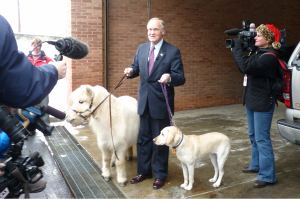
Gov. Jim Douglas has been saying goodbye for a while now. His portrait was unveiled last month in a moving ceremony; he lighted the Statehouse Christmas tree for the last time in December; and he held a final press conference before the holidays in which he gave a fond, if guarded, auf wiedersehen performance for reporters, complete with a real dog and pony show (not to mention Kool-Aid).
In the coming days he’ll greet lawmakers in his ceremonial office, give his parting address to the state and walk up the five flights to his office on the top floor of the Pavilion Building for the last time.
Over the course of his remarkable 38-year political career, including four terms as governor, Douglas has made an indelible mark on the state. Douglas has been in office longer than any other Vermont politician in recent history, with the exception of Sen. Patrick Leahy, who started his career as a state’s attorney in 1966. (Rep. Michael Obuchowski, D-Rockingham, the longest-serving member of the House, is in a dead heat with Douglas – he’s also been in office for 38 years, and he’s stepping down to take a job in the Shumlin administration.)
Douglas was elected to the Vermont House after he graduated from Middlebury College in 1972. At the tender age of 25, and three terms into his career as a representative from Middlebury, he became majority leader of the House. He later became a top aide for Republican Gov. Richard Snelling and then went on to run for statewide office 15 times. Douglas served as secretary of state, state treasurer and governor. He lost only once, in 1992, to Leahy, in a race for the U.S. Senate.
“More people voted for Jim Douglas than have ever voted for anyone else in the history of Vermont,” according to Garrison Nelson, a University of Vermont political science professor. (Nelson himself voted for Douglas “half a dozen times.”)
Even after Douglas announced he would step down from office, his public approval ratings remained high – in a June survey, 65 percent of Vermonters gave the governor high marks. Typically, governors who are in office as long as Douglas has been don’t leave with their popularity intact, according to Chris Graff, the vice president of communications at National Life and former Montpelier bureau chief of the Associated Press.
Such a successful run in politics is no mean feat, particularly for a Republican in a state that has trended increasingly Democratic over the last four decades, according to Graff and Nelson. At a time when Vermont was an anti-war, anti-Bush state, voters continued to cast ballots for Douglas, even though he was a supporter of President George W. Bush.
So what accounts for his immense popularity? How could a “Reaganesque” Republican (Nelson’s term) be successful in Vermont, the most liberal state in the nation?
It wasn’t Douglas’ policies that gave him the edge, Nelson said, which were often at odds with the majority of Vermonters’ interest in maintaining school funding levels and supporting programs for the poor. (In budget addresses over his eight-year tenure, Douglas repeatedly proposed reining in government programs, reducing property taxes, placing caps on school spending, and the like. “The problem is not that Vermonters are under-taxed; it is that government has overspent,” as he put it in 2003.)
What counted when Vermonters went to the ballot box, was Douglas’ personal popularity, Nelson says.
“His personal likability made him difficult to campaign against,” Nelson said. “It was like punching a pillow. He is the most likeable life insurance salesman you’ll ever meet. He’s got this wonderful way of telling unpleasant truths in a pleasant way.”
Graff attributes Douglas’ success as a conservative in a liberal-leaning political climate to his strong ethics, high integrity and uncanny ability to connect with people.
“Vermonters felt he was watching out for him, whether on fiscal matters or whatever, and that’s why he managed to succeed all these years,” Graff said. “Of all the politicians I’ve known he’s the most humble. To get into that business, you need an ego … I’m sure Jim Douglas has an ego, but I don’t think it was in evidence. He came across as a normal guy.”

Nelson agreed: “He wasn’t like Dean or Snelling — tough guys who knew they were smarter than you and wanted to let you know it.”
Douglas crisscrossed Vermont on an almost daily basis, typically logging in 15-hour days in the office and on the road. He worked seven days a week.
Douglas’ due diligence set the standard for political glad-handing, Nelson said. “He is far and away the most ubiquitous politician in the state,” he said. “There isn’t a street corner in the state Jim Douglas hasn’t set foot on. He’s by far and away the best retail politician the state has ever seen.”
Though the governor was mercilessly ribbed about his frequent appearances at ribbon cuttings and other events (the late Seven Days columnist Peter Freyne dubbed him Governor Scissorhands), Douglas takes these encounters with Vermonters very seriously. The governor is renowned for his flawless memory for the names of constituents and details about their families.
Tom Evslin, an entrepreneur and former Douglas administration official, said the governor’s interest in Vermonters is genuine. Douglas doesn’t, like many politicians, look over the shoulder of the person he’s talking with to search out the VIPs in the room (a common exhibition of poor manners exercised by many pols).
Freyne’s “scissorhands” moniker would have stuck if Douglas had been an absentee governor, according to Graff: “You never had a sense he (Douglas) didn’t know what was going on in state government.”
In an interview in his office in November, Douglas said his personal connection with constituents has been the best part of his job.
“The state is my office,” Douglas said. “That’s where I get ideas and energy and get what I need to do a better job. That’s what I’ll miss … getting around the state as much as I have, seeing people do good things, succeeding in a business or a community activity or organization – somehow making Vermont even better. That’s what I enjoy the most.”
Graff put it this way: “A lot of politicians talk about being here to serve the people. I think he truly believes that, and I think Vermonters understood that.”
An interest in working across party lines
Douglas displayed a level of bipartisanship on the state and national levels that has become a rarity, according to retired Middlebury College professor Eric Davis.
Douglas was the first governor to meet with President Barack Obama, and as the chairman of the National Governors Association, he worked with the president to promote the federal stimulus bill. During the State of the Union address in 2009, he sat near Michelle Obama.
Though he vetoed Vermont’s 2009 gay marriage bill (the House overrode the veto), Douglas is less socially conservative than his preferred successor, Republican gubernatorial candidate Lt. Gov. Brian Dubie.
“In his willingness to work across party lines, Douglas may represent the end of an era,” Davis said.
Douglas is not only one of the last of the Aiken-style Republicans, according to Davis, but also he “might have turned out to be the last Republican governor of the state for a very long time.”
According to Election Day exit polls, 25 percent of Vermonters self identified as Republicans, Davis said. The last Republican presidential candidate to win Vermont’s electoral vote was George H.W. Bush in 1988.
“If you break down the numbers, the core Republican voter is older; it’s people who tend not to have a college degree; and they’re concentrated in parts of the state that are not growing,” Davis said.

The areas of the state that are trending heavily Democratic are the “economic engines of the state” – Chittenden County and the Connecticut River Valley.
“I think Brian Dubie’s 47 percent may have been the high-water mark for a Republican gubernatorial candidate,” Davis said.
Douglas’ retirement may be indicative of another shift. Like U.S. Sens. Jim Jeffords and Bob Stafford, the governor, Davis said, entered politics at an early age and proceeded to make a lifelong career of it.
Davis predicted that in the future, there will be fewer “political lifers.” Instead, mid-career professionals will turn to politics in middle age. Rep. Peter Welch, D-Vt., Democratic Gov.-elect Peter Shumlin and
Republican Lt. Gov.-elect Phil Scott, for example, all pursued other work before they were first elected to the General Assembly and then sought higher office.
“Details weren’t beneath him”
Tom Evslin, who was persuaded to come out of retirement to work with Douglas as Vermont’s chief technology officer, had a unique vantage point to observe the governor on the job. “There’s no one who has a better grasp of how Vermont government works,” he said.
Douglas was successful because he had a deep understanding of state government, and he knew state statutes inside out, Evslin said.
The message he conveyed to the public was extremely important to Douglas, and he regularly vetted press releases, speeches and proposed legislation with a keen eye for errors and grammatical faux pas. Evslin characterized Douglas as a detail-oriented manager.
“The details weren’t beneath him; he was interested in getting it right,” Evslin said. “He is a careful person, and he had deep knowledge. It’s a view most people didn’t have — you’d have to work with him to see that.”
Evslin said it wouldn’t be fair to call Douglas a micromanager because he gave his staff a lot of room. “He expected you’d go on your own, until the time came to ask his opinion or warn him of a potential hubbub,” Evslin said.
The governor paid careful attention to those he appointed, Evslin said, and he was close to his top staff, particularly Neale Lunderville, secretary of the Agency of Administration; Susanne Young, his legal counsel; and Jim Reardon, commissioner of the Department of Finance and Management.
“They knew him well, and he knew them well,” Evslin said.
Lunderville and Tim Hayward, his chief of staff, were crucial go-betweens with the Legislature. Evslin described Douglas’ team as hardworking, smart, disciplined and able to work across party lines.
Hayward was the disciplinarian, and Lunderville had the grasp of numbers and management skills to run the “backoffice of government,” Evslin said.

“Last session would have been a disaster if it weren’t for the good relationship Neale had with (Speaker of the House) Shap (Smith) and Obie (Rep. Michael Obuchowski),” Evslin said.
Douglas’ impeccable memory came in handy when it came to policy matters. He was a very quick study, Evslin said.
In briefings before press conferences, particularly during the legislative session when he might be alerted to new complex policy matters 15 minutes before he went before the cameras, Evslin said, the governor not only absorbed the information, but he could “say better than yourself what you’d hoped he say.”
Though he didn’t write his own speeches, he worked over the drafts until he owned them. Then Douglas, who didn’t use a teleprompter, set to work rehearsing them. “The reason they sounded right is because he would mold every speech,” Evslin said.
His farewell address on Wednesday afternoon will likely be no exception.
A push-pull relationship with the Legislature
Policywise, according to Davis, there is a distinction between Douglas’ first four years in office and his last four years. Early on in his tenure, when Republicans were more of a force in the House and Senate, Douglas had fewer political hurdles to overcome. Later, he didn’t have the votes in the General Assembly to push through initiatives without compromise.
From 2003 to 2006, Douglas worked with the Legislature to pass major bills, including: Act 68, education funding reform legislation that raised the sales tax to help diversify funding sources for the state’s schools; Act 250 permit reforms that helped to make the application process more predictable for developers; and a health care reform bill that included the creation of Catamount Health and the Blueprint for Health.
“In his first two terms, Republicans still had control of the Senate and the House,” Davis said. “In the first four years, Douglas was able to work with Democrats in the Legislature on things like Act 68 and Catamount Health.”
At the time, Democratic Senate President Pro Tem Peter Welch was interested in working across party lines because he was building a record to run for Congress in 2006, Davis said.
Because of these factors, compromise was the name of the game, and neither Douglas nor the Democrats got exactly what they wanted, Davis said.
“Because of the nature of his personality, he was able to forge majorities in a Democratically-controlled Legislature,” Nelson said of Douglas. “He is not a polarizing figure — he didn’t lecture people. He brought a high level of civility to the state.”
Once the Legislature shifted toward a predominantly Democratic body, it became more difficult for Douglas to set the agenda. After 2006, many of his initiatives were thwarted, and over the last few years of his tenure, Douglas constantly referred to the “Democratic supermajority” as the source of proposals that would lead to runaway spending (even though the Legislature agreed to major cuts). In his weekly press conferences, he made a habit of chiding the General Assembly for plans that ran afoul of his goals and personal convictions.
In 2009, his battle with the Legislature came to a head. Douglas vetoed the same-sex marriage bill in April 2009, and the Democrats overrode the veto the next day. The Democratic majority flexed its muscle again in June 2009, when lawmakers voted to override Douglas’ veto of the state budget.
It was the first time in the state’s history a General Assembly had exerted such power.

Davis said in the last few years Douglas spent more time resisting things the Legislature wanted to do than pushing his own initiatives. The General Assembly wasn’t interested in wholesale education reform and relicensing Vermont Yankee, according to Davis.
At the end of the last session, enough good will was restored so that the Douglas administration and the Democratic leadership were able to agree on significant reforms: an overhaul of the bankrupt Unemployment Insurance Trust Fund, a rollback of capital gains and estate taxes, and the Challenges for Change government restructuring plan.
Still, Douglas leaves office with a few regrets. He believes Vermont has a relatively high tax burden that will cause “a drag on our economic future” and “exacerbate the demographic shift.”
“We’re the second oldest population by median age, and I really believe one of the major reasons is taxation,” Douglas said.
His biggest disappointment? “The unwillingness of the Legislature to wrestle with school funding and property taxation.”
The legacy thing
Will Vermonters remember what Douglas tried to accomplish 10 years from now?
Not likely, according to Chris Graff.

“Governors are not like presidents,” Graff said. “We’ve already got books about Bush, trying to analyze his presidential legacy. You never see that on the state level. After Jim Douglas leaves, he becomes part of history. There isn’t much attention to legacy.”
Graff says gubernatorial legacies often boil down to an impression that can often be summed up in one line.
Gov. Phil Hoff, for example, made significant changes in the state’s political and social infrastructure over the six years of his tenure. He ended the Overseer of the Poor system and founded the Vermont District Court system, the Judicial Nominating Board, the Vermont State Housing Authority, and Vermont Student Assistance Corp.
“We only remember him, if we do at all, as the first Democratic governor,” Graff said. “Deane Davis was Act 250; Madeleine Kunin was the first woman in office; Dick Snelling was a pretty amazing governor, and how do we remember him now? — oh, he died in office. As for Howard Dean, we don’t think of his most recent role as governor, we think about him running for president.”
Under Graff’s rubric, Douglas’ defining sentence would be: “He was a Republican governor in a Democratic time.”
