

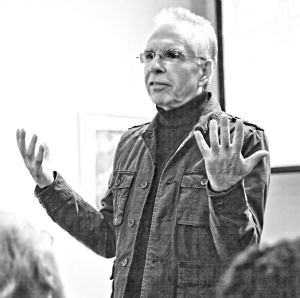
BURLINGTON – Helmo Hernandez, one of Cuba’s most respected ambassadors of the arts visited Vermont this week, thanks to a small Burlington nonprofit.
Hernandez, the president of the Ludwig Foundation of Cuba, had heard other Cubans in the arts world talk about the Vermont Institute on the Caribbean, so when its executive director invited him to explore setting up a permanent program of cultural exchanges, he accepted.
The Vermont Institute on the Caribbean’s founder, Marisha Kazeniac, has taken groups to Cuba from the Flynn Center for the Performing Arts and Preservation Trust of Vermont, put together a New England tour of Cuban art and helped sponsor a residency for a young Cuban artist at the Vermont Studio Center. This year the Institute received a grant to establish art exchanges with Cuba.
There is a long, if forgotten, history of cultural exchanges between Cuba and the United States. In 1958, at the time of the Cuban Revolution, “Cuba was the most American country outside the United States,” Hernandez said. In part, that was because in the 20th century, Cuba was the place where large American corporations were “rehearsing globalization.” But Hernandez traces the country’s cultural ties with the United States back much farther than that.
Cuba’s national hero, José Martí – a literary icon who was an exemplar of the Modernist movement and a leading advocate of independence from Spain – lived in exile in New York City for the last 15 years of his life, writing for the New York Sun as well as for several Latin American newspapers. Martí grasped the difference between the banal and the best in American culture, Hernandez said. He was a great admirer of Walt Whitman.
Hernandez maintains that the break in relations between the United States and Cuba resulted from the American government’s fundamental misunderstanding of the nature of the Cuban Revolution.
“It’s a mistake to think that the Cuban Revolution started as part of the Cold War. The Cuban Revolution was part of the Third World Movement,” Hernandez said. “The main goal of the Cubans at that time was independence and social justice.” Cuba had no interest in being part of the Easter European or Chinese sphere but was forced into alien connections through a lack of understanding on the part of the United States, which viewed the revolution through the lens of the Cold War.
“The Cuban Revolution was part of the Third World Movement,” Hernandez said. “The main goal of the Cubans at that time was independence and social justice.”
Hernandez, a slim, exuberant man with cropped gray hair and a degree in art history, began his career as a university professor, developed theater arts programs and organized international theater festivals for a dozen years at the Ministry of Culture and, after being named advisor to the president of the National Arts Council in 1989, began developing programs to promote emerging artists.
In 1995, Peter and Irene Ludwig, German collectors of contemporary art who bought and exhibited Cuban art internationally, established the nongovernmental foundation that bears their name. Its mission was to strengthen Cuba’s relation with cultural communities abroad, especially in Europe and the United States. Hernandez became its president.
Havana has always been cosmopolitan. “Cuba is for dialogs,” Hernandez says. Since colonial times, people from many countries have converged on the island and exchanged ideas.
He notes that during the first 50 years of the 20th century, the country’s intellectual elite supported vibrant cultural institutions. Alicia Alonso founded the Ballet de Cuba. The ideas of Lee Strasberg, Bertolt Brecht and Constantin Stanislavski were introduced into the Cuban theater. Abstract expressionism influenced Cuban painters. In the 1950s, Cuba’s television system was as advanced as that in the United States.
But the embargo initiated a period of cultural isolation, especially from U.S. institutions. “One of our most important roles is to re-establish the relations, or the bridges, with the leaders of American institutions,” Hernandez said, naming America’s leading art museums and art schools, and adding Burlington College, “which is (in Cuba) every year.”
When the Ludwig Foundation was first established, it focused on supporting visual artists. Since then, it has widened its spectrum to include “all that could be considered part of Cuban experimental contemporary culture,” both in Cuba and abroad. A parallel goal is attracting new – especially young – audiences in Havana and the provinces to the arts. Hernandez explains that the ultimate goal of strengthening the arts is to strengthen civil society.
Every Wednesday the foundation hosts what it calls an Inventario – an “uncensored” show of all a young artist’s works. “We say openly, ‘This is not an exhibition.’ You are in the middle of the process of finding your own way of expression, so we want you to be able to be generous enough to open your process for other people to see and to discuss.” The show is an all-day open house on the foundation’s terrace, with a free bar. “It gives a chance for Cuban young people to meet without spending money, and they talk with the artists,” he noted.
The artists are required to give a slide show between 2-3 p.m. illustrating the entire development of their work and to explain what they are looking for. Guests ask questions and challenge them, without implying that they are looking at a finished work. Hernandez says, “This is the respect that any experimental work deserves, to be considered as part of a process. In my opinion, this is one of the main characteristics of the arts, to be part of a permanent process.”
“Our culture is still the shell that protects the soul of the nation – that gives the soul the possibility to develop, to grow.”
The Ludwig Foundation of Cuba does not have a Web site because Cubans don’t have Internet access. That means the foundation has had to find other means of sharing its collection with Cubans. Using its audio-visual information center on contemporary culture, the best in the country, it is digitizing all its materials – creating a “digital clone” in the form of DVDs and hard drives – and distributing the material to schools and other institutions all over the country that can share the foundation’s collection with the public.
Why this sense of urgency about providing a platform for emerging artists?
“In the Western world – and we are part of the Western world, without any doubt – the main role of the arts since the second half of the 19th century has been to be part of the critical consciousness of society,” Hernandez said. “We have seen Cuban avant-garde culture as a resistance movement. Resistant to what? Resistant to the penetration of the banalization of ideas, trying to go farther, beyond consumerism. Trying to be, yes, critical but trying to better understand the sense of beauty.”
Through all the changes that Cuba has experienced in the past 50 years, he said, “Our culture is still the shell that protects the soul of the nation – that gives the soul the possibility to develop, to grow.”
Hernandez contrasted the “banalization” of tourism with cultural exchanges, which contribute to strengthening the shell through dialog. He accepted the invitation from the Vermont Institute on the Caribbean to form a cultural exchange partnership – he believes it will benefit both Vermonters and Cubans.
Hernandez said he admires how “proud Vermont is of its own memory.”
“I think Vermont is a kind of jewel,” he added, “because there’s a sense of preservation of life, preservation of memory, preservation of values different than ours that we must receive from Vermont in some way.”
Disclaimer: The author has previously consulted for the Vermont Institute on the Caribbean.

