

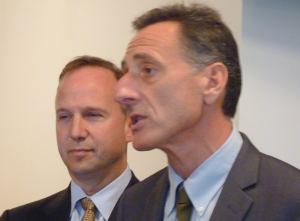
At dueling press conferences on Monday, the two rivals for the governor’s office met with tech industry business leaders and agreed on one thing: Vermont businesses need blanket broadband coverage — ASAP.
Lt. Gov. Brian Dubie, the Republican candidate for governor, and Sen. Peter Shumlin, the Democrat, both said Internet access is essential for the state’s businesses.
Listen to the podcast:Lt. Gov. Brian Dubie, press conference, Oct. 25, 2010 Courtesy of FOX44.
According to a map from Vermont Telecommunications Authority, more than 85 Vermont towns – out of 256 – lack broadband Internet access. At the same time, more sectors of the state’s economy, including education, health care and media, are become increasingly digitized.
Each candidate assigned blame for the state’s lack of adequate coverage, especially in the mountainous parts of the state, to different sources.
Shumlin cast aspersions on the leadership of Republican Gov. Jim Douglas and Dubie, by association. Dubie said the state didn’t have the money – until now, thanks to federal stimulus funds – to pull it off.
Shumlin also blasted the Douglas administration for missing its self-imposed 2010 deadline for statewide access. For 90 percent of his early morning drive through northern Vermont on Monday, Shumlin said he couldn’t get cell service. He stopped to use a landline at Sterling College during his tour of the Northeast Kingdom.
“We’re in the Middle Ages here,” Shumlin said. “The state of Vermont is behind Slovakia and Romania. The developing world has us beat. I have been in Danang, Vietnam, I have been in Malai, and I’ve had faster cell service than in Putney or the Northeast Kingdom.”
Shumlin said Douglas and Dubie should be held accountable. He said after health care costs, inadequate broadband service is the second biggest obstacle to success for small businesses in Vermont. The policy statement was quickly followed by a critique of Dubie.
“The lieutenant governor says he wants to get it done,” Shumlin said. “The obvious question is, why didn’t he? If you have a state chief executive who promises me they’re going to create jobs and get broadband to every last mile and provide affordable health care, and you fail on all three counts, I would say, fire the management,” Shumlin said.
Reporters asked Shumlin if it was fair to lay the blame at Dubie’s feet, as the lieutenant governor’s role is largely ceremonial. “The promise was made,” Shumlin said. “We missed it.”
Shumlin appeared at Kelliher Samets Volk with Delaware Gov. Jack Markell, the chairman of the Democratic Governors Association.
In an earlier press conference at Vermont Systems Inc. in Essex Junction, journalists asked Dubie why the administration didn’t meet its 2010 deadline. He said: “You’d have to ask Gov. Douglas that question. As you know, I’m an independently elected lieutenant governor; the governor set an expectation. I have briefed the governor. I said it would be a very important question for you to be able answer to the people of Vermont that question. You set an expectation. I think you have answer for it, but I think it’s probably more appropriate coming from the governor.”
Dubie pinned the failure to get broadband to every town in the state on external forces, namely topography and the rural nature of the state. But now that the federal government has given the state $172 million in broadband stimulus funding, he says the “pieces of the puzzle” are coming together.
Dubie said the creation of the Vermont Telecommunications Authority and the expedited siting of cell towers are also crucial in order for Vermont to become an “e-state.”
“When I look at Tom Evslin and say, no really, can we achieve the expectations of an e-state?” Dubie asked. “The answer I’ve heard is yes, the pieces of the puzzle are now in place. We should be able to meet that expectation, especially in rural Vermont.”
The candidates’ approaches to broadband deployment aren’t substantially different.
Dubie and Shumlin both proposed extending Act 248, the law that allows for the expedited siting of cell phone towers, beyond its June 2011 expiration.
They even came up with a similar deadline – both say the state has to achieve the oft-repeated nostrum “broadband to every last mile” by 2013.
Their modes of getting there, however, do differ.
Dubie puts his faith in VTel, the Springfield, Vt.-based company owned by Michel Guite (a major contributor to the Vermont GOP). The federal government awarded VTel $81 million in grants and $35 million in loans to build out fiber-optic and wireless infrastructure in Vermont. Guite told Vermonters last month that the company will contribute an additional $30 million in equity. He has proposed bringing fiber optic cable to 200 “anchor institutions” around the state — cutting-edge, “fourth- generation” wireless network for the nearly 100 Vermont communities that lack broadband service.
“I’ve talked to Michel Guite about his timeline,” Dubie said. “VTel has a very comprehensive contract that will be executed. The federal government and the Department of Public Service will be in the midst of that. … There is a detailed statement of work with specific milestones to demonstrate that all the taxpayers of Vermont expectations of transparency, of fulfillment of milestones, are achieved.
Shumlin proposes a more hands-on approach. He wants to devise a plan based on advice from leading experts in the industry, and he envisions creating cooperatives and public-private partnerships.
“If you elect me governor, we will deliver to every last mile high-speed Internet by 2013, and we will do it by bringing together all the providers of the state, putting together a comprehensive plan and moving like a jack rabbit to get it done,” Shumlin said. “We cannot grow jobs; businesses like this cannot succeed unless we get it done.”
He also suggested that he would push for hard-wired cable line where feasible.
“I’m a fiber guy,” Shumlin said. “We have to get as much fiber to the state as we possibly can. I’m also a finance guy. I’m a conservative fiscal person; (we) can’t spend a $1 and take in 50 cents. We have to figure out how far we can get the fiber.”
