


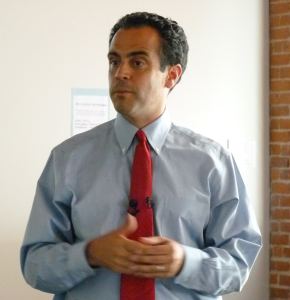
Matt Dunne laid the blame for a significant decline in Vermont business startups at the feet of Republican Gov. Jim Douglas on Monday.
The total number of businesses launched in the state dropped significantly from 2003 through 2009, from a high of about 2,700 new companies to a low of about 1,800, according to a chart Dunne presented at a press conference in Winooski. The chart was based on data from the Vermont Secretary of State’s office.
Dunne, one of five candidates in the Democratic gubernatorial primary, told an audience of several dozen reporters and business owners that the sharp dropoff began the year the Douglas administration began in 2003, and he made a point of singling out Lt. Gov. Brian Dubie, the sole Republican candidate for governor, for a share of the blame.
Dubie has been campaigning hard on a pro-business platform, with a sharply different view of the state’s economic difficulties, blaming too much government, taxation and regulation.
Dunne countered Monday, “We are losing ground and losing ground quite dramatically.” The state, he added, “doesn’t have the farm team for the next generation of IDXes.”
The former state senator asked rhetorically, “What went wrong?”, and then proceeded to tick off a list of missteps. Dunne said the Douglas administration failed to implement a comprehensive business plan, to invest in higher education, to foster discussion between state leaders and business leaders, to address the state’s complex tax structure and regulations, and to find a way to stem the burdensome costs of doing business in Vermont – particularly escalating health care expenditures.
All of these factors are stifling the state’s economic growth, Dunne said.
Though Vermont has topnotch quality of life and education ratings compared with the rest of the country, its business rankings, according to a recent CNBC study, are near the bottom. Vermont is ranked 40th for technology and innovation, 46th for transportation and infrastructure, 43rd in cost of
living, 37th in business friendliness and 40th in access to capital for businesses.
“Vermont succeeds when it sends out intellectual property and brings in cash – whether it’s value-added food, software or comic books,” the Google community affairs executive said.
State government needs to take a fundamentally different approach to the economy, Dunne said, because the state is not a “sweet spot” for large out-of-state corporations. In his view, small startups create a necessary economic “churn” when they grow successful enough to be acquired by bigger
companies. Vermont should also focus on the “creative” economy, communities that attract congregations of innovative artsy people; its “place-based” economy, that is its parks, downtowns and tourism; and the “slow money” economy, investments in agriculture, food markets and historic preservation.
He said the state’s brand potential, its natural beauty and convenient location – near Montreal, Boston and New York – give entrepreneurs a distinct marketing advantage that has not been capitalized on. In addition, the state’s high bond rating should enable it to make revenue bond investments in broadband that would give Vermonters Internet access “to the last mile of every town.”
The broadband investment would create 5,270 jobs and bring an influx of $275 million into the state, according to a study he cited from “Connected Nation.” As governor, Dunne said he would also create a “pre-permitting system” for redevelopment of 4 million square feet of unused industrial space in Vermont. He called for investments in rail and air transportation for business travel, “next generation” agriculture, including an “Intervale” in every county, as well as shared processing facilities and slaughterhouses.
Dunne would give small businesses access to capital through micro-loan programs, a capital gains tax incentive for investments in Vermont companies and an expansion of the “seed capital fund” for startups.
He proposed a “service scholarship” program to reduce the high debt load carried by Vermont college graduates and additional funding for job training, preschool and higher education.
Health care costs, which are rising at a rate of $1 million a day, are too burdensome for local companies, he said, and he proposed a self-insurance plan for the state that would put the administration of health care in the hands of one insurer regulated by the state.
He also said the “management culture” in Montpelier needs to change. Dunne said the regulatory process needs to be more predictable, and government spending on private contracts ought to be more transparent.
“We are in the dark ages as a state and we’re unable to take advantage of the resources we have,” Dunne said.
Dunne is the fourth Democratic gubernatorial candidate to release an economic development plan in the last few months. He did not release specifics regarding the costs of the aforementioned programs.
Read a copy of Dunne’s report, “The Innovation State.”
