

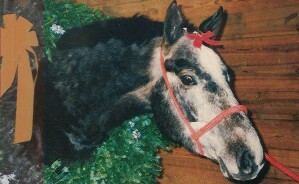
“A fiery horse, with the speed of light, a cloud of dust and a hearty ‘Hi-Yo Silver!’”
“The Lone Ranger” intro
Return with us now to those thrilling days of yesteryear. Well, okay, they weren’t so thrilling, and it was only last year, but there was still plenty of drama. So cue the “William Tell Overture:” Exactly a year ago, just after his 16th birthday, my beloved horse Silver was stricken with kidney failure.
This is the story of Silver’s life and near-death experience. And while I’d love to know whether he saw the tunnel and the bright lights, he’s not talking. He may be my TV star, but he’s no Mister Ed.
In the 12 years since I’ve owned horses, I thought I’d seen it all–my share of colic, founder, mystery lameness and recalcitrant eye problems. That was before I found Silly half-dead in his stall, covered in a foul-smelling muck that soaked the walls and ran out the front door, early one Saturday morning after his triumphal dressage debut in Florida–the one that would almost kill him.
Having had primary care of our horses for most of the last 12 years, we knew the procedure for horse emergencies. First get him up–a horse that is down too long is down for the count. Then listen for gut sounds (roiling loudly); take his temperature (way below normal); and get the vet out ASAP.
The first blood test results later that afternoon pointed to an attack of colitis, likely brought on by the stress of the dressage show in hot weather, which led to dehydration and diarrhea and caused kidney failure–literally overnight. Kidney failure in horses! I wasn’t expecting that–but, then no one expects the Spanish Inquisition.
There had been no real signs before his collapse. But some horses, like Silver, are so stoic in nature that they display no physical discomfort ’til it’s an emergency. Since there is no dialysis for horses, our only course of treatment was IV fluids, antibiotics, probiotics, antacids and plasma. In short, he would be on life support.
I couldn’t lose Silver now. I’d had him a dozen years; he was way too young. We’d been through so much together and only just now were coming to an understanding.
Call him Silly, call me insane for buying him
Back when I’d only been riding for three months, I decided I had to have a horse of my own. Never having ridden as a child, my inner 6-year-old would not be denied. He was both the first and last horse I looked at that day at the sales barn in Maine. I took an instant dislike to his braided tail–he looked like a horsey Willie Nelson–and to his arrogant expression as he appraised me from the corner of his stall. Did I want to see him, they asked? No thanks, said I. Several hours later, having tried every other horse in the barn, it was Silly or nobody. Turned out, he was actually by far the nicest we had seen, related to two of the top quarter horse sires of the past 100 years.
So Silly it was. Silly the anxious; Silly the high-strung, opinionated and stubborn, who liked to argue and would “fight you on one hoof; fight you with his hooves tied behind his back; fight you with his eyes closed.” Silly who was convinced that, in riding matters, you were wrong and he knew better. Silly who tossed me two dozen times in the first four years I owned him, Silly who had dumped far better riders than I. Silly the quarter horse, who I liked to joke was “One-quarter horse–and we’re not sure what the other three-quarters are.”
Call him Silly and call me insane for buying him. I soon realized how ill-equipped I was for the enormous responsibility of horse ownership. And I had one giant 1,000-pound case of post-partum depression. What was worse, I would be totally dependent on my trainer, who had certain characteristics in common with the bad guys from my childhood.
Horses seem to attract both the abused and the abusive–it’s a pattern I’ve seen over and over again.
Horses seem to attract both the abused and the abusive–it’s a pattern I’ve seen over and over again in my years as certifiable (horse-crazy). And Silver and I were both victims of abuse at a very young age, which shaped our anxious personalities. He was basically me in a horse’s body. Shown competitively as a 2-year-old, he had no childhood, having grown up in a quarter-horse factory with all work and no play (turn-out). I did not understand the emotional complexity or intelligence of horses back then, but for the first few years I owned him, when I looked in his eyes I could see there was no one home.
Like many AQHA (American Quarter Horse Association) prospects, he had been trained as a Western Pleasure horse, which I would come to re-dub Western Misery for the harsh methods sometimes used in training these horses. If he didn’t bend easily enough to the left, the poor horse would spend the night in his stall with his head tied to that side. He was ridden with a severe bit, which would be yanked straight up whenever he would make a mistake or pick his head up above the desired low-slung headset. So he literally kept his head down, to stay out of harm’s way. Often he would be saddled and left to stand around for hours, like in some old Western.
Now, a four-year-old and a four-month-old in riding terms were not the best match. His lovely, rangy trot bounced me around and threw me off balance, terrifying me. I had not been riding long enough to have much of a seat, so I would grab the reins, and consequently his mouth, which was the fastest route to ejection, tripping off the claustrophobia of his Western Misery days.
My trainer was only too happy to take over much of the riding. She quickly became verbally abusive when she did teach me, and before I knew it I was forbidden to ride my own horse. I felt totally at her mercy, scared of Silver, and suddenly found myself thrust back into my childhood–trusting and unable to see I was being abused. Surely it must be my fault.
Three months into horse ownership, Silly and I fled to another barn, but not before I finally awoke to what was transpiring, standing up to the trainer as I had never done to my childhood abusers–empowered by a horse. In six short months of riding, I had revisited my childhood and triumphed–at least for now.
At my second barn, I lent Silly to a college student who needed a horse to ride, and took lessons on him. But I found myself not riding him for months on end after a particularly bad scare or a fall: It was torture to watch other people riding him.
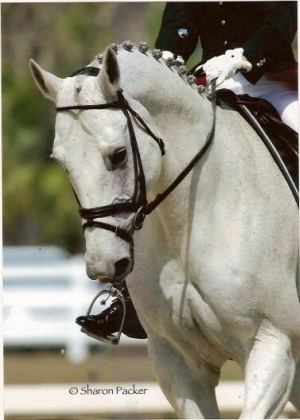
Age 7 brought Silver’s rebellious teenage years and my decision to give dressage a serious try. And thanks to just the right trainer who pushed him too hard, too fast, Silver broke down, probably exacerbated by a fall a few months before in mid-tantrum on the lunge line. To my horror, he slid almost the entire length of our outdoor ring on his side.
After the fall, Silver became increasingly intractable, probably in pain though not lame. He was volatile while being ridden and difficult to handle, refusing to stand still for saddling, sometimes kicking out and even sweating profusely before the ride.
Within two short months in training, he was totally lame. After extensive diagnostic tests at a Massachusetts vet hospital, the prognosis was bad. There seemed to be multiple problems with his back and stifle, and they doubted he would ever be sound again. He was now broken both emotionally and physically.
But Silver and I had finally bonded. He seemed to know we had tried to help him.
After a year off, to our astonishment, Silver recovered. My husband decided we would start him over, using groundwork and natural horsemanship, and slowly, painstakingly we progressed to riding. Eventually I, too, would begin again on Silly.
A predilection to fight saved his life
Flash forward, 10 years later–one year ago: He had stayed sound, and we were carefully back at it with dressage, largely to get him off his forehand to preserve his joints. My friend Danielle wanted to show him at a sanctioned USDF (United States Dressage Federation) event. Unfortunately, this involved three trips in three days to the nearby showgrounds, and Silver hated loading into the trailer. Each time, a longer and more protracted battle ensued, with Silver refusing to climb the ramp, and if he did, backing quickly out, flying first off one side then the other–a frightening sight–and threatening to rear rather than load. Eventually he got on, but he did not go gently.
At the show, Danielle mounted, and he just started backing up with her–one of Silver’s many anxious evasions, a repertoire that included balking (refusing to enter the ring); executing a 180-spin-and-gallop-off in the opposite direction with his rider; bucking and rearing. I guess if I didn’t want him to rear, I shouldn’t have named him after the Lone Ranger’s horse.
With much effort, he settled in at the show, coached by my friend’s trainer, an Olympic rider, who approved of Silly: “He’s got really lovely gaits–he looks like a warmblood.” By the end, he’d won third and fourth place behind professional riders on much fancier mounts.
Exactly six days later, here stood Silver in his makeshift ICU after the vet’s visit, hardly healthy as a horse. Weak but still standing, he was hooked up to an IV drip hanging from the top of his stall, so he could move around. The initial blood results that measured his kidney function were very bad. His “packed-cell” count was high–so high my vet would later confide to me that she’d never seen a horse with such elevated numbers survive.

All we could do now was wait–hope the diarrhea would cease and that his kidneys would begin to function again without help. So began the daily blood tests and ritual of hooking him up to fluids in the morning and again at night. Every morning Danielle, a former vet tech, would come and draw a blood sample, and my husband would drive it down to the vet’s. The awful truth: He was literally living blood test to blood test.
If the test results were grim the first day, they were even worse the second. “We’re treating the horse, not the numbers,” said Naomi, our vet, trying to offer some encouragement and give Silly a chance to pull out of his death spiral.
We monitored him nonstop that second night–one of us always with him, the other watching from the house only 30 feet away.
Silver shifted uncomfortably on his feet but stayed upright, and as the minutes passed began to hang his head lower and lower. We knew the other horses would likely warn us if his condition worsened. Scout, the paint, his best buddy (named after Tonto’s horse), draped his head over the stall wall into Silver’s looking alarmed. Normally, a Scout incursion would be greeted with flattened ears, a threatening swat of the head or a cow-kick, but his friend was past caring. Silly’s pal Jester the palomino (a Trigger look-alike) had been in similar shape four years before in Scout’s stall–and it was Silver who had looked concerned. In fact, when Jester collapsed in a paddock, Silver and Bailey, my Connemara pony, had tried to get him up–Silver nipping at his neck and Bailey pawing at his hind end–assisted by my husband in the middle.
“It’s up to you Silly,” I encouraged as I nuzzled his neck. “You know we love you. But it’s your decision to stay or go.” He had a vacant look in his eyes–like he had already gone. I had seen this same look before our other two horses had died. I imagined Red and Jester waiting for him in horsey heaven.
Silver became agitated and looked like he was going down but then resumed his droopy-headed posture–quieter and weaker than before. Around midnight, my husband went out for his turn–distraught but trying not to show this in front of Silly. He began stroking him all over, and he would later tell me that he had said a prayer. Suddenly, Silver raised his head and began eating some hay–the first time he’d eaten in two days.
Silver’s predilection to fight, always such a liability, would serve him well in the days to come. We still had a long, long way to go. He could not stay on life support indefinitely, and his uncomfortable shifting was and would continue to be cause for alarm. Horses in such fragile condition can begin to recover only to have founder claim their lives. Along with all our other ICU duties, we were to apply ice packs to three feet, which he hated. Meanwhile, the horrendous diarrhea continued.
But slowly, slowly, his blood tests began to turn around–he continued to eat and drink a little on his own. But he needed our full attention, and we were already all exhausted. At 1 a.m., we’d be fiddling with tiny caps in the dark, praying we’d be able to cap off the IV correctly.
Twice in the next 10 days, he would escape his stall with the IV attached to his neck, desperate to be free. Twice it had to be sewn back in.
Miraculously, through eight more sleepless nights and worried days we were able to disconnect him on the 10th day. No guarantees that he wouldn’t just relapse and we’d still lose him, warned Naomi. But hours and days turned into a week and then two–all the while founder a concern, and now an elevated heart rate, which would take almost two months to return to normal. His body had been so stressed that his heart was working overtime to regulate all its systems.
Silver would turn his head to look at me sympathetically as I sat crying, struggling with my fear and pain.
He was too weak to even eat a carrot, and still not interested in grain. He would lose all his muscle and about 300 pounds, a sickly shadow of his stocky quarter-horse self–the “Horse-enegger,” as I call him.
I remembered how afraid I once was of cantering Silver (he had bucked me off and dumped me too many times in this gait). Now, all I could think of was how much I wanted to feel that rocking-horse canter. It would take me years to comprehend that he was as afraid of me as I was of him. When he would argue and fight, he was just trying to survive the best way he knew how.
We were both survivors. After years of struggling with anxiety while riding, I began having panic attacks and was finally diagnosed with PTSD. The abuse would not be denied–it lived in my body, as did the fear and anxiety–and it was the horses who had unleashed it.
But I had embarked on a therapeutic program that had begun to help. And something really curious had begun to happen. On the days when I was more anxious, Silver began taking care of me: He would turn his head to look at me sympathetically as I sat crying, struggling with my fear and pain. Maybe Silver and I had been brought together for a reason: to help one another heal our childhood hurts.
I had plenty of time, too, to think about decisions I’d made about him over the years, for which I felt responsible. I trusted my trainers because I assumed they must know more than I, yet time after time I made bad choices for both of us based on their advice. And Silver’s grave illness had finally driven the lesson home for once and for all. Now I would trust my own instincts. I knew my horse better than anyone, and I would decide what was best for him.
Most of my waking moments and energy for the next two months would revolve around Silver’s recuperation.
Naomi arrived once for a re-check and blood test to find his heart racing dangerously and his legs swollen. She left us with a warning: He was still quite fragile, and overtaxing his weak heart or running on his delicate feet could be disastrous. But he pulled through.
In the end we would have to postpone our trip to Vermont by almost a month because Silver was too weak to make the 36-hour trailer trip. And it would be June before I could begin to ride him again–but only very slowly and carefully. It took two months more before he could be ridden normally–a full six months from the day he almost died. But I was so lucky to have him–and so grateful that he had decided to stay.
We’ve sworn off trainers now–even friends just trying to help. It is Silver, ironically, who is finally teaching me to ride.
Silly and I now have a deep, unshakeable bond. I finally understand that he loves me. Horses lower their head to their feet as a sign of affection and submission, and if Silver’s was any lower, he’d be in China.
I always thought it was curious that he never nickered when he saw me. Then one day last spring, when he was feeling better, I saw his lips move and heard the softest nicker imaginable. He had been calling me all these years, but I hadn’t heard him.
Barbara Ann Curcio is a former reporter and syndicated columnist for The Washington Post.

