

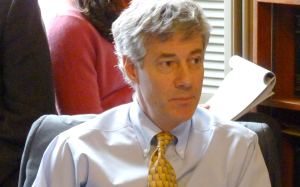
I caught up with Doug Racine shortly after Gov. James Douglas gave his budget address and recommended $53 million in cuts to the Agency of Human Services. Racine, a Democratic candidate for governor, is the chairman of the Senate Health and Welfare Committee.
Q. Could you talk about the $53 million that the Douglas administration is looking to take out of the Agency of Human Services budget?
Doug Racine: I’m concerned about that, on top of what’s anticipated to come out through the Challenge initiative, which is perhaps going to be another $18 million out of human services. Take the two together and it’s a huge hit.
Q. Can you take the two together?
DR: They are booking both. The $18 million is on top of the $53 million. They’re starting with $38 million total in anticipatory savings, and the $53 million is on top of that; that’s my understanding. I’m concerned that those cuts are falling disproportionately on the most vulnerable in our society. Any one of them you might be able to live with, but when you look at proposed cuts in unemployment benefits for those who have lost their jobs, Catamount deductible increases, mental health cuts, Reach Up cuts, other health care cuts, those are all falling on the same segment of the population, which is those who are having the toughest time in this recession.
I chair the Senate Health and Welfare Committee, and I want to look at those impacts. I’m very concerned that they’re falling on those who have the quietest voice around here, or who have no voice at all in the Legislature. So my job is going to be to look at those cuts. I’m going to be very skeptical about them and try to understand the impacts on people and be a voice for those who are receiving those cuts.
You know we all have a job here, and it starts with finding ways to make government more efficient, and I’m absolutely committed to that. There’s no question that Vermonters expect us to do it, and we are doing it, and there’s great cooperation between the Legislature and the administration to try to do that.
But all that aside, these are real cuts on real Vermonters.
Q. So how would you solve the problem (the budget gap)?
DR: It’s hard to be saying we should be cutting direct services to people who are already hurting when we’re sitting on $60 million of rainy-day funds.
Q. But the Douglas administration says they’re making lots of smaller cuts, rather than eliminating programs.
DR: They aren’t eliminating programs, but the point is, smaller cuts in several different program areas affecting the same families is a huge cut. It’s not like eliminating an entire program, I understand that, but that’s sort of a false choice.
Q. Can you play that out with an individual family at some point?
DR: It’s hard to do it because the agency doesn’t like to do that, they don’t like to give us the total impacts, but yes, we ought to be looking at that. It would be good to get a family in that’s lost their jobs and living on unemployment benefits and have a child who has some mental health needs and who are eligible for Catamount because they’ve lost their health insurance and they’re seeing those premiums go up; maybe they’re going to see a property tax increase, (in spite of what the governor said), and ask them about the cumulative effects of all of those different cuts. That’s my job to take a look at those.
Q. So you would use the rainy-day funds?
DR: Yes.
Q. Would you use them in their entirety?
DR: No, I don’t think we can use them in their entirety because the governor is right when he says this is a problem that’s going to continue through fiscal year 2012 as well, unless things turn around before that.
No I don’t think it would be responsible to use them all, but I think they can be part of the solution, and then we could look at those proposed cuts that might have the most severe impact on Vermonters and say, why don’t we use some of the rainy day funds to backfill some of that? I think we need to be careful. We need to be selective, we need to be responsible, but I don’t believe we can cut as much as the Douglas administration has proposed.
Q. What about the rollback on taxes that the governor’s proposing, the $10 million?
DR: They need to be replaced if we roll them back. Frankly, I agree on the capital gains tax. That isn’t what I supported last year. I believed that we did need new revenues. Everybody in this building talked about new revenues. Everybody likes to say we can’t talk about tax increases here, but the Legislature passed $25 million in new taxes, plus the gas tax. The governor approved the gas tax and wanted a property tax increase instead. We were all talking tax increases.
But I believe the estate tax cut had some unforeseen consequences for Vermont families.
Q. Such as?
DR: Such as changing the way they are structuring their estate planning, their business transitions, their passing a business on to the next generation — things that I don’t think the Legislature fully understood when that passed. It wasn’t a good process. The folks that I talk to who are higher income said we know we’re going to see a hit; use the income tax — it’s fair; it’s transparent; and it’s not going to have a dramatic impact on our behavior and the way we plan for our futures.
We really didn’t explore it properly, and now I’m hearing about it.
Q. What do you think about income sensitivity? What do you think about lowering the $90,000 cap (in the property tax relief program)?
DR: I don’t think we should do that; that’s a tax increase on people who earn in the $70,000 to $90,000 range. They’re still paying the same proportion of their income as other lower income people.
Q. Could you adjust it down $15,000?
DR: I don’t know. I haven’t looked at the numbers. It’s really hard to say. Can you adjust the percentage amount a little bit? Perhaps. But to eliminate it, and see a huge property tax increase for a lot of
Vermonters, I don’t think is the right way to go.
Vermonters are hurting across the board. I think what they expect us to do is to do this in a very fair and even-handed way, and that has not been the case. It’s certainly not the case with what the governor has proposed.
Q. When I look at the long-term gap, it’s $200 million a year for the foreseeable future. So how do you reconcile that over the long haul?
DR: You look for places to cut the budgets, and we’ve been cutting budgets here for two years, and there’s more that can be done. I’ve been part of it, and I’ve voted for it.
Q. Where would you cut more?
DR: I’ve got to look at his budget and see what he has proposed. I believe there are things in there that we could go along with. There will be things I could go along with, and they’re tough. I’ll look at some of the human services cuts and say some of them he talked about as being aimed at doing assets tests means tests for people. I’m happy to look at that. I think it’s important to look at that, so our monies are aimed at those who are the most vulnerable and not those who have other means of protecting themselves. I believe there are things we can do. I have to look at the details.
I support this whole process of making government more efficient. It’s long overdue.
Putting pressure on schools, and putting pressure on our nonprofit sector to do more with less — I absolutely go along with that. Those are important things for us to do, but you get to a point where you’re causing, with further budget cuts, real harm to Vermonters, and they’re Vermonters who are the most vulnerable. They may be our elderly; they may be our kids, children with low-income parents, children with disabilities.
If there are service cuts to those individuals, I want to know what the impacts are going to be.
And then I look at what I call the balanced approach. You look at all of that, you look at the rainy-day funds, and you look at what we did last year, too. Everybody in this building proposed and supported some sort of tax increase. So you try to find what’s fairest and recognize we’re all one community, we’re all in this together. Let’s try to find an approach where everybody in the state is going to feel a little bit of the pinch of these budget proposals. And right now, I think the highest income Vermonters have been feeling the pinch in terms of the decline in their investments, I understand that, but in terms of the direct impact of this budget on people who are not on the receiving end of state services, they
aren’t feeling much at all.
Republican Gov. Snelling in 1991 proposed that kind of balanced approach, and that’s what I think we should look at: (We should) see what the potential is on cutting and efficiencies and look to the rainy-day funds.
