

Budget cuts in state government can appear straightforward on paper. Agency heads find places to trim, or make wholesale changes in personnel, space or services, and the amounts add up to expected savings.
But the process of determining what gets cut and what doesn’t is complicated and can often look like card shuffling.
The way in which several recent budget decisions have been executed by Vermont’s Mental Health Department serves to illustrate in microcosm the Douglas Administration’s priorities, and how difficult it can be to wring savings out of program cuts or office shifts.
Dig Deeper
Documents
For this report, Vtdigger.org examined the department’s recent decisions to shut down the Canteen at the Vermont State Hospital and to move the department from Burlington to the state office complex in Waterbury.
These budget items are in the tens of thousands of dollars and seem like small potatoes relative to the department’s $130 million FY2010 budget, two-thirds of which came from the federal government this year.
But Rob Hofmann, Secretary of the Agency of Health and Human Services, doesn’t see such sums as insignificant. He says closing the Canteen will save $100,000 next year, and he says this is a sizeable budget item in light of the administration’s call for 8 percent across-the-board cuts in every agency.
“The state is facing this enormous shortfall. I liken it to we’re on the 3-yard line and we have 97 yards to go to balance the budget, and folks are saying we should go back a yard and not make this difficult choice,” Hofmann says. “Some people in the (mental health) community are concerned, but I think the majority of Vermonters are concerned that we have an obligation to manage the programs of the state to keep it in line and to keep it solvent.”
It’s less clear, however, how much money DMH and the state will save from the department’s move to Waterbury.
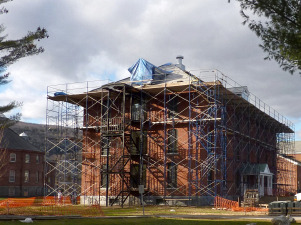
Wasson Hall gets a makeover
Last Friday, DMH closed the Canteen. On Monday, DMH moved into its newly renovated office space at nearby Wasson Hall, which features new windows, repointed brick and interior renovations. The three-story structure is also getting a new slate roof. (Gerry Myers, commissioner of the Department of Buildings and General Services, says he had hoped the roof would have been completed before the move-in date, but the first roofing contractor quit after laying a quarter of the slates, and a new contractor had to be found. The reslating was started from scratch, according to Myers.)
The price tag is $2.5 million, not including $47,000 for new hardwood furniture purchased from the Vermont Offender Work Program and a $33,000 contract with All Links, a Williston-based telecommunications firm, to install voice and data cabling in the building, according to state buildings officials and internal DMH budget documents. The new furniture and cabling costs came out of the Department of Mental Health’s budget, Myers says.
The department left its existing furniture at their previous location at 108 Cherry St., “which was a large savings,” Myers says, because dismantling and moving the furniture would have been expensive. It also would have added six days to the department’s move, says Beth Tanzman deputy commissioner of DMH.
The Agency of Health and Human Services agency, Tanzman wrote in an e-mail, “will also save money on the next move into the vacated space as it is already set up, powered, and cabled.”
The state of Vermont has three leases at the Burlington Town Center mall, including the Burlington District Office, which, according to Tanzman, will move into DMH’s vacated space (complete with the furniture that was left behind) at 108 Cherry. Myers says the district office lease, which expires at the end of May, is for $162,000. The new space will cost about $100,000 a year.
DMH’s annual savings in fees for space at its new digs in Wasson Hall will be about $15,000 a year, at best. Myers says the department paid about $99,000 for 8,198 square feet at 108 Cherry, and he says the department will use 7,534 square feet total at Wasson, at a cost of $84,000 a year.
But it’s unclear whether that will be the total cost to house all 41 DMH employees because Wasson is set up for 33 workers, and Tanzman says several staffers will work in an unspecified building. The department’s 9-person legal team will be located elsewhere on the state office complex campus.

Canteen ‘survey’ conducted after story broke
Memos from the Department of Mental Health show that officials didn’t assess the impact of closing the Canteen on Vermont State Hospital patients until nearly a month after the decision to shut down the snack bar was finalized.
In comments cited in a previous Vtdigger.org story, Michael Hartman, the commissioner of the Department of Mental Health, appeared to be more concerned about how to minimize his agency’s staff cuts (complicated by the federal-state matching funds problem) than the impact closing the canteen would have on patients. For Hartman, it was a good-faith effort to choose the lesser of two evils—closing the Canteen instead of cutting more staff at the Vermont State Hospital (which would probably impact patients, too).
However, it was only after the initial story broke about the Canteen and hell started breaking loose that Hartman ordered a one-time “survey” of patients who had access to the Canteen — the only place hospital residents with privileges to leave the ward could go.
Jack McCullough, a regular contributor to the Vermont news blog Green Mountain Daily and director of the Vermont Legal Aid office in Waterbury, was the first to report on Oct. 15 that the state was closing the Canteen at the Vermont State Hospital. The Burlington Free Press picked up the story on Oct. 16. The patient count used as a justification for closing the Canteen wasn’t ordered until even later — Oct 18.
In an e-mail marked “urgent” and sent on that date to Terry Rowe, executive director of the Vermont State Hospital, Hartman asked Rowe to count the number of patients who had access to the snack bar.
Not until Oct. 19 were supervisors on three wards asked to generate a patient count from the previous Friday. They reported that 23 patients out of a total of 51 could gain access to the snack bar in the basement of the Dale Building. The remaining 28 could not leave the secured areas of the hospital because they pose a “risk of harm to others.”
Tanzman insists an earlier survey was unnecessary because the decision to close the Canteen was based on the VSH staff’s working knowledge of patients with buildings and grounds privileges.
Also, Hofmann says, the Canteen didn’t primarily serve patients.
“The overwhelming majority of people who patronize the Canteen are not patients at the VSH,” Hofmann says. “Most of the patients VSH cannot go there under any circumstances. Only two, three, four could go without supervision. A few more in a group could go, or with one-on-one accompaniment, which is a strain on staff resources.”
Patient advocates disagree. They say the snapshot survey belies the fact that most patients who left the hospital eventually gained access to the snack bar as part of their transition to the community.
In response, Hofmann says, “Is there any possibility that the person who could not go today could go in two weeks or two weeks ago? I think that’s a fair question.” The department, in its survey, however, didn’t attempt to answer that question.
Internal resistance to closing the Canteen
Curtis Sinclair, the Canteen coordinator, pleaded with Hartman in a series of e-mails and public records requests to keep the snack bar open. In one letter, he alleged that the Canteen could have broken even if he had been allowed to raise prices.
Hartman forwarded the e-mail to Rowe and she responded with concerns about closing the Canteen. “I am aware that we have not wanted to make a profit on the canteen, but I was unaware that we were forcing prices down,” Rowe wrote on Oct. 29. “I think we are on dangerous grounds arguing this cost issue. The fact is we could raise prices, cut back on staff and not eliminate the service.”
She went on to write, “I think the reason you selected the canteen for closure was about preserving essential functions at DMH. I think a presentation of why that is crucial would be very helpful. I think most people would understand it as a reasonable decision.”
Nearly a month earlier, she was vehement in her support of the Canteen. On Oct. 1 she wrote the following to Heidi Hall, finance director for the department.
“Most patients at the VSH have a gradual increase in privileges which allows them to leave the Brooks Building (VSH) and go to the canteen as part of their preparation for community placement. Patients are motivated to go to the canteen for drinks, snacks, and, in one patient’s case, his daily food intake (he is a male anorexic who will only eat canteen food). VSH uses the canteen as an incentive for patients to develop new skills to manage their psychotic symptoms or difficult behaviors.”
“VSH staff,” she continued, “eat at the canteen on weekends when they have their 30-minute lunch breaks; most hospitals have cafeterias for visitors, patients, and employees. It would be sorely missed.”
In a recent telephone interview, Rowe stood by her written statements. One of the advantages of the Canteen was its proximity to the hospital, Rowe says. The location was important, because if a patient had a problem, the hospital staff could respond quickly.
Possible compromise?
Rowe says there is a possibility the hospital will continue to use the space for patient activities.
“We’re trying to think of how we might use that space,” Rowe says. “How else would we use it as an incentive for patients?”
If so, it’s not clear how VSH will save $30,000 in rent for the space.
When asked about the lost rent savings in this scenario, Hofmann announced that he will entertain proposals for the reopening of the Canteen by a separate nonprofit entity.
“Some folks have made the contention that this can be run as a money maker, and if that’s the case, we welcome (that),” Hofmann says. “Or if they think it can be run and operate at a moderate loss and can shoulder that, we are very open and willing.”
