Providing mental health care a challenge for prisons

Vermont does better than many states in providing mental health treatment for its prisoners, according to a consultant, Milliman, Inc., cited by the Joint Legislative Corrections Oversight Committee.
But the author of the report goes on to express concern that the efforts may be insufficient to ensure that prisoners succeed when they are released into the community.
“We learned from several sources, including the Department of Corrections itself, that treatment is designed to stabilize conditions so that each inmate can function in the prison setting,” the committee said. “The administration and the legislature have never given the Department of Corrections the funding needed to provide the kind of intensive treatment necessary to ensure success upon re-entry (into the community).”
Evaluating the effectiveness of mental health treatment given in Vermont’s prisons would require data that are not currently available. Because the Department of Corrections contracts with outside providers for mental health services, it is difficult to access information on the amount and type of treatment provided.
Weighing Corrections’ relative investment in services is also difficult. The Department of Corrections spent a total of $2,105,613 on mental health services for prisoners in fiscal year 2008, according to Corrections Financial Director Ira Sollace, but the average cost per prisoner with mental illness is not available.
Calculating the figure is complicated by the constant turnover of prisoners, changes in their mental health status and widely varying diagnoses, said Planning Director John Perry, who retired at the end of August.
In addition, “there is no ongoing ‘data system’ for collecting information about mental illness in corrections, any more than there is a system for collecting individual health information. These are systems that would be helpful but are not funded,” Perry said.
A rough figure can be arrived at by dividing the average number of prisoners receiving mental health services on the dates of two “snapshots” – data collected “by hand” on one day in 2007 and another in 2008 – into the total spent on mental health services. That gives a per-person amount of a little more than $3,800.
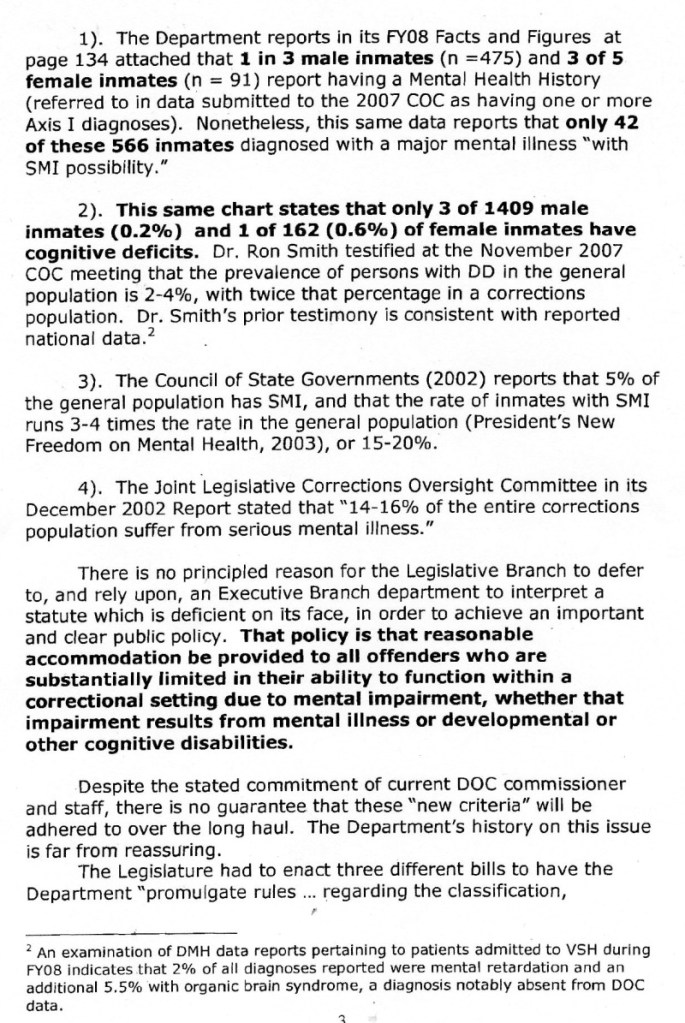
The average blends the cost of short-term and intensive treatment. How many prisoners have serious functional impairments – and require intensive treatment – is a vexed question: Some mental health advocates claim the Department of Corrections significantly underreports the numbers. (See April 2009 memo from Robert Appel, executive director of the Vermont Human Rights Commission, following story.)
In fiscal year 2008, Corrections reported that a monthly average of 40 prisoners (from a low of 23 to a high of 60) had serious functional impairments, such as a serious mental illness, personality disorder, developmental disability or traumatic brain injury, among others.
Because of the limitations of the prison setting, the type of mental health treatment provided in prison differs from that given in the community, said Dr. Delores Burroughs-Biron, director of health services for the Department of Corrections.
One limiting feature is extreme overcrowding. On August 6, Vermont was housing 1,599 prisoners in-state. It has 1,600 prison beds. “We have periods when we’re over,” said Commissioner of Corrections Andrew Pallito. “We’re dealing with a lot of flow.”
Several years ago when the corrections population was smaller, the superintendent of one prison noted that she processed 1,900 prisoners into her facility and 1,700 out of it in the course of a year. “Do you think I know who they are, let alone tell you that I provide them corrections and rehabilitative services?” she asked. “I stash them until they are moved.”
Biron explained that “when you think as a psychologist or a psychiatrist of ‘treatment’ – intensive therapy or psychotherapy – it’s not going to be the same, because what you do in corrections, you do in the corrections milieu.”
Programs and services have to be planned for the average length of stay, which may be no more than 60 days. “When we recently ran some statistics on length of stay, the number of people who were there at the end of the year was small,” Biron said. “You don’t get into psychotherapy with 60 days.
The first step in treating people entering prison is assessing their immediate needs, Biron said: “We first want to make sure they are safe. When we get someone that is acutely mentally ill and destabilized, we want to stabilize them.”
The initial screening includes determining whether offenders are at risk of committing suicide – a risk that rises when people enter prison.
To clinical purists, the concept of treatment has “a different dimension than what most correctional facilities provide,” Biron said, but the care provided in prison does meet “some standards for treatment, because people see their mental health clinician on a weekly basis, or trice-weekly if needed, and they see a psychiatrist regularly and they take part in support groups.” (Advocates dispute the timely availability of care.)
Prisoners have a treatment plan that lists a diagnosis and spells out a plan of action, although the treatment plan is not going to be Freudian, Biron said: “It’s going to be really cognitively based and in a manner to support the individual within the correctional setting, as well as to help them become more reflective and knowledgeable about what their individual issues are.”
Recently, the corrections department turned to an expert clinician in the community for guidance in developing a treatment plan for a difficult case, Biron said. The approach is cost-effective for extremely ill prisoners, she observed, and the department plans to use it more often.
According to Biron, the chief obstacle to providing intensive treatment is finding staff. Noting the large number of job site postings for mental health clinicians, licensed addiction counselors and psychiatrists, she said, “We just don’t have the people in the state who are prepared to do the jobs that we need them to do. And we don’t have people knocking on our door to get jobs here.”
See related stories:
‘This is bankrupting our state’
Prison, a tough environment for the mentally ill
State: Suicidal patients watched more closely
Court mandates treatment for prisoners instead of jail time