


A town of 4,000 residents in southern Vermont is battling a major commercial solar developer that wants to build one of the state’s largest solar farms on two sides of a country road once used as farmland.
Rutland Town is fighting a 2.2-megawatt solar farm to be built on two sides of Cold River Road, which locals use as a bypass to avoid traffic held up at the nearby bustling traffic lights.
The developer, groSolar, under its subsidiary Rutland Renewable Energy LLC, has received approval from the Public Service Board, but Rutland Town residents are appealing that decision to the Vermont Supreme Court. Local opponents hope to set a legal precedent that forces regulators to pay attention to town planning.
The company, based in White River Junction and doing business across the country, would sell enough electricity directly to Green Mountain Power to supply energy to 400 homes, and reap federal and state tax advantages.
When townspeople found out about the project, they reacted by passing solar siting standards in October 2013. Opponents also got 50 towns to sign onto a resolution urging the Legislature to adopt siting regulations for solar projects and force developers to screen the arrays from public view.
Lawmakers responded by requiring solar projects of more than 150 kilowatts on about an acre of land to be set back 100 feet from highways and 50 feet from abutting property; allowing towns to recommend screening requirements to the Public Service Board; and creating a study committee to suggest a new law on land use to the legislature by Jan. 15.
But as the land use committee’s work unfolds, the small town’s battle underscores the watershed struggle in Vermont’s heavily subsidized solar industry: Locals across the state say they come to Montpelier to have a say in which of the town’s lands will be covered in solar panels, but they don’t feel heard in the regulatory process, which is separate from the normal development review that takes place under Act 250.
The subtext of the legal battle is a race against the clock: Solar developers are rushing to take advantage of a federal tax break for solar projects that expires at the end of 2016. They also want to receive state incentives that make building solar in Vermont attractive.
“We’ve been beating a drum that nobody seems to hear, and that drum says that we have no opposition to solar per se,” says Don Chioffi, a Rutland Town Selectboard member. “What we have opposition to is the bastardization of the legitimate planning process in Vermont to give 100 percent preferential treatment to solar developers.
“There’s many places the 9,000 industrial solar farm could be appropriate in the town of Rutland, but in an open field that’s been farmed for years … that isn’t the place for that project,” he says. “The opposition from the people was totally ignored by the Public Service Board.”
Gary Skulnik, a spokesperson for groSolar, says the Vermont Supreme Court will have to decide the issue, but he’s “very confident” the project will move forward.

Solar development on the U.S. 7 corridor
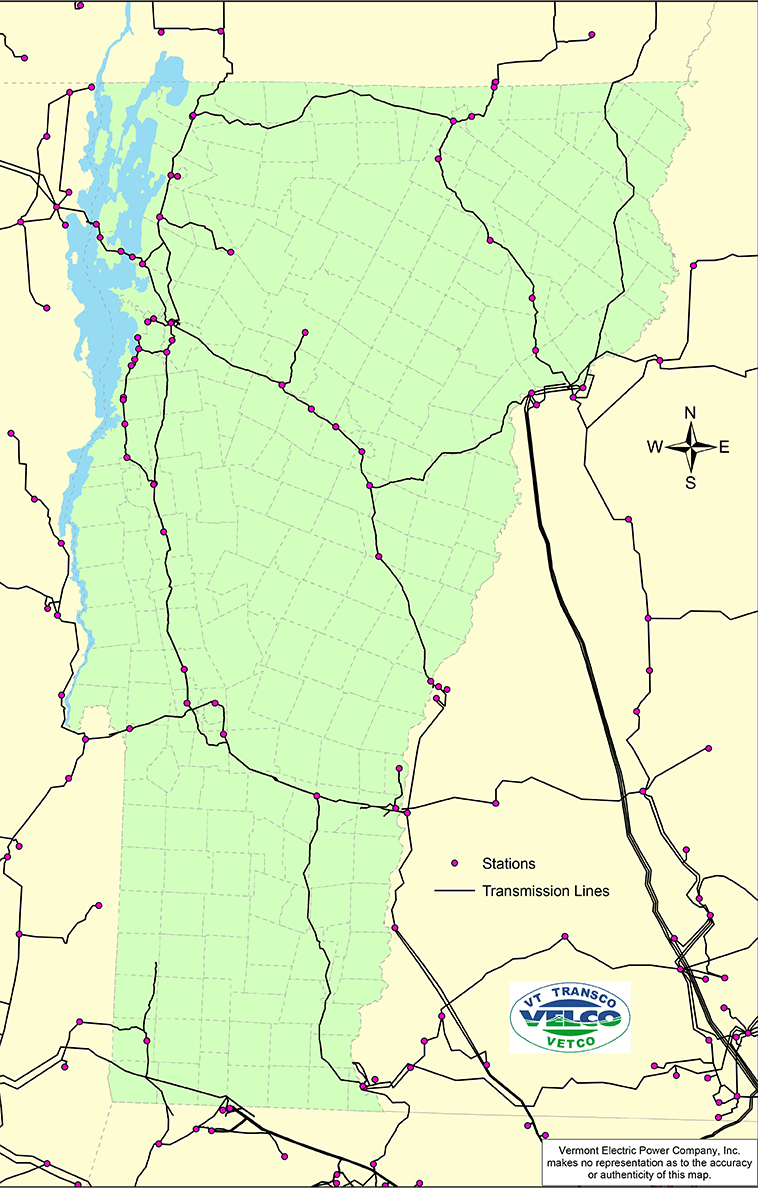
The Vermont Electric Power Co. (VELCO) transmission lines sit along major highways, making the flat, shade-free land nearby prime real estate for solar arrays. And data acquired as part of this investigation show that many of the industrial solar projects approved in Vermont are in small towns along U.S. 7, where the transmission lines run nearby large parcels of flat farmland.
“The reason they’re kind of popping up in particular places is these larger systems do require three-phase power, which is in limited locations,” says Chris Recchia, commissioner of the Public Service Department. “Obviously, the developer looks to, ‘Where is that power, and how can I best connect to it?’”
According to data compiled from the Public Service Board’s certificates of public good, 25 of the 79 solar projects approved through August 2015 were along the U.S. 7 corridor. Six approved projects border Interstate 89, where VELCO runs another transmission line, and 11 approved projects border Interstate 91, near more transmission lines.
(There is no way of tracking down all the projects that are in the planning process in Vermont, but estimates for how many applications the Public Service Board has received for certificates of public good this year are in the 150 range.)
“Wind turbines go where wind is generated, and energy is going to go to the least expensive path,” says Kerrick Johnson, vice president of communications, systems and strategy for VELCO. “We’ll always make it work. I’m sure there’s gonna be people who are upset. That’s what happens when there’s a change.”
That change is having an effect on the Addison County town of New Haven, where the town says it’s hosting more solar projects than it can use and local residents are trying to swat down new proposals. The town has 1,800 people, five solar arrays in the ground, three that are ready to be constructed, and more applications pending according to Doug Tolles, a selectboard member.
“Between the lack of trees, the flatness and the access to power, especially, we are attractive to solar developers,” Tolles says. “Most of these solar developers absolutely do not care about where they put their solar, and they do not care in any way about how it affects the town or the looks of the town.
“By my last calculation, from renewable energy, we produce currently over 13 times our electrical usage for the town,” he says. “And if the ones that are proposed are actually constructed, New Haven would be producing approximately 23 times what it’s using. We’re clearly doing our share, and more.”
Green Mountain Power spokesperson Kristin Carlson says the utility has not reached a point where it has had to reject energy from a solar developer, but she says the company is developing a mapping tool that will identify solar sites for sections of the grid that need it most.
In Rutland Town, Chioffi says the issues that drove them to file suit at the state’s highest court were proportionality, use of farmland, and local input at the Public Service Board.
“We’re not renegades,” he said. “It’s a democratic issue for us.”
The town passed solar siting standards in October 2013 recommending that solar projects be limited to 300 kilowatts and endorsing rooftop solar, such as the panels on the local elementary school.
The board wrote in its order granting groSolar a permit that Rutland Town’s siting plans “would impede the legislated policy of Vermont that supports the deployment of in-state renewable generation facilities” and that the standards for aesthetics were not clear. The board also disagreed with the town’s proposal to set the project 500 feet away from historic buildings.
Chioffi compared solar aesthetics to billboards, which are illegal in Vermont.

Alternative sites
Sen. John Rodgers, D-Essex/Orleans, said solar developers are largely multimillionaires and corporations who “seem to have carte blanche.”
Rodgers said solar panels should only be put on existing structures. “We should not be cutting down forests to put up solar panels,” Rodgers said. “We should not be putting them in open fields. The only reason (for farmland development is) that the people who are building them are getting very rich off of them.”
Tolles, of New Haven, agrees.
“Solar on roofs makes great sense,” he said. “Roofs are ugly. Solar’s ugly. No harm done.” Tolles also supports putting panels on parking garages, landfills and brownfield sites.
In the first six months of 2015, more than 500 solar projects of 15 kilowatts or less were registered with the Public Service Board, and those are generally pole-mounted or roof-mounted projects for homeowners and small community organizations. Roof-mounted solar arrays are usually around 6 kilowatts, according to SunCommon, and cost about $20,000 to $30,000 without a financing plan.
For projects smaller than 15 kilowatts, applicants send a registration form to the board and a certificate of public good is assumed to exist after two weeks, so the board never has to formally approve those projects. Two of the state’s three wealthiest counties, Chittenden and Windsor, have the highest number of small solar projects approved.
SunCommon, which expanded in 2014, has been successfully marketing to Vermonters who want rooftop solar, and others who want to join small solar arrays for a 7 percent reduction on their electric bills. The company brought on 1,590 residential customers between 2012 and 2014.
SunCommon says it uses efficient panels from an American company, a South Korean company and a Japanese company that require less space. Commercial companies, by contrast, have an incentive to use inexpensive, less-efficient panels manufactured in China that can be used to cover larger land areas in order to produce the same amount of electricity.
Small-scale solar projects approved January – July

Solar divides environmentalists
As solar becomes more popular, developers are installing larger arrays. Some environmentalists say the bigger installations are impacting land that should be conserved.
Two connected projects in Bennington would total more than 4 megawatts and require developers to clear-cut forests. A 4.9-megawatt project proposed by Green Mountain Power and groSolar in Windsor, which has now been put on hold, would have been located adjacent to endangered species habitat.
Annette Smith, executive director of Vermonters for a Clean Environment in Danby, has been fighting the project in Bennington. Smith points to new scientific research that discusses how trees improve air quality next to highways, and says that even though the Public Service Board allows developers to clear cut up to 50 acres of forests, the development in Vermont is getting out of hand.
“I want there to be a process through which we can evaluate the issues in a way that respects the public and towns, so it really to me is not a one-size-fits-all thing,” she says. “A lot of our problems would be much better addressed through Act 250.”
Act 250 is Vermont’s land use law. The statute, which has been in place since the 1970s, often pits developers against environmentalists. The law has nine criteria that are used to determine how development impacts the community and the environment.
Section 248, the legal name for the Public Service Board process, is used for utility projects. The law gives the PSB broad authority to deny applications in order to protect Vermont’s land from undue environmental impact, but it’s virtually unheard of for the board to deny a solar permit application.
After years of complaints from local groups who said their voices weren’t being heard, the state enacted Act 56 signed this year. The law gives planning commissions and selectboards the legal right to participate in the Section 248 process.
Smith says the problem starts with the Public Service Board process, but it doesn’t end there.
“The way that the public is cut out from and really abused from the Public Service Board process is why we’re fighting, and we don’t need to be fighting about renewable energy,” Smith said. “Until we start talking about the process itself, we’re not going to make any progress.
“It’s about the heart and soul of our democracy,” she said. “We’ve been shut out. The only way that people find out about what’s going on is to file public records requests. The system has been corrupted by the renewable energy industry.”
Sen. Joe Benning, R-Caledonia, has concerns about land use in the Northeast Kingdom, one of the least populated areas of the state. There are already plans for wind, methane, hydro and solar projects within a 60-mile radius in the area, he said.
“The problem from my perspective is you’ve only got so much land in the state of Vermont, and most people come to Vermont to see that land,” Benning said. “So if you’re going to change the dynamic of why tourists come to Vermont, that’s a heavy price to pay. I would really be reluctant to keep subsidizing everything that walks down the path.”
Other environmentalists have accused Smith of being a friend to oil and coal companies because of her concerns about solar siting.
Benning said he is often labeled a “climate change denier” for voicing his concerns about land use.
“As far as I’m concerned, I’ve always been an environmentalist,” Benning said. “I have a sincere desire to work in the direction of renewables. (The situation is) unfortunate because people who normally should be on the same side of the fence environmentally are now polarized by this issue.”
Paul Burns is the executive director of the Vermont Public Interest Research Group, or VPIRG, an environmental lobbying organization that helped appoint a citizen advocate to the Solar Siting Task Force this summer.
Burns said Vermont needs to continue its current rate of solar development in order to get 90 percent of the state’s energy from renewable sources by 2050. It’s all about protecting the next generations from the catastrophic effects of climate change, he said.
“We have a process that’s been set up to ensure that our natural resources will be protected,” Burns said. “I don’t always agree with where the Public Service Board comes down on an issue, but … I don’t suggest that it’s just an entirely rigged game.”
Burns said the groups opposing solar are largely the same ones that opposed wind power. He disagrees that environmentalists are divided over solar.
“Those are the same groups that were opposing wind,” Burns said. “I wouldn’t consider those to be environmental groups. They can call themselves whatever they want, but it doesn’t really equal a divide among environmental groups in the state.
“If you find yourself siding with Donald Trump and Carly Fiorina, you should reconsider whether you’re an environmental organization,” Burns said.
This map shows where VELCO’s transmission lines run throughout Vermont. Developers often seek to build close to the transmission lines.
How the Legislature is reacting
During the 2015 legislative session the Legislature included language in Act 56 to assuage some of the critics. However, several comprehensive siting bills emerged and became stuck on the walls in committees of the Senate and the House.
Lawmakers decided to let planning commissions and selectboards participate in Public Service Board proceedings, make developers set their projects back from highways and abutting property, allow municipalities to suggest screening rules to the Public Service Board, and create the Solar Siting Task Force, which must report back by Jan. 15.
H.341 would have brought municipalities into the siting of solar systems under 500 kilowatts. H.360 would have set standards regarding putting solar on primary agricultural soils. H.358 would make the Public Service Board consider “any issues” that a municipality raises during the regulatory process. H.100 and S.48 would allow towns to introduce setback and screening requirements for solar projects.
Rep. Butch Shaw, R-Florence, is one of more than a dozen lawmakers that has co-sponsored some of the legislation. He says he does not have a problem with solar development, but he does have an issue with the lack of local control.
“I think solar’s a great thing,” Shaw says. “I have nothing particularly against solar, but I think we need to listen to the locals and get their input.”
Shaw points to a solar project under development in his town. He says the site choice was good “because it’s set back from the road, and it’s screened by some existing vegetation. But here again the town had very little to say about that.”
Rep. Tony Klein, D-East Montpelier, is the chair of the House Committee on Energy and Natural Resources and the architect of the renewable energy bill that became Act 56.
“What we’re seeing now is the positive results of the policies that we put in place, so that is a really good thing, and that people want, because they’re buying it, is another good thing,” Klein says. “The fact that it is creating jobs and industry and tax bases for towns is another really good thing. Along with these things come unforeseen circumstances that cause people problems.”
Klein called the Solar Siting Task Force and the Joint Committee on Energy a first step to establishing new solar siting laws.
“We’ll get there, but you have to do it in a reasonable and responsible manner,” he says.
