


Over 200 terminally ill patients have sought and qualified to receive life-ending drugs since Vermont first legalized medical-aid-in-dying more than a decade ago, according to a recent report from the Vermont Department of Health.
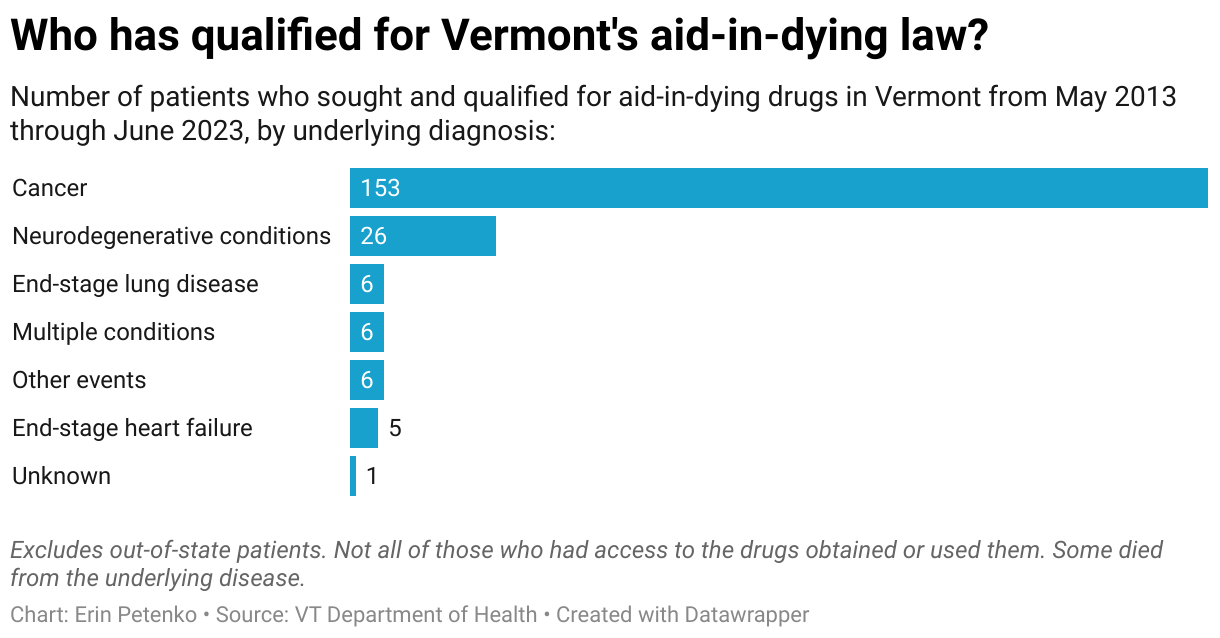
Vermont first legalized the practice — sometimes referred to as “death with dignity” by supporters or “assisted suicide” by opponents — in May 2013. From then until the end of June 2023, 203 Vermonters sought and qualified for the medication, according to the report.
Not all of those who had access to the drugs obtained or used them, according to the Department of Health. Some died from the underlying disease.
A vast majority of those who utilized the program had been diagnosed with terminal cancer, according to the report. Others had been diagnosed with neurodegenerative conditions, such as ALS, end-stage lung diseases and other ailments.
Medical-aid-in-dying is legal in just nine other states, as well as the District of Columbia, according to Compassion & Choices, an advocacy group.
“I think that it’s worked out very well for people,” said Sen. Ginny Lyons, D-Chittenden Southeast, who has advocated for medical-aid-of-dying in the Vermont Legislature since the early 2000s.
“I think one of the more important parts of the (aid-in-dying) law is that it allows for people to realize the end of their life along with family members and to have that close relationship with people,” said Lyons, who chairs the Senate Committee on Health and Welfare. “A number of folks, including some whom I knew who took advantage of this, were very happy at the end of their lives to be able to have their family around them.”
More recently, Vermont has worked to ease the process by which patients can access aid-in-dying care.
Under Vermont’s original aid-in-dying law, patients with a prognosis of six months or less to live had to make two in-person visits to a physician, visit another consulting physician in person, and submit a written request. Finally, the patient had to wait an additional 48 hours to obtain a prescription.
In the spring of 2022, however, the state amended the law to streamline that process, permitting patients to speak with prescribing physicians via telemedicine and eliminating the final 48-hour waiting period.
“We’ve made some really important changes over the last two years,” said Betsy Walkerman, president of Patient Choices Vermont, a group that has lobbied for the practice. “Making it possible for the requests and conversations with doctors to occur over telemedicine in particular was really comforting and helpful to people who have limited mobility and can’t physically get to a doctor.”
Those changes appear to have already enabled further access to medical-aid-in-dying care for Vermonters. Of the 203 patients that requested and qualified for the prescription in the first decade of the practice, 85 did so between the summers of 2021 and 2023, according to the report.
In May of this year, Vermont also expanded access to aid-in-dying to nonresidents of the state, allowing terminally ill adults who live outside of Vermont to consult with Vermont-licensed physicians about receiving a prescription to hasten their death. The recent Department of Health report, which only includes data through June of 2023, specifies that it does not include cases of out-of-state residents.
“The numbers do indicate that people are now having more open conversations about all of their options with their families and medical providers and that getting access to medical-aid-in-dying has become more direct and easy,” said Walkerman.
