

[R]UTLAND — Saying she didn’t find him credible, Judge Theresa DiMauro sentenced a former municipal attorney for Rutland to the same prison term she handed down two years earlier for his role in a fatal hit-and-run crash.
Christopher Sullivan’s attorney argued for a lesser prison sentence than the one the judge originally imposed, which the Vermont Supreme Court had tossed out earlier this year. Meanwhile, the prosecutor sought a longer prison term for 57-year-old Sullivan.
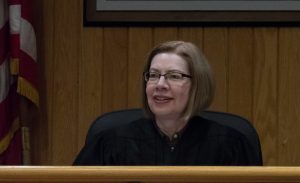
The judge, in delivering that same sentence Thursday in Rutland Superior Court of four to 10 years in prison, spoke for about 15 minutes.
She punctuated her comments with stinging words aimed at Sullivan and his actions leading up to and following the crash in Rutland on April 10, 2013, that killed Jane Outslay, 71, of Mendon.
“He stated that he panicked and was unsure what to do,” DiMauro said of Sullivan. “It is simply not credible that he was totally disoriented.”
He appealed, and earlier this year the Vermont Supreme Court affirmed those convictions but threw out the sentence. The high court ruled DiMauro should have allowed Sullivan’s defense attorney more time to prepare testimony from a “mitigation” expert.
That mitigation expert, Dr. Thomas Powell, a clinical psychologist, testified Thursday that the crash created a “traumatic” event for Sullivan, causing him to react “reflexively,” not rationally.
Powell said a series of tests revealed Sullivan as a person who lived a life of “order” and “predictability,” and liked to be “in control.”
“He’s a guy who lives his life well within the wickets,” Powell testified. “He’s a conformist.”
He added of Sullivan, “He thrives on order and achievement.”
The clinical psychologist said there was no sign that Sullivan was mentally ill.
Powell said he would recommend that Sullivan receive treatment for his use of alcohol and get counseling on how to move his life forward and cope with the situation in which he now finds himself.
Eventually, Powell said, Sullivan will be free from jail and needs to become a productive member of society. “I don’t want to throw him on the ash heap of history,” the clinical psychologist said.
Sullivan, who for years had been the city attorney in Rutland but was in private practice at the time of the fatal crash, had already served about two years of his four-year prison term when the high court overturned his sentence.
He has been free for the past several weeks after his wife posted a required $50,000 deposit on his $500,000 bail.
A court officer placed Sullivan in handcuffs Thursday after the hearing and led him back to prison to serve another roughly two years as a result of the new sentence.
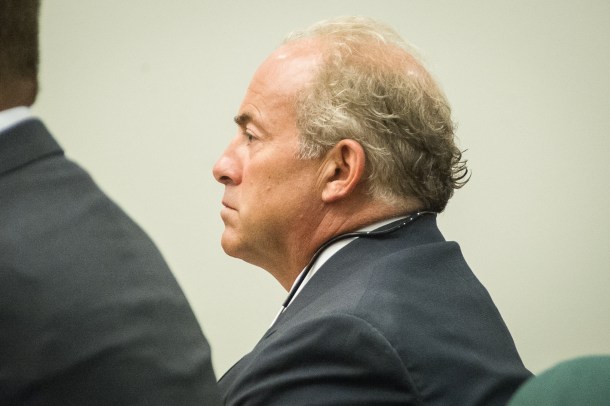
Sullivan wore a dark suit to the hearing, but had on sneakers rather than dress shoes, perhaps an indication he anticipated heading back behind bars.
He hugged and shook hands with his friends and family in the courtroom after the hearing and before he was taken off to prison. He was listed later Thursday afternoon on the state Department of Corrections website as an inmate at the Rutland jail.
Public defender Joshua O’Hara said after the hearing that he needed to consult Sullivan before commenting on whether his client intended to appeal.
Gregor Outslay, Jane Outslay’s son, said outside the courtroom that while he was satisfied the original sentence “stuck,” he had no doubt an appeal would be coming.
“I expect every legal tactic available to him to be used to diminish and deny any level of responsibility,” Gregor Outslay said. “It’s going to open up the old wounds. It’s going to be terrible, but it’s expected.”
The sentencing Thursday was the latest turn in a case that has been working its way through the legal system for more than four years.
Most recently, after the Supreme Court ruling that overturned the sentence, Sullivan’s attorney argued that DiMauro had “prejudged” the case based on comments she made at a hearing in May.
At that hearing, the judge indicated the chances that Sullivan would get a sentence with no additional prison time were slim.
Eventually, another judge ruled that DiMauro could continue to preside and that issues Sullivan’s attorneys raised could be argued on appeal.
DiMauro did not appear swayed by Powell’s testimony Thursday that Sullivan “panicked.”

“Even most teenagers would realize that something significant had just happened and they have to accept responsibility for their actions and remain at the scene.”
She said Sullivan’s action appeared more calculated than panicked on the day of the crash.
The judge said Sullivan had gone to a bar after getting out of work and then to a friend’s house for a cookout, consuming six or seven alcoholic beverages over 2½ hours. They included three glasses of pinot noir and three or four Bud Lights, according to testimony in the case.
After leaving the cookout to pick up his son, who was getting out of work in Rutland, Sullivan drove his vehicle that evening into Outslay as she crossed Strongs Avenue downtown.
Outslay was waving a cane in the roadway when struck by Sullivan, who did not brake before or after striking her, the judge said.
Sullivan, DiMauro said, then called his son and told him he would not be able to pick him up, before phoning his law partner several times. Eventually Sullivan returned to his home in Rutland and watched television with his son. He turned himself in the next day.
DiMauro said she received several letters written on Sullivan’s behalf by friends and family. She said many spoke of Sullivan’s “empathy,” emphasizing how he always put his family first, making sure they were cared for and secure.
“It seems that this expression of empathy may depend on who needs that empathy,” the judge said as she handed down the sentence.
DiMauro also said it was “abundantly clear” that Sullivan waited to turn himself in so the alcohol he had consumed could leave his system. It also gave Sullivan time to “work on his story,” the judge added, “which was less than credible.”
Vermont Assistant Attorney General Evan Meehan, whose office prosecuted the case two years ago and sought a prison term of eight to 15 years at the initial sentencing, reiterated that argument Thursday.
But, he added, the four- to 10-year sentence handed down at that first hearing would be appropriate, too.
Meehan said the mitigation evidence presented Thursday revealed nothing that would warrant a lesser sentence.
O’Hara, Sullivan’s public defender, repeatedly told the judge Thursday that his client “accepts responsibility” for his actions.
“It’s something that haunts him, it truly haunts him every day,” O’Hara said.
The defense attorney pointed to Powell’s testimony that Sullivan’s fleeing the crash scene was a reflexive response to a traumatic situation. It does not absolve his client of guilt, O’Hara said, but does help explain his action.
Sullivan also spoke in court Thursday, delivering his words in a soft voice.
“I accept full and complete responsibility for causing the death of Mrs. Outslay,” he said, adding that he feels “overwhelming guilt” for his actions.
“I am sorry, I’m deeply sorry,” he said to Jane Outslay’s relatives, telling them they are in his prayers.
He also admitted drinking and getting behind the wheel of a vehicle, as well as leaving the crash scene.
He added, “I should have stopped.”
