

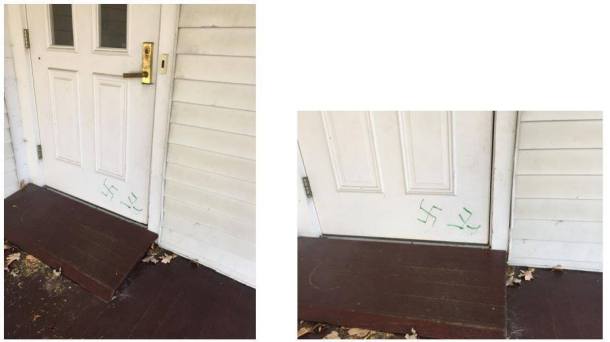
The education director for Havurah House discovered the markings Monday morning when she arrived to prepare for Hebrew school, according to a statement on the group’s website.
The graffiti included two symbols, one clearly a swastika, drawn in dark green on the bottom of the front door. The other symbol resembles a malformed swastika.
The center contacted police to report the incident and told members of Havurah as well as others in the community.
Sgt. Mike Christopher of the Middlebury Police Department said Thursday that officers are investigating the graffiti but there are no suspects at this point. There have been no reports of similar incidents in the area, he said.
An investigation into this type of report typically involves canvassing the neighborhood for any witnesses, looking for a container or implement that may have been used to write the symbols, and checking in with local hardware stores, Christopher said.
In the statement on its website, Havurah put the graffiti in a national context.
“Havurah was the target this week for the first time that anyone can remember,” the statement said. “In some respects this may be considered an isolated incident, but it is part of a pattern of malicious speech and actions elsewhere in our community and across our country.”
Ken Wolpin, who is on Havurah’s leadership council, said members of the congregation are still reacting to the event.
“It ranges from being very, very upset, to moderately upset,” Wolpin said.
Members of the community have been very supportive, he said. Some plan to attend a previously scheduled shabbat morning service Saturday. Later that day, a vigil is planned at Middlebury College.
John Freidin, a member of Havurah, called the graffiti “an outrageous act of hatred” in a statement.
“It is a horrifying incident that not merely causes pain, but tears at the fabric of our community and beyond,” Freidin said.
Freidin sought to bring the incident to the attention of the community in Addison County and beyond.
“It is human to get angry. But acts of hatred are not acceptable,” he wrote. “Let us reach out to those whose suffering leads them to strike out at others. Their behavior cleaves their own society and makes our working together more difficult. But we must try to do so.”
The report in Middlebury is one of several around the state of apparent racially or ethnically motivated hate speech in the wake of last week’s election.
Last week, a Donald Trump lawn sign marked with a spray-painted swastika was found near a Jewish organization’s building on the University of Vermont campus.
On Thursday, Gov. Peter Shumlin and Gov.-elect Phil Scott issued a statement on the post-election climate.
A staff attorney for the American Civil Liberties Union of Vermont, Jay Diaz, said the organization has been informed of instances of hate speech and fear within Vermont in the wake of the election.
Diaz said the trend began before Election Day, citing incidents like the theft of a Black Lives Matter flag at UVM in September.
“We hope that Vermont’s communities come together and speak out against these acts of vandalism and the climate of fear some people are trying to create,” Diaz said.

