


It’s both a gift and a curse: Bilecki has to figure out how to distribute or process these large donations. In the case of the corn, Bilecki gave more than half of it to a new program run by the Vermont Farmers Food Center in Rutland that provides families with fresh local food. The rest she processed for freezing.
However, as Bilecki points out, the amount of usable produce salvaged from farms in Vermont pales in comparison to the vast quantity of food that goes to waste every year. According to a recent study by Salvation Farms, a nonprofit devoted to making use of surplus food, 14.3 million pounds of vegetables and berries from Vermont farms is lost every year. Based on surveys completed by 58 farms in nearly every county in the state, the number “highlights the great opportunity to place more Vermont-grown food onto people’s plates,” the authors write.
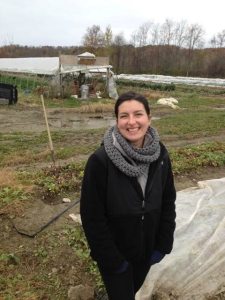
On Thursday morning Bilecki and two volunteers were hunched over a row of arugula at Dutchess Farm in Poultney. The farm, run by Stephen Chamberlain, sits on about 10 acres in a remote wooded area just south of Castleton.
Chamberlain’s been farming for 31 years and has worked the fields in Poultney for more than a decade. At any given time, he typically farms 4 to 5 acres and uses the rest for cover crops. In the past Chamberlain donated excess food to the Castleton-Hubbardton food shelf or trucked it to the Open Door Mission in Rutland.

According to the Salvation Farms survey, the top reasons farmers did not harvest food were blemishing, lack of confidence they’d be able to sell it, and lack of available or affordable labor.
“While some of the edible produce that is left unpicked by farmers is captured by gleaners,” the authors write, “a large percentage is turned under in the field or fed to pasturing animals. It is this food — that which never makes it onto people’s plates — that we consider food lost in the field.”
According to the report, greater access to markets, incentives for farmers, and expansion of gleaning and food rescue operations could help reduce the waste.
After bagging the arugula, volunteers McKenna Hayes and Jaya Davis boxed it up for transport to the Vermont Foodbank site in Rutland, which has a large walk-in cooler that RAFFL uses. Every Monday Bilecki takes stock of what’s been harvested during the week and then figures out where it’s going to go.
There’s no shortage of interested partners, including the Open Door Mission, Rutland County Parent-Child Center, BROC and Meals on Wheels. Bilecki also makes regular deliveries to food shelves throughout the county.
Since its inception in 2009 the Rutland glean team has harvested and distributed more than 130,000 pounds of fresh food. Hayes, who is getting her master’s at Vermont Law School, says it’s important to understand the connection between farms and the local food economy. Plus it gives her the opportunity to get her hands dirty.
This summer she and Bilecki spent three hours harvesting 500 pounds of potatoes in the hot sun. “I think it’s really important to know what goes into it,” Hayes said.
And what it can yield. According to Bilecki, “Vermont could feed itself so easily with the food it has.”

