


[L]egislators have called for self-evaluation from the board of a popular business incentive program, but some people — including the state auditor — say that evaluation doesn’t go far enough.
The program is the Vermont Employment Growth Incentive, or VEGI, and a recent piece of legislation called Act 157 directs its decision-makers to review the program according to eight metrics and to make suggestions to improve it.
Members of the program’s oversight board, the Vermont Economic Progress Council, choose the award recipients, and the Legislature has asked that board members review policies underpinning the program as well.
The review should state whether VEGI should prioritize recipients in certain fields over others; whether the state should act as an equity investor through the program; and whether companies that receive subsidies and are later sold — as in the case with Keurig Green Mountain, which received more than $10 million in state subsidies — should pay that money back.
The review should also discuss whether to target subsidies to industries expected to grow; how to ensure recipients follow environmental laws; how to secure greater transparency from businesses receiving VEGI funds; and how to better serve small businesses through the program.
But legislators and the state auditor say the review asks board members to evaluate measures that depend on some fundamentally non-auditable numbers.
“The question is how much, if any, of this economic activity … would have occurred even without the incentive,” State Auditor Doug Hoffer said. “That’s the question we can’t answer. It’s impossible.”
The VEGI program relies on a condition called “but-for” as part of its application requirements. The condition stipulates that a business is eligible for money only to pay for business growth it wouldn’t have undertaken without the funds.
An economic analysis for each recipient forecasts how much additional revenue this business growth represents for the state. Economic incentives awarded to participating businesses come from this additional state revenue and so don’t cost the state anything, supporters say.
But there’s no evidence the program actually works or that the jobs VEGI purportedly creates wouldn’t have existed anyway, Hoffer said.
For instance, the “but-for” stipulation is one that companies applying for VEGI incentives attest to themselves. There’s no way to verify whether a business that says it’ll expand only with state funding would actually remain the same size without the subsidies, Hoffer said.
It’s a tough situation for an auditor to find himself in, Hoffer said.

“My job is to provide information about the performance of existing programs, and I’m frustrated that in some cases I can’t do that,” he said.
Hoffer said he’s in no way accusing anyone at VEGI of running things improperly, but at the same time, he said, it’s impossible to know whether the program functions as intended.
That’s understandable, said Fred Kenney, executive director of the Vermont Economic Progress Council.
“I know it’s difficult to audit a determination that’s subjective,” Kenney said. It’s undeniable, though, that the companies VEGI supports do create new jobs, he said. Company representatives must sign statements, and come before the VEPC board to give assurances, to the effect that the incentives will pay for only those jobs the company wasn’t already planning to create, Kenney said.
The board met for the first time last week to consider the criteria it’s charged with under Act 157. It’s worth remembering that the board hasn’t been asked to revisit the “but-for” question, Kenney said, and that previous boards have had plenty of opportunities to evaluate that requirement over the last 18 years.
Of the eight areas of the program the Legislature asked to have evaluated, the “but-for” question isn’t one, Kenney said.
Board members have been asked, through Act 157, to consider barring from VEGI incentives any company that doesn’t meet state pollution laws. That provision came from Rep. Cynthia Browning, D-Arlington.
Most government assistance to individuals requires that the applicant submit tax forms, be current on child support payments and perform other obligations, Browning said.
Companies should likewise be expected to comply with Vermont’s pollution laws in order to remain eligible for state support, she said. Otherwise, state subsidies would pay for a company that could well be creating new costs Vermonters will need to pay for later through environmental remediation, she said.
Browning isn’t accusing any VEGI recipient of having violated state laws, nor is she singling out VEGI as an entity that supports polluters more than any other of the state’s incentive programs, she said. All incentive programs should meet the same standard, she said.
“If you’re asking for taxpayer money, they should be accountable in a whole lot of ways,” Browning said.
She and other legislators sought to require in Act 157 still greater accountability over VEGI funds, she said. The ones who pushed for greater transparency didn’t manage to put into law what they had hoped, Browning said.
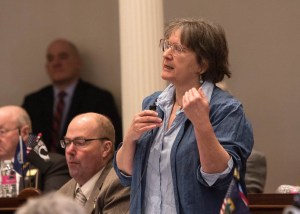
“Many of us would have wanted to make a VEGI program that’s fully auditable” so the state auditor might tell legislators whether the program’s worth the investment, Browning said.
“I don’t think having funding (based on) subjective criteria is a good way to spend tax money,” she said, “and I don’t think we’d tolerate that for a spending program, and yet we tolerate it for a tax credit.”
The fact that the program acts as a sort of tax credit hides the true subsidy it involves, said Browning, who holds a doctorate in economics.
“If you’re going to do something like VEGI, you have to do it in an auditable way, and it has to be accountable,” Browning said. “I don’t think it meets either of those standards.”
The program theoretically costs the state nothing, Kenney said.
The money companies receive from VEGI actually comes from new revenue the state realizes from its investment in those same companies, he said.
“That’s the whole point: It’s revenue we never would have seen,” Kenney said.
In a sense, he said, the state pays about $2 million to $3 million annually for the program, but that number is deceptive, he said.
“You can look at what’s paid out every year, but that’s not a cost, because they created new revenues to the state that we wouldn’t have gotten,” Kenney said.
The board will probably resume its discussion at the next regularly scheduled meeting, which is slated for Aug. 25, Kenney said. The board will issue a public notice beforehand if another meeting must occur before that, he said.
