



(Editor’s note: VTDigger will be profiling each of the five leading candidates for governor over the coming weeks. This story kicks off the series.)
ENOSBURG FALLS — Before the start of the Vermont Dairy Festival parade, billed as the state’s longest, Phil Scott stood in the back of a pickup truck, carefully installing a brown flag honoring World War II veterans. He adjusted the helmet and boots that would ride along with a vintage motorcycle in the bed of the truck. He spent a good 10 minutes getting the setup just right.
After he jumped down, Scott plastered each side of the truck with half a dozen 8-by-10 placards reading “Thank A Vet Today!”
It was advance work typically done by a staffer on most campaigns, but not on Team Scott, where they walked in one morning to find the man widely considered the favorite to be the next governor of Vermont mopping the floor at campaign headquarters in Middlesex.
At the parade site, Scott leaned in and said: “I like to do things myself. Then I know it’s done right. I have a particular way I like things to be done.”
Then he flashed a big Phil Scott smile.
‘You just keep going’
One of many lessons Scott learned from Tom Curley, the co-owner of Thunder Road in Barre Town — where Scott is the winningest race car driver — is that when you go to a parade as a political candidate, you bring your own parade with you. Curley, like his racetrack partner Ken Squier, is a showman at heart and a huge supporter of Scott.
So at the Enosburg Falls parade, Team Scott was ready with a small passenger bus, a 1929 vintage automobile, the pickup with the motorcycle, a ceramic cow on wheels the kids could ride and, of course, the big draw, Scott’s No. 14 race car, a bright green vibrating machine. It sounds like a giant is clearing his throat when the engine gets revved.
Scott, the lieutenant governor since 2011 and the only Republican statewide officeholder, doesn’t drive in the parade, instead walking and working the crowd. He is clearly the candidate, but at events like these, there’s no question who’s really in charge: Dick Wobby, whom everyone refers to by his last name only.
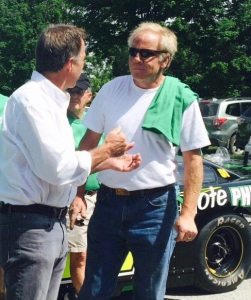
Wobby and Scott go way back, 40 years, to junior high and then Spaulding High School in Barre, where they both grew up. Wobby is a stocky, gregarious man with a big laugh and an equally large appetite for life — he recalls a motorcycle crash where he hit a rock and had Scott pop back in his dislocated shoulder.
Wobby has field marshaled every one of Scott’s political campaigns, starting with his first state Senate run in 2000. He was on Scott’s first pit crew more than 35 years ago. Scott refers to Wobby as one of his best friends. Wobby scoffs at the BFF label and says they are brothers.
Scott, 57, says he gets up every day at 4 a.m., and staff say they get emails and texts late at night. Asked how he keeps going on little sleep, Scott says, “You just keep going.”
Wobby is an early riser too. The day of the parade, he got up before sunrise to get the vehicles ready.
“When you share the same values, it’s easy,” he says. Asked what those are, he mentions loyalty three times before adding integrity and honesty too.
Wobby is more than a campaign manager. He is also bouncer and booster. During the parade, he stepped between Scott and a drunk parade-goer who confronted the candidate. He made sure Scott kept on pace, and he cheered and whooped up the unusually subdued crowd as the candidate approached.
“I’m Doc Holliday,” Wobby says, to Scott’s Wyatt Earp. Wobby relishes the role of second fiddle, working behind the scenes, the campaign equivalent of the pit crew chief, who decides when the tires get changed and when it’s time to refuel.
They agree, he says, about 75 percent of the time and love to challenge each other. Wobby, for example, wanted Scott to try to tap into the enthusiasm for Donald Trump, to look at his record more closely before dismissing him, but Scott was so appalled by Trump’s comments about women that he rejected the idea. “What would I say to my wife and daughters?” Scott asked him.
Not to mention his mother, Marion, the biggest influence in his life. Scott calls her “my hero.”
‘The man of the house’
Scott’s parents met when his father, Howard, was working at the Elmore General Store. Howard had lost both legs when his tank was blown up during the D-Day invasion. Marion says she didn’t really notice his disability. She loved his attentiveness and kindness. He had a good heart.
The three Scott boys helped their dad as they grew up. He was determined to lead an active life: The family traveled to Florida every year before hotel rooms were handicapped-accessible. Long before curb cuts, the family learned which Barre restaurants had railings and big back doors for easy entrance and exit. Often, Howard Scott wore prostheses, bulky by today’s high-tech standards, but his wife says he never complained.
“He’d joke and say, ‘I’m glad it’s not the Civil War days,’” when only the crudest of prostheses existed.
The experience growing up with a dad who was disabled, she says, made the boys “more thoughtful, caring and compassionate.”
Howard Scott worked for the state Highway Department, where he issued permits for oversized vehicles.
Scotty, as he was called, died when Phil was 11, of a heart attack that his widow says was related to his World War II service. Phil is the middle child; Kevin is 17 months older, and Chuck is 2½ years younger.

“The boys became very strong,” Marion Scott says. “Phil took over like he was the man of the house. He went to the funeral home and picked out the casket.” She recalls he and Kevin spent Christmas that year shoveling other people’s driveways — perhaps, she says, trying to block out their dad’s passing.
She had been a racing buff since high school. She took the boys to Thunder Road when they were young. She later remarried into the DuBois family, who owned the construction business where Scott started working while in high school and which he owns half of today.
Scott’s mother lives in Florida and still loves the races. She lives less than 10 miles from the Daytona International Speedway. On her 60th and 70th birthdays, she rode shotgun on the tracks at Disney and Daytona, the drivers topping out at 140 and 160 mph. It’s an adrenaline rush, she says, but what she found hard to imagine as she watched the blur go by was going that fast with 40 other cars on the track.
Her middle son loves race car driving, she says, because he’s competitive and likes a challenge. And when he’s out there on the track, he focuses on that and blocks everything else out.
“He alone can do this. It’s up to him to win or to lose — of course with his team — but he is actually out there doing it,” she says.
(His campaign staff says he gets the same focus — and relief — riding a bicycle. After the Enosburg Falls parade, Scott rode his bike from Richmond back to Middlesex, about 22 miles. Last year, he rode more than 4,000 miles.)
Of course, even though she’s a big race fan, she admits it was hard to “watch Phil go upside down a few times or kind of caught on fire.” But she has great confidence in him, her middle son, the mediator. “He doesn’t make decisions quickly, doesn’t make rash decisions. He thinks things through,” she says.
And when he crashes, he “always comes out of it with a good attitude.”
Neat as a pin, Scott leaves the room spotless and strips the bed when he visits her in Florida.
He loves to make and restore things, she says. One of her most treasured pieces of furniture is a grandfather clock he made her in school when he was 16.
“When Phil looks at it, he sees every flaw in it. What I see is a beautiful tribute from a 16-year-old boy,” she says.
For his first daughter’s first birthday, Scott made her a rocking chair. For his second daughter’s first birthday, he made her a cabinet to store tea party cups. Erica, 30, works with her dad at DuBois Construction. Rachael is 27 and lives in Providence, Rhode Island.
After a divorce, Scott remarried in 2011. He and Diana McTeague Scott, a nurse, live in Berlin.
‘He’s more Jim Jeffords’
“We’re all just mechanics,” Wobby says of Scott, himself and the rest of their small core group. He describes how Scott confronts an issue: He’ll take it apart, examine the parts, fix it and then put it back together. It’s the same way a mechanic would take apart an engine to figure out how it really worked before trying to fix it.
Jason Gibbs, a campaign adviser, uses the same description of Scott. Gibbs worked for former Gov. Jim Douglas and reveres his onetime boss. He says the difference between Douglas and Scott is “one’s an academic and the other a mechanic.” One is more oriented toward white collar, the other blue.
Both men have their strengths, he says.
Douglas went to Middlebury College and always wore a suit and tie; it’s hard to imagine him mopping the floor of his campaign headquarters. Scott graduated from the University of Vermont, favors blue jeans and work boots, and was behind the wheel of the campaign’s tractor-trailer truck on the winding back roads of Franklin County on the way to the parade.
Can he fix the problems plaguing Vermont? His critics say he speaks in platitudes, that his ideas — like restricting the Legislature to a 90-day session, enacting a two-year budget instead of annual ones (even Douglas dumped water on that idea), creating a health care exchange with other states — sound simplistic. They say his call to limit budget increases to the rate of inflation sounds nice but may be impractical. And some Republicans have complained he should have dealt sharper attacks against Democratic Gov. Peter Shumlin. Scott’s primary opponent, former Wall Street businessman Bruce Lisman, has tried to portray Shumlin and Scott, who for a time attended Shumlin Cabinet meetings, as being joined at the political hip.
Scott has complained about Lisman’s brochures, claiming they amount to negative tactics, though by national standards they appear tame. And campaign staff say most voters they talk to don’t buy the attempt to connect Scott with the unpopular governor, who barely won re-election in 2014.
To Scott, the biggest issue is affordability, a word that would stand tallest if his speeches were run through a word cloud.
Scott says high property taxes are the biggest reason Vermont is unaffordable. Add on increasing government fees, and he says Vermonters are like frogs in the frying pan. One idea he promotes is to increase the state’s population to 700,000 to spread the costs of government more broadly. In particular, he wants to recruit younger people. Asked how, he suggests offering 20- and 30-year-olds a break on their state income tax.
“I like incentives,’’ he says, whether it’s adding population or encouraging communities to consolidate schools. He can’t believe there were “only three bills” this legislative session that would have encouraged economic growth. “We’ve got to focus,” he says.
Scott is not a gifted public speaker. He’s plainspoken yet often lacks passion. His website outlining the three major areas of reform he seeks — education, health care and the state budget — describes the problem but offers little in the way of solutions. His most specific call is for an audit of all state agencies and departments.
Even Douglas had difficulty at Scott’s campaign kickoff coming up with any public policy issue Scott is closely identified with after 16 years in the Statehouse.
“He’s more Jim Jeffords in presentation than Jim Douglas,” says Gibbs, the campaign adviser, referring to the late senator, who was a painfully awkward public speaker and was nicknamed “Jeezum Jim” by columnist Peter Freyne.
Let Scott get in there, break down the problem into parts, and he’ll fashion a solution, Gibbs says.
Wobby adds that Scott doesn’t want to alienate too many factions when he’ll have to work with all three political parties to fashion solutions and get them passed.
Getting there could be a challenge, however, in a state that leans Democratic, where Trump could prove a distraction, and for a candidate uncomfortable blowing his own horn. Or going on the attack; with Trump, his strategy is to not talk about him and refer reporters to earlier critical statements.
“It can be kind of difficult sometimes,” admits Wobby.
For example, Scott just hates making fundraising calls. Wobby shrugs and says it’s just not what Scott likes to do, so they’ve revised the campaign budget, not counting on the candidate raising the typical 20 to 25 percent of the haul, but more like 10 percent. Wobby says it’s not ego, but Scott believes if you support his cause, he shouldn’t have to ask.
He won’t do the political stroking.
“He’s more inclined to want to go talk to the people on the factory floor, on Main Street, at the racetrack or the auto shop, or at the auto parts store, than want to go to the boardrooms and meet with the political elites,” says Gibbs.
Because of that disinclination to schmooze and Scott’s lack of hard-right credentials, Wobby says Scott has gotten “black sheep” treatment by some in the Republican Party.
Scott says his success will be his ability to generate consensus across party lines. He and the rest of Team Scott promise if he wins, they won’t re-create the Douglas administration Cabinet.
“I think I treat people with respect. I think I listen to them. I think they listen to me. I think it’s an equal amount of respect on both sides,” Scott says. Gibbs says one of Scott’s strengths is that no one ever feels like he’s talking down to them.
‘Not a politically minded person’
The first words about Scott from the mouths of supporters and rivals alike are: “Phil Scott. Great guy.”
Scott, with some prodding, says he thinks part of his nice guy appeal is that he has experienced some hard times. People can relate, he says. The 1997 divorce and how hard that was on his daughters; challenging financial times at DuBois Construction; a 2012 fire at the business that caused significant damage.
Scott also says he failed as a restaurant and bar owner. As a young business owner, he thought he had all the permits he needed for a motorcycle shop expansion when he was told he needed to go through Act 250.
“I’ve had my share of down times like anyone else,” Scott says, but he also learned “there’s always somebody worse off.”
Losing his dad at a young age was tough too, he says, “except we didn’t know it.”
Team Scott says the candidate speaks more eloquently with action than words. His website lists some of his “quiet accomplishments.”
After Tropical Storm Irene in 2011, Scott spearheaded an effort to help remove severely damaged mobile homes at a far lower cost than what homeowners had been originally told. In some cases, he just did it for free.

A classic Phil Scott story is that while he was a state senator, the day after a massive Valentine’s Day snowstorm, he went up on the roof of a barn at the Scribner Farm in Moretown and shoveled the snow off, after calling local agencies and WDEV radio to appeal for help to save the structure and the cows stuck inside.
“He probably violated every OSHA and VOSHA rule in the book,” says Gibbs, not to mention putting himself at personal risk.
“And he’s not the kind of guy who’s going to be waiting around for the cameras to show up,” says Gibbs, who wore a cow outfit, including udders, for the parade and said he wasn’t the least bit embarrassed.
Scott has also done a program where he spends a day doing the job of an average Vermonter, whether it’s bagging groceries or cleaning computer chips at what was then IBM.
Sen. Dick Mazza, a Democrat and his closest friend in the Senate, says Scott never seeks headlines. He says Scott turned around the Institutions Committee when he took over as chair, eliminating pork that had started to accumulate in the capital bill. His strengths, Mazza says, were that he never overpromised and never took credit when a bill passed. He also says Scott never took advantage of his position, parking his vehicle blocks away from an event instead of pulling rank.
“He’s not a politically minded person, and that might hurt him,” Mazza says. “But that’s who he is. He’s going to work as hard as you ever find someone work,” but he’s not “going to scream and holler and take credit. That’s not Phil Scott.”
Mazza says he and Scott grew close because of shared values.
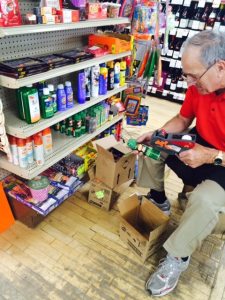
“Because he does a lot of the same things that I do. I just see the real Phil Scott. Not a politician, just a real guy who’s trying to help people, who’s trying to do the best he can, who knows what it’s like to make a buck, who knows what it’s like to write a paycheck, who’s come up the hard way, up from the bottom. Nobody gave him anything,” says Mazza, who runs a general store on Mallets Bay.
Mazza says Scott is very private, doesn’t share much and is not very emotional. What may upset him the most, Mazza says, is that Scott will have to give up race car driving if he’s elected and in fact quit driving in general because the Vermont State Police transport the governor.
Scott says there’s a time for everything and that giving up racing would just be part of the deal.
Wobby agrees Scott keeps things to himself: “We’re not into drama. And emotions lead to drama.”
‘The only lap he needs to lead is the last one’
At the parade, Scott worked one side of the road and then the other, like a slalom skier zigzagging gate to gate: a handshake, a lean in, all topped with a big Phil Scott smile.
He went off the route at one point to shake hands with a deputy sheriff who was on duty. “Thank you for your service,” he said. Then, a bit more than halfway through, Scott bounded up the stairs to the porch of a house hundreds of feet back from the street where an elderly woman was sitting in a wheelchair.
Later, Wobby held his hands to the sides of his head when the story was recounted, knowing it wasn’t an efficient way to cover the route, but also aware that Scott will go way out of his way, particularly to thank someone in uniform.
“That’s Phil,” Wobby said. Which means letting him do what he wants, including mopping the floor. “I’ll let him do that like once a month. Tops.”
Campaign staff and volunteers learn early that if you don’t want the candidate to do a job, you’d better get to it quickly yourself. Wobby says he planned to repaint a campaign vehicle only to get a call from Scott that he’d already done it.
Glen Wright got to drive the No. 14 race car during the parade. He is an accountant and has been a friend of Scott’s for 30 years. He is also tight with the Thunder Road owners and has been a part-owner in some of their ventures.
Wright says Scott has employed a similar strategy on the campaign trail as he does on the high banks of Thunder Road.
“He figures out a strategy and then figures out how to implement it,” Wright says. “He’ll watch the field, and he knows the only lap he needs to lead is the last one.” He’s a gentleman, too, Wright says, who won’t advance using “the chrome horn,” also known as a bumper, but who isn’t afraid to use the “angel expressway,” the top part of the track, to get by an opponent.
Thunder Road co-owner Squier says Scott “lets the race come to him.”
At the end of the parade, Wright climbed out of the sports car. The gear shift, he said, was hot to the touch after the stop-and-go strain of the parade pace. He covered it with a rag toward the end of the route to keep from burning his hand.
After Wright got out, Scott hopped in, put the steering wheel back in place and eased the No. 14 car up the ramp into the back of the Team Scott tractor-trailer.
